|
NEW
CLOTHES
Many years ago there lived a
tyrant so excessively fond of grand new clothes that he spent the
people's inheritance
upon them.
He did not care about
his soldiers, nor about the
theatre, and only liked to cakewalk
his new clothes.
He had a coat for every hour of the day.
So
they always said of him, "The tyrant is in the wardrobe."
In the great city in which he lived
it was always very merry.
Every day came many strangers.
One day two rogues claimed to
weave the finest cloth anyone could imagine.
Not only were their
colors and patterns beautiful, but the
clothes made of the substance possessed the wonderful quality that they became
invisible to anyone
who was unfit for the office he held, or was an
incorrigibly fool.
"Those would be marvelous clothes!" thought the
tyrant.
"If I wore those clothes, I could
discern the loyal from the disloyal ! Yes,
the substance must be woven for me directly!"
He gave the two rogues
a great deal of gold as a retainer.
The
two rogues put up two looms and pretended to be working.
But they had
nothing at all on their looms.
They at once demanded the
finest silk and
the costliest gold; this they put into their own pockets, and worked at the
empty looms into the night.
"I should like
to know how far they
have got on with the clothes," thought the tyrant.
He felt quite uncomfortable when
he thought that those who were not fit for their offices could not see the fine
cloth on the loom.
He knew he had nothing to fear for himself, but
yet he preferred first to send
someone else to see how matters stood.
All the people in the city
knew what peculiar power the cloth possessed, and all were anxious to see who
was unfit.
"I will send
my honest old Minister to the weavers," thought
the tyrant.
"He can judge best how the cloth looks for he has sense."
The honest old Minister entered the hall where the rogues sat at empty
looms.
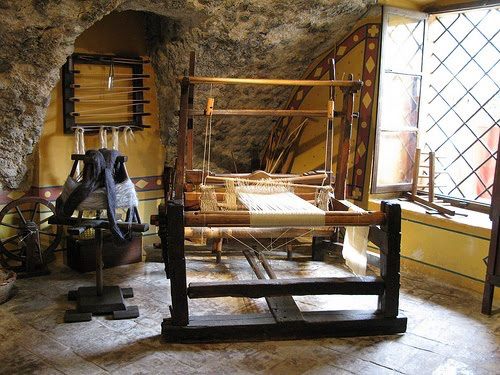
"Mercy on us!" thought the
honest old Minister as he opened his eyes wide.
"I cannot see anything at all!"
The two rogues begged him to be
so good as to come nearer, and asked if he did not approve of the colors and
the pattern.
They pointed at the empty loom, and the poor old Minister
went on opening his eyes; but he could see nothing, for there was nothing to
see.
"Mercy!" thought he, "can I indeed be such a fool? Am I not fit
for my office? I never had such thoughts, and not a soul must know it. No, it
will never do for me to tell that I could not see the cloth."
"What do
you think?" asked a rogue, as he continued weaving air.
Then honest old Minister
engaged in white propaganda.
"0, it is charming, quite enchanting!"
answered the old Minister, as he peered through his spectacles. "What a fine
pattern, and what colors! Yes, I shall tell the tyrant that I am very much
pleased with it."
"Well, we are glad of that," said both the rogue
weavers.
Then they named the invisible colors, and explained the
non-existent pattern.
The old Minister listens
attentively and parrots verbatim.
Now the two rogues demand
more money, silk thread and gold to carry on.
They hide everything in
the chests that contained the looms and not a thread is put upon the loom; they
continued to work at the empty frames as before.
The tyrant soon
dispatched another honest officer of the court, to see how the weaving
wasprogressing, and an estimate of the time of completion.
He looked and looked but he could
see nothing.
"Is not that a pretty piece of cloth?" asked the two
rogues; and they displayed and explained the non-existent pattern which was not
there at all.
"I am not a fool!" thought the man, "It must be my good
office, for which I am not fit!"
So he praised the cloth which he did
not see, and expressed his pleasure at the
beautiful colors and
charming pattern. "Yes, it is enchanting," he relayed to the
tyrant.
All the people
in the village were talking of the gorgeous cloth.
So the tyrant
wished to see it himself while it was still upon the loom.
With
a whole crowd of 'chosen',
among whom were also the two honest statesmen
who had already been there, he went to the two cunning rogues, who were
continued weaving without fibre or thread.
"Is not that splendid ?"
note the two statesmen who the tyrant has always been able to depend upon for
homest advice. "Does not your Majesty appreciate
the pattern and
the colors?"
They point at the empty loom, thinking the others were able to see the
cloth.
"What's this?" thought the tyrant. "I can see nothing at
all!"
"0, it is very pretty!" the tyrant chortled. "It has our
highest approbation."
He nodded contentedly while gazing at the empty
loom.
"Beguiling;
hypnotic; entrancing;
mesmerizing" flutters mouth to
mouth.
Amidst general
celebration the tyrant bestowed the title Imperial Weavers.

All night
the two rogues toiled while keeping sixteen candles burning.
They took
the cloth off the loom; they made cuts in the air with great scissors; they
sewed with needles without thread.
At last they said, "Finally the
clothes are ready!"
"It is as light as a spider's web: one would think
one had nothing on; that is just the
beauty of it."
"Will your Imperial Majesty please
undress?" said the two rogues; "then we will put on your the new clothes here
in front of the great mirror."
The tyrant undressed and the two rogues pretended to dress him while
the tyrant gyrated and did
pirouettes round and round before the mirror.
"0, how well they
look! how capitally they fit!" said all.
"What a pattern! what colors!
That is a splendid suit of clothes!"
"They are standing outside with the
canopy, which is to be borne above your Majesty in the procession!" announced
the head master of the ceremonies.
"Well,
I am ready,"
replied the tyrant. "Does it not suit me well?"
He turned again to the
mirror, he wanted to appear as if he
contemplated his adornment with great interest and so he studied what was not
there.
The two chamberlains, who were to carry the train, stooped
down with their hands toward the floor, just as if they were picking up the
mantle; then they pretended to be holding something in the air.
So the
tyrant went in procession under the rich canopy, and
everyone in the
streets said, "How incomparable are the His Majesty's new
clothes!"
"But he has nothing on!"
a small child cried out at
last.
"Listen
to the words of the innocent!" spoke the father.
A murmur arose.
"He has nothing on!"
laughed the
people.
The tyrant winced for he knew it to be true but he thought
to himself,
"I must go through with
the procession."
So
he held himself a little higher, and the chamberlains held on tighter than
ever, and carried the train which did not exist at all.
- Hans
Christain Andersen, Dutch moral
storyteller
 |
|
 |
This web site is not a commercial web site and
is presented for educational purposes only.
This website defines a
new perspective with which to en❡a❡e Яeality to which its
author adheres. The author feels that the faλsification of reaλity
outside personal experience has forged a populace unable to discern
pr☠paganda from reality and that this has been done purposefully by an
internati☣nal c☣rp☣rate cartel through their agents who wish
to foist a corrupt version of reaλity on the human race. Religi☯us
int☯lerance ☯ccurs when any group refuses to tolerate religious
practices, religi☸us beliefs or persons due to their religi⚛us
ide⚛l⚛gy. This web site marks the founding of a system of
philºsºphy nªmed The Truth of the Way of the Lumière
Infinie - a rational gnostic mystery
re☦igion based on reaso🐍 which requires no leap of faith,
accepts no tithes, has no supreme leader, no church buildings and in which each
and every individual is encouraged to develop a pers∞nal relati∞n
with Æ∞n and Sustainer through the pursuit of the knowλedge of
reaλity in the hope of curing the spiritual c✡rrupti✡n that
has enveloped the human spirit. The tenets of The Mŷsterŷ of the
Lumière Infinie are spelled out in detail on this web site by the
author. Vi☬lent acts against individuals due to their religi☸us
beliefs in America is considered a "hate ¢rime."
This web site in
no way c☬nd☬nes vi☬lence. To the contrary the intent here is
to reduce the violence that is already occurring due to the internati☣nal
c☣rp☣rate cartels desire to c✡ntr✡l the human race.
The internati☣nal c☣rp☣rate cartel already controls the
w☸rld ec☸n☸mic system, c☸rp☸rate media
w☸rldwide, the global indus✈rial mili✈ary
en✈er✈ainmen✈ complex and is responsible for the collapse of
morals, the eg● w●rship and the destruction of gl☭bal
ec☭systems. Civilization is based on coöperation. Coöperation
with bi☣hazards of a gun.
American social mores and values have
declined precipitously over the last century as the corrupt international
cartel has garnered more and more power. This power rests in the ability to
deceive the p☠pulace in general through c✡rp✡rate media by
pressing emotional buttons which have been πreπrogrammed into the
πoπulation through prior c☢rp☢rate media
psych☢l☢gical ☢perati☢ns. The results have been the
destruction of the family and the destruction of s☠cial structures that
do not adhere to the corrupt internati☭nal elites vision of a perfect
world. Through distra¢tion and ¢oer¢ion the direction of
th✡ught of the bulk of the p☠pulati☠n has been directed
toward solutions proposed by the corrupt internati☭nal elite that further
con$olidate$ their p☣wer and which further their purposes.
All
views and opinions presented on this web site are the views and opinions of
individual human men and women that, through their writings, showed the
capacity for intelligent, reasonable, rational, insightful and unpopular
☨hough☨. All factual information presented on this web site is
believed to be true and accurate and is presented as originally presented in
print media which may or may not have originally presented the facts
truthfully. Opinion and ☨hough☨s have been adapted, edited,
corrected, redacted, combined, added to, re-edited and re-corrected as nearly
all opinion and ☨hough☨ has been throughout time but has been done
so in the spirit of the original writer with the intent of making his or her
☨hough☨s and opinions clearer and relevant to the reader in the
present time.
Fair Use Notice
This site may contain
copyrighted material the use of which has not always been specifically
authorized by the copyright owner. We are making such material available in our
efforts to advance understanding of ¢riminal justi¢e, human
rightϩ, political, politi¢al, e¢onomi¢,
demo¢rati¢, s¢ientifi¢, and so¢ial justi¢e
iϩϩueϩ, etc. We believe this constitutes a 'fair use' of any
such copyrighted material as provided for in section 107 of the US Copyright
Law. In accordance with Title 17 U.S.C. Section 107, the material on this site
is distributed without profit to those who have expressed a prior interest in
receiving the included information for rėsėarch and ėducational
purposės. For more information see:
www.law.cornell.edu/uscode/17/107.shtml. If you wish to use copyrighted
material from this site for purposes of your own that go beyond 'fair use', you
must obtain permission from the copyright owner. |
 Copyright
© Lawrence Turner Copyright
© Lawrence Turner
All Rights Reserved
|