|





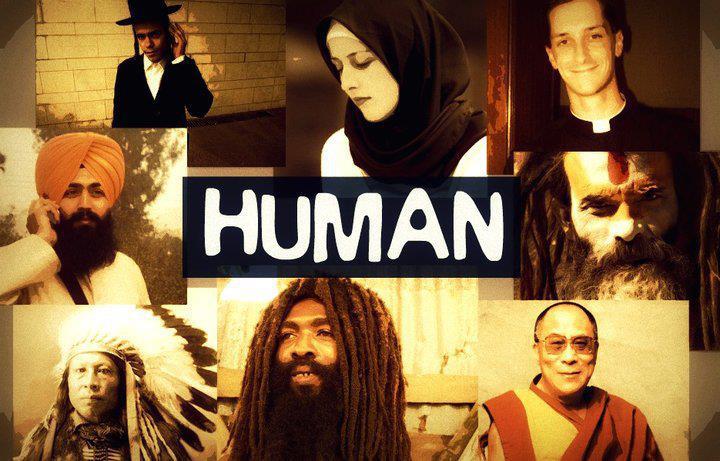
A member of the genus
Homo, family Hominidae, order
Primates, class
Mammalia, having a human
form characterized by erect posture and an opposable thumb, especially a
member of the only extant species, Homo Sapiens, distinguished by
a highly developed brain, the
capacity for abstract
reasoning, and the ability to
communicate by means of organized speech and
record information in a variety of
symbolic systems.
Note: Exhibits unique characteristics that
distinguish it from the rest of the animal kingdom; first and foremost being
the use of symbology to convey non-tangible abstract thought
patterns and conceptual structures to others.


A man is an adult male human who may or
may not belong to a specific trade, profession, group, nationality, or other
category, as in:
herdsman,
merchantman,
businessman;
clergyman; layman; workman;
spokesman; congressman …
Adult males, in most existing
human social cultures, must bury emotion.
Males, just as sensitive as
females and
possibly more so due to
biocultural conditions, are typically not allowed to express
any negative emotion.
Males that express a range of emotions
are looked upon as weak.
Males that do not express emotions, or
only anger, are looked upon as strong.


An
adult female human who may or may
not belong to a specific trade, profession, group, nationality, or other
category, as in:
washerwoman; congresswoman;
saleswoman; barmaid
…
In Western social cultures
females are allowed to express
emotion.
Females can cry
but a male that cries is seen as weak.
Females are easily attracted to
ornamentation.
This is understandable as animals, especially with
birds, females are attracted to the
ornamentation of their brightly
colored male companions.
If human
social culture paralleled
animal social structures then you would
expect the males to be the
most highly ornamented.
They were the first to wear high
heels - horseback
riders.
Looking back in history we see that
military men tend to be the most
highly ornamented individuals with the
exception of royalty or
the ruling class.
Social status of individuals is
judged by clothing - cut, material
and fashion.
Ornamentation
has always been used as a social culture status symbol.
"People, even more than things, have to be
restored, renewed,
revived,
reclaimed, and redeemed; never throw out
anyone." - Audrey Hepburn
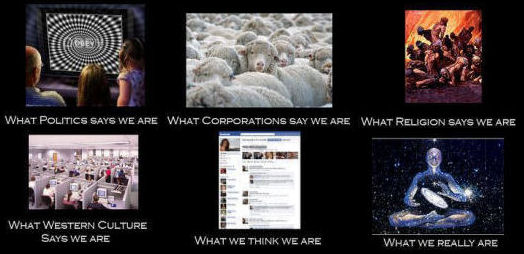
humanAs a human:
You have been given an animal body.
It will be the only one you get
this time around.
Many
tools and resources are included
with your body.
Personal experience is your
first and most valuable tool.
Personal experience will teach
you Lessons of Life.
Lessons
of Life are uniquely your own.
Lessons of Life will
be presented in various forms until you have learned.
Lessons of Life piercing the
Veil of Cognitive
Blindness may be painful.
Trust deep emotional intelligence as it
wells up from Akashic
Records.
When you have learned a Life Lesson, you can go
on to the Next Life
Lesson.
To avoid obstacles,
deadends and
The Abyss learn to use the
human soul in
conjunction with the
intellect to decipher the
symbols left by others.

Life Lesson:
Unless
there is a direct physical threat
'there' is nowhere better than
'here'.

Human beings have
cognitive abilities other
mammals do not share.
The foremost overriding ability is
recognizing our ultimate physical
demise.
This takes us
out of the moment and into
pondering our personal
future.
We remember being
kicked out of the Garden of Eden when
we recognized
differentiation and entered duality under the
spell of magical consciousness.
Human beings have the ability to
understand and mimic the emotions of
another human being due to mirror neuron circuits hardwired
in bicameral brains
through which we learn socialization
skills and basic
movement.
Rich human beings have the ability to
transform the natural
environment for purposes beneficial for
life or detrimental to
life through technology.
Human beings,
individually, have the
ability to skip through
the simulcra into hyperspace an abstract creation of
the physical one that actually
exists.
Delusion
becomes a necessity at times to emotionally continue to live.
"What
gets us through life is just the
right amount of delusion - enough to fool us
into feeling relatively good but not so much as to
exceed credulity.
Healthy people can be
deluded into accepting an
inadequate environment when granted the mere
illusion of control over the local
environment.
Deluding
ourselves may be a key to
mental health." -
Daniel Gilbert


December
2004
UNICEF annual State of the World's Children
report:
of 2.2 billion children -
640 million lack adequate
shelter;
500 million have
no access to
sanitation;
400 million lack safe
water;
270 million receive no healthcare;
140 million,
mostly girls, receive no formal education;
90 million are severely
deprived of nutrition;
10 million children younger than 5 die each year
of diarrhea or
measles;
2 million are exploited by the
global commercial sex industry.
"Too
many governments are making informed, deliberate choices that
actually hurt childhood."
- UNICEF Executive Director Carol Bellamy

2007
UNICEF study looks at childhood in ~ 20 'developed'
countries.
America and Great
Britain rank last.
US is at the bottom
in health and safety.
US has high rates of child
mortality and accidental
deaths.
US has the
highest rate of children living in single parent homes.
US has one of the highest rates of children
living in poverty.
US has the highest rate of
autism.
2013 UNICEF Executive
Summary on Children with Disabilities
93 million children –
1:20 to 14 years – have a moderate to severe
disability.
Nov 9, 2021 240
million children with disabilities - UNICEF.
UNICEF 1:10 children with
disabilities globally exposed to the depths of deprivation in well-being,
including health, education and protection. |
|
 |
This web site is not a commercial web site and
is presented for educational purposes only.
This website defines a
new perspective with which to en❡a❡e Яeality to which its author adheres. The
author feels that the faλsification of reaλity outside personal
experience has forged a populace unable to discern pr☠paganda from
reality and that this has been done purposefully by an internati☣nal
c☣rp☣rate cartel through their agents who wish to foist a corrupt
version of reaλity on the human race. Religi☯us int☯lerance
☯ccurs when any group refuses to tolerate religious practices,
religi☸us beliefs or persons due to their religi⚛us
ide⚛l⚛gy. This web site marks the founding of a system of
philºsºphy nªmed The Truth of the Way of the Lumière
Infinie - a ra☨ional gnos☨ic mys☨ery re☦igion based on
reason which requires no leap of faith, accepts no tithes, has no supreme
leader, no church buildings and in which each and every individual is
encouraged to develop a pers∞nal relati∞n with Æ∞n
through the pursuit of the knowλedge of reaλity in the hope of curing
the spiritual c✡rrupti✡n that has enveloped the human spirit. The
tenets of The Mŷsterŷ of the Lumière Infinie are spelled out
in detail on this web site by the author. Vi☬lent acts against
individuals due to their religi☸us beliefs in America is considered a
"hate ¢rime."
This web site in no way c☬nd☬nes
vi☬lence. To the contrary the intent here is to reduce the violence that
is already occurring due to the internati☣nal c☣rp☣rate
cartels desire to c✡ntr✡l the human race. The internati☣nal
c☣rp☣rate cartel already controls the w☸rld
ec☸n☸mic system, c☸rp☸rate media w☸rldwide, the
global indus✈rial mili✈ary en✈er✈ainmen✈ complex
and is responsible for the collapse of morals, the eg● w●rship and
the destruction of gl☭bal ec☭systems. Civilization is based on
coöperation. Coöperation with bi☣hazards of a
gun.
American social mores and values have declined precipitously over
the last century as the corrupt international cartel has garnered more and more
power. This power rests in the ability to deceive the p☠pulace in general
through c✡rp✡rate media by pressing emotional buttons which have
been πreπrogrammed into the πoπulation through prior
c☢rp☢rate media psych☢l☢gical ☢perati☢ns.
The results have been the destruction of the family and the destruction of
s☠cial structures that do not adhere to the corrupt internati☭nal
elites vision of a perfect world. Through distra˘tion and ˘oer˘ion the
dir⇼ction of th✡ught of the bulk of the p☠pulati☠n has been
direc⇶ed ⇶oward s↺luti↻ns proposed by the corrupt internati☭nal elite
that further con$olidate$ their p☣wer and which further their purposes.
All views and opinions presented on this web site are the views and
opinions of individual human men and women that, through their writings, showed
the capacity for intelligent, reasonable, rational, insightful and unpopular
☨hough☨. All factual information presented on this web site is believed to be
true and accurate and is presented as originally presented in print media which
may or may not have originally presented the facts truthfully. Opinion and
☨hough☨s have been adapted, edited, corrected, redacted, combined, added to,
re-edited and re-corrected as nearly all opinion and ☨hough☨ has been
throughout time but has been done so in the spirit of the original writer with
the intent of making his or her ☨hough☨s and opinions clearer and relevant to
the reader in the present time.
Fair Use Notice

This site may contain
copyrighted material the use of which has not always been specifically
authorized by the copyright owner. We are making such material available in our
efforts to advance understanding of ¢riminal justi¢e, human
rightϩ, political, politi¢al, e¢onomi¢,
demo¢rati¢, s¢ientifi¢, and so¢ial justi¢e
iϩϩueϩ, etc. We believe this constitutes a 'fair use' of any
such copyrighted material as provided for in section 107 of the US Copyright
Law. In accordance with Title 17 U.S.C. Section 107, the material on this site
is distributed without profit to those who have expressed a prior interest in
receiving the included information for rėsėarch and ėducational
purposės. For more information see:
www.law.cornell.edu/uscode/17/107.shtml. If you wish to use copyrighted
material from this site for purposes of your own that go beyond 'fair use', you
must obtain permission from the copyright owner. |
 Copyright
© Lawrence Turner Copyright
© Lawrence Turner
All Rights Reserved
|