
|
banality
a trite or
obvious remark
the condition or quality of being banal;
triviality
some thing that is
trite, obvious, or predictable; a
commonplace
banal obvious and dull
drearily
commonplace and often
predictable
repeated too often; overfamiliar through
overuse
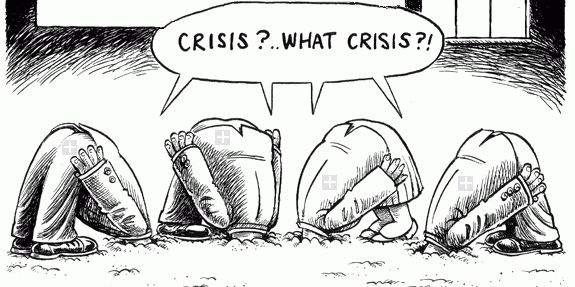
"Anyone who thinks the human race does not have a
powerful impact on the environment and climate definitely has their head in the
sand." - Bill Patzert
"Where will we turn if we destroy our planet's
ability to sustain life?" - Vickere Murphy
"The ultra
wealthy and Hollywood elite
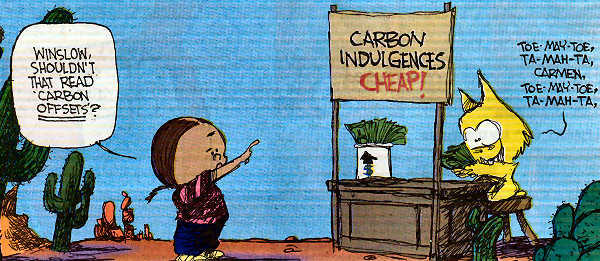
signing up for carbon-trading schemes to feel good about
their extravagant lifestyles is morally
equivalent to the nobility buying dispensations from the
church in the Middle Ages." - John Newman
"I will be merciful only if you stop your evil
thoughts and deeds." - Jeremiah 7:5 Over one hundred years ago
Svante Arrhenius, a Swedish
physical chemist and future Nobel laureate, first
published his
scientific paper on the
greenhouse effect. Combining graceful
prose and careful mathematics, the
paper documents Arrhenius'
experimental
verification of the ability of what was called
'carbonic acid" carbon dioxide
to trap heat near
Earth's surface.
The
United Nations sponsored intergovernmental
Panel on Climate Change has
reconfirmed the basic accuracy of Svante
Arrhenius' calculations. Before
the industrial age and extensive use of
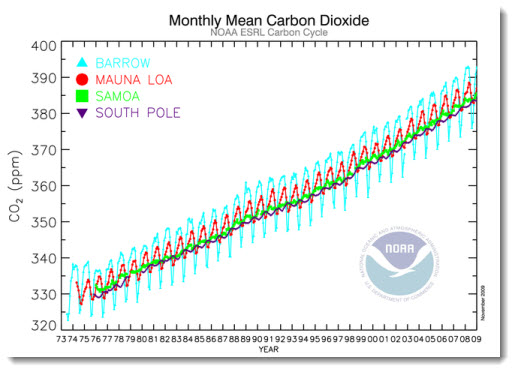
fossil fuels the concentration of
carbon dioxide in the atmosphere was
about 280 parts per million. Average readings at the 11,141 foot Mauna Loa
Observatory, where carbon dioxide
density peaks each northern winter hovered around 379 parts per million on
March 19, 2004 compared with about 376 parts per million
a year before. In early spring 2008 carbon dioxide
levels 385 parts per million.
That year-to-year increase of about 3 parts per million is
considerably higher than the average annual increase of 1.8 parts per million
over the last decade and markedly more accelerated
than the 1-part-per-million annual increase recorded a half-century ago, when observations were first
made at Mauna Loa Observatory.
In 2007 world polluters pumped 24,126,416,000
metric tons of carbon dioxide (CO2) into
the environment. The United States and its territories were responsible for 5.8
billion metric tons, more than China (3.3 billion), Russia (1.4 billion) and
India (1.2 billion) combined.Yet, as evidence of ongoing
global warming grows, we try ever harder to avoid the subject.
We "have to put
food on the table," we are "in
denial," we are too terrified to think
about the future and, so
protect ourselves through "psychic numbing," and besides, "there's so much else to
worry about."
And, besides,
perhaps the warming is caused by "sunspots" or a gradual increase in the heat
given off by the sun as the fossil fuel
industry claims.
"The
influence of the
sun on global
warming is utterly negligible." - Tom Wigley, climate
expert committing on an article in a
fall issue of the journal Nature which studied
patterns of solar activity over the past thousand
years.
What is at work here is a fervid
animosity to the possibility that our
understanding of
reality is somehow flawed.
One of
oldest and deepest flaws of
humanity is this lack of
critical thinking.
Accepting what the mass media
spin doctors and
propagandists, pawns of
American aristocracy, rely as "factual truth"
without researching the reality for oneself is
lazy, slothful
behavior.
The destructive
effects of this lack of critical
thinking are reflected in the inhospitable
reception initially given the work that earned
Svante Arrhenius the Nobel Prize: a
theory explaining the electrical conductivity of
highly dilute solutions, or
electrolysis.
When Svante
Arrhenius, a doctoral candidate, presented his theory of
electrolysis to his
professor, the latter responded with a comment
that most likely sounded like this: "Of what possible value is this!" Subsequently, many of his colleagues
treated Svante Arrhenius with
hostility, his
work being too challenging to their parochial
thinking.
We are now treating the
scientific research on
global warming the same
way that
Arrhenius and his
theory of
electrolysis were initially
greeted: timorous disdain. For responding to
the threat of climatic
mayhem requires not only
social change
of the most fundamental
category, but hospitality to the
planetary imagination, an ability to
passionately and vividly
imagine planetary goings on that may not appear to have
immediate effects in our
lives: like increasing tropical
deforestation, retreating glaciers, rising sea levels,
the spread of disease bearing insects and more
frequent extreme,
hot and cold, weather events.
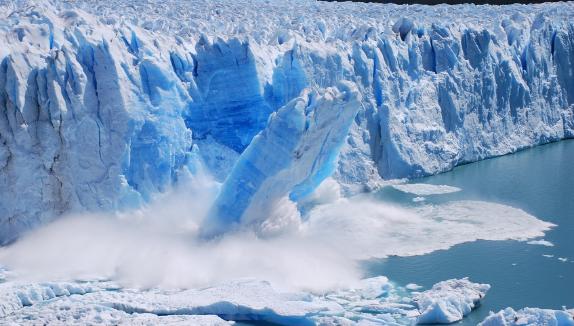
In 2002
the Antarctic Larsen B ice shelf broke up.
Now Antarctic glaciers in the region are flowing at up to eight times their
previous flow rate. The breakup of the Larsen B ice shelf left the glacial flow into
Antarctica's Wendell Sea unimpeded.
One of the
deadliest weather phenomena in
the past century occurred in the summer of 2003
when there were more than 19,000 deaths attributed to the
heat. It was the hottest summer in Europe in
500 years, according to an
analysis of temperatures dating back to
1500. Record temperatures were recorded in most of the major cities of Europe
with many readings of more than 100 degrees.
"When you consider Europe
as a whole, it was by far the
hottest summer," said Jurg Luterbacher,
climatologist, a researcher at the
University of Bern, Switzerland . Jurg said increased temperatures were not
limited to summer in Europe; winters also have been warmer than the
historical record. In the study, Luterbacher
and his team analyzed the temperature
history of Europe starting in
1500 to the present. For the earliest part of the
half millennium, the temperatures are estimates
based on proxy measures, such as tree rings
and soil cores. After about
1750, he said, instrumented readings became generally available
throughout Europe.
Scientists of the United States Geological
Survey stated in a report published
June 2004 that by using tree ring
reconstructions of Colorado River flows they had
determined that the lowest five year average flow of the Colorado River occurred between 1590 and 1594. The
average yearly flow at that time was determined to
be 8.84 million acre-feet. During the Dust Bowl years 1930 to 1937 the average
yearly flow was 10.2 million acre-feet. Between the years 2001 and 2004 the
average yearly flow was 5.4 million acre-feet. The drought, which ended in
2005, may be the most severe drought experienced in the Colorado River Basin for over 500 years.
About
288,000 square miles of perennial Arctic ice
shelf was lost between September 2004 and September 2005 - 14% overall and
50% of the east Arctic Ocean.
The reduction of
sea ice
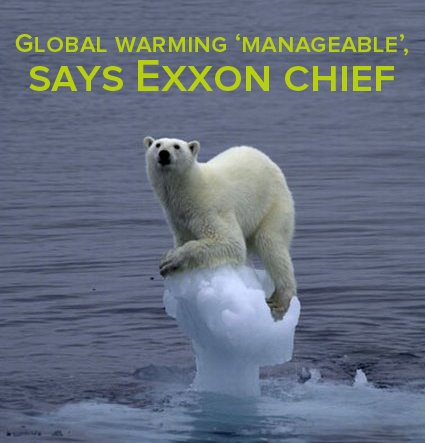
shelf is making it more difficult for the polar
bear to survive as polar bears are dependent on the seals for sustenance and use
sea ice
shelf as a platform from which to hunt the seals.
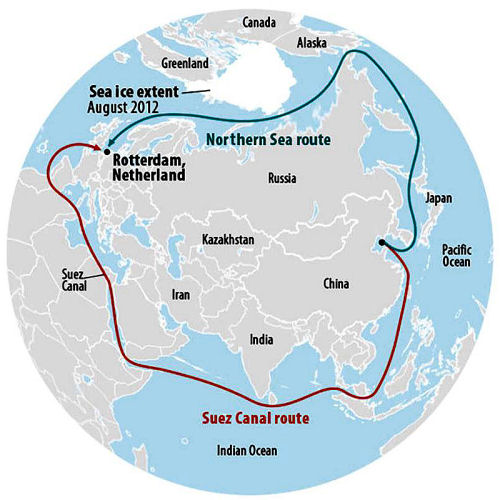
In 2007 the Northwest Passage became
navigable. National Snow and Ice Data Center reported that satellite
measurements showed a reduction of the sea
ice shelf to less than 2.02 million miles -
down 386,100 square miles from the previous low in September 2005. At current
rates Mark Serreze, a senior research scientist, predicted the
sea ice
shelf could be gone as soon as 2030.
In 2008 global multinational
industrial concerns ordered 152 reinforced hull ships to ply the newly opened
Northwest Passage at a cost of $100 million per ship - a $15 billion
investment. (Global multinational industrial concerns plan for global warming
to continue unabated!)
Cherry trees
flowered on average in 2005 two weeks earlier than in 1995.
In the late
spring of 2005 more than a thousand large lakes
in Siberia had dried up within the
last 25 years. Scientists speculate that the
thawing of the perma frost layer allowed the water from these lakes to seep into the ground. Many migratory birds depend upon the
lakes of Siberia and they are expected to be
negatively impacted.
The Mexican government reported a suprising
reduction of 75% of the Monarch butterfly
population in the winter of
2005 due to adverse weather conditions.
"I've been doing this I was big
enough to carry a bucket. Tapping in January? Never. Never. Never." - Rex
Marsh, a 71 year old a Vermont maple syrup producer, stated in the spring of
2006 that he had tapped his 9000 sugar maple trees in January - two years in a
row.
The July heat wave of 2006 in America set more than 2,300 daily records and 50
all-time records for hottest temperature ever recorded.
By 2006 a good
example of the damage that can be done by a slight moderation in temperature
was being seen in pine forests of the California, Utah, Colorado, New Mexico,
Wyoming, Idaho and Montana. Lodgepole pines in Idaho and Colorado, ancient
white-bark pines of Idaho and Montana, pinon pines in Colorado, firs in Montana
and aspen trees throughout the West are
dying by the millions. Beetles have ravaged the drought weakened
trees. The beetles are best kept in check by
cold weather.
"Nothing like this has occurred in the last 350 years.
Whole landscapes have been affected."
- Wayne Shepperd, Forest Service researcher
In 2008 a 160 square mile
ice chunk broke off the Wilkins Ice Shelf in Antarctica.
Hurricane Katrina was
expectedIn the August 2005
issue of National Geographic magazine
it was noted that sea temperatures in the Atlantic
Ocean have risen by one to two degrees Fahrenheit since 1994. Since 1995
the Atlantic has been producing hurricanes at a pace double that of previous
quarter century. The rise of sea temperatures in the Atlantic is directly
responsible for the
severity and frequency of hurricanes.
Lower temperatures cause less severe and
frequent hurricanes while higher
temperatures create more severe and
frequent hurricanes. In the
analysis presented it was predicted that
frequent severe hurricanes in the
near future could cause much more damage to the region than hurricanes in the
past.
Our solar system is
unusual and unique. The discovery
of at least 120 other
solar systems that have been found have big gassy
planets circling too close to their
stars to allow them to be like our
solar system. If the
discovered
systems prove
representative of all
systems then
Earth like planets are very rare.
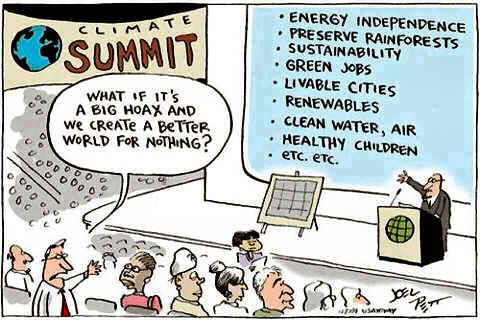
We need to learn to listen for the acid aversion to
imagination in the kinds of comments made
by defenders of the fossil fuel
industrial complex. Global
warming, claims that chorus, is mere "speculation" or
conjecture "left-wing" or "apocalyptic fantasy", climate change is "unproved";
we should be "skeptical" because there are so many
"uncertainties" in the theory; in any case, it's
"unrealistic" or "wishful
thinking" to expect societies to
make needed changes and that such
changes would "cost jobs." Or if there is a
problem, it is more "realistic" to try to adapt.
In this vapid,
banal "realism," the
spirit of Arrhenius' professor echoes.
Andrew Marshall, the director of the Pentagon's Office of Net
Assessment, the father of Star
Wars' and the military's graybeard
expert on future
strategic
threats, was commissioned by Richard
Nixon "to weigh the military
balance in specific areas, determine what
the important long term trends
are, and to highlight existing or emergent
problem areas, or important opportunities
that deserve attention to improve the future American position in the continuing
global military-economic-political
competition."
A report
commissioned by Andrew Marshall describes the
disasters that would
occur if the climate shifted abruptly in a decade or two, as happened some
12,000 years ago. The climate model used in the movie The Day After
Tomorrow is based on the climate model portrayed in this report.
According to this climate scenario, most of Holland and
Bangladesh would be submerged by violent
storms and rising oceans. Northern Europe would freeze because of
disruptions to the Gulf Stream currents.
Millions of environmental refugees
would gather at the frontiers of the developed world, driven by
wars, famines, and floods. Nuclear
conflict, continental droughts, and
widespread rioting
would erupt across the face of the Earth. Nations
would be forced to expand their
military power to defend dwindling food,
water, and energy supplies. The report paints
an image of America as a giant gated community insulating
itself from an Earth it helped
create, isolated and
despised by its
angry, jealous neighbors.
Although this outcome is presented as a worst-case
scenario the report suggests climate change
should be elevated beyond a
debate over reality to a
American national
security concern.An
ice shelf core about two miles long - drilled
in Antarctica - shows that at no time in the last 650,000 years have levels of
the greenhouse gases
carbon dioxide and methane been as high
as they are today.
The
research,
published in a 2005 issue of the
journal Science, describes the content of the
greenhouse gases within the core and shows
that carbon dioxide levels
today are 27% higher than they have been
at any time in the last 650,000 years and levels of methane are 130% higher.
The research proves that
human activity has significantly altered
the Earth's atmosphere.
"Anyone counting
on an ice age to head off global warming or hoping to
justify human
greenhouse gas emissions to head off the
next ice age, will find no comfort in the ice core record." - Richard Alley,
Penn State University geophysicist and ice core analysis expert.
Americans need to take seriously the implications
of global warming and
act decisively to stop what
could turn into all out climatic mayhem.
Americans do not need to remain on
our self
destructive course.
"A 2005
study on Americans'
perceptions of
global warming found that most are moderately
concerned, but 68% believe that the greatest
threats are to people far away or to
nonhuman nature - a
and delusional misperception.
Only 13% of
Americans
perceive risk to themselves,
their families or their communities.
Many Americans
perceive
global warming to be an insoluble problem and respond
by circling the family wagons and turning
inward.
Americans
behave as better
environmental
citizens when
educated. When our individual actions are
visible and rewarded a phenomenon
known as "social facilitation" occurs. The opposite "social loafing", the tendency of individuals to
drag their feet when work is shared and individual
performance is not assessed. (The monkey that broke the back of totalitarian
communism in the
Joseph Vissarionovich Stalin's United
Soviet Socialist Union (USSR), Mao Tse Tung's Red China and Ho Chi Minh's
Vietnam.) If Americans were vigorously
informed about how global warming endangers our
neighborhoods, we would individually forgo the McMansions and the Hummers and
make sustainable choices.
Anything
less compromises our children's
future." - Julia Whitty
"Nobody can use the phrase 'our greatest problem'
anymore unless they are talking about global
warming.
George W. Bush is an
alien sent here to
destroy us; I know it sounds crazy, but it made
perfect sense when
Tom Cruise explained it to
me.
This is not about being a liberal or a
tree hugger; it's not even about my
sentimental love of innocent animals - it's about my even more profound
love for my own butt.
Man
is the animal on the endangered
species list I'm concerned about, especially
this man." - Bill
MaherAddressing the threat of
climate mayhem could offer avenues of
hope and renewal
everywhere for everyone.
The basic changes
needed to effectively limit global warming would necessarily entail a tremendous
amount of hands on labor, providing
meaningful, community based employment in areas
such as the reconstruction and retrofitting of buildings for
energy efficiency and
solar power, the
reforestation and redesign of cities, the
accelerated development of high mileage
cars, the nurturing of sustainable local
agriculture, the construction of interlinked
public transportation
systems and high speed rail
networks and intensive
development of
renewable energy
sources.
"Everything is
interconnected. (Just look at
Google Earth.) Everyone everywhere is
affected by global warming.
We all must do our part now. See Al Gore's
movie. The facts are empowering. Use
your car as little as possible. Turn off the engine when waiting at the curb.
Turn off the lights. Hang your clothes outside to dry. Buy only things you
really need. Encourage others to follow your
lead. Let elected officials
know you care about reducing
global warming. Don't
despair. Every effort we make to reduce
global warming contributes to reversing the increase
in weather-related catastrophes. America
consumes more
oil and produces more
carbon dioxide emissions per person than
any other country on
Earth. It is time
for Americans - that's you and me - to take
the lead in reducing global warming." - Robin
Schlevink
Of course wealth could no
longer be concentrated in the hands of a
few resource hoarders and manipulators, American
aristocracy, and this is precisely why little has been done to stop the
train wreck of climate mayhem.
A
transition to an ecologically benign
civilization, proceeding
industry by
industry, building by building and
tree by tree, could radically improve the
material circumstances of most
individual's
lives and greatly reduce
economic disparity.
Bloated
militaries would have to go: The need to limit
global warming provides a compelling argument for
massive cuts in national arsenals and greatly
increased international
cooperation.
New hope for
planet Earth could
supplant insipid consumption and
temper our acid
cynicism.
We need not remain in thrall to the
mind's machinery
of animosity to the
imagination, in the
mind's banal reaction to new possibilities and to
hope itself.
The
sky, as Svante
Arrhenius has shown, really is the limit.
"The average American would probably take it as a badge of
pride that he's less interested in
rational debate than his European counterpart,
and therein lies the problem. America has
cornered the market on blissful
ignorance." - John
Wolfenden
From the 1920s to the 1960s seven
incinerators dumped toxic ash containing
lead, arsenic, dioxins and
PCBs into predominantly African
American neighborhoods in Jacksonville,
Florida.
In May 2001 thousands of people were evacuated or sealed off
their homes when a toxic cloud blanketed
a Chicago residential area. Acme Barrel Co. removed
chemical residues from barrels and
drums and repainted them for reuse.
In August, 2001 a professor at
Carnegie Mellon University's Heinz School for Public Policy and
Management stated that "it is our best estimate that more people are being
killed by air pollution from traffic than from
traffic accidents." This includes people who prematurely die from asthma, heart
disease and lung disorders.
Texas Petrochemicals released 148,000 pounds
of 1,3 butadiene in 2002 over East Harris County, Texas neighborhoods. The
Texas Commission on Environmental Quality took air samples from 41 monitoring sites during 2003.
The results found excessive levels of benzene, 1,3 butadiene and formaldehyde.
Industrial facilities in Harris and Brazoria counties in Texas released 20.4
billion and 19.2 billion pounds of toxic
air pollutants in 2003.
In January
2003 the Ohio Environmental Protection Agency stated that people who lived near
the New Boston Coke plant during the 1990s, "are more at risk of
cancer than almost anyone else in the
world." Throughout the 1990s the company also failed to accurately report
emissions. For example, in 1996 the company originally reported that the New
Boston facility released 60 tons of chemicals into the
air. Two years later, the company admitted it
was actually 5,357 tons of chemicals.
In August 2003 according to an internal inquiry by the
Environmental Protection Agency's
Inspector General, at the request of the
White House, the
Environmental Protection Agency
skewed reports on the air quality in New York
City following the collapse of the World Trade Center on September 11th. The
White House "convinced" the
Environmental Protection Agency to
issue "misleading assurances that there was no health risk from the
debris-laden air."
White House has stated that lying
was justified by national security. In June 2002 the
Environmental Protection Agency found
that the air quality had returned to pre-9/11
levels.
In September, 2004 a federal jury in Alabama ordered Continental
Carbon and its parent company China Synthetic Rubber, to pay $20.7 million in
damages caused by excessive releases of carbon black into the surrounding
neighborhood. The releases were caused 40 year old equipment which did not have
the required pollution controls.
In June, 2004 it was estimated that American power
plant emissions shorten nearly 24,000 lives by an average of 14 years, caused
2,800 cases of lung cancer and 38,200
nonfatal heart attacks annually.
In August, 2004 Stone Container Corp.
has agreed to pay $885,000 to settle allegations that it
violated air
pollution regulations at its
Hopewell facility. The facility violated
emission limits for sulfur, sulfur dioxide and particulate matter.
In October, 2004 Chevron
Phillips Chemical Co. agreed to settle a federal action by paying a $1.8
million fine for Clean Air Act violations. The
chemical releases took place at the
Pasadena, Texas plant in 1999 and 2000.
In
November, 2004 a study by researchers from the University of Southern
California concluded that exposure to fine particulates, like those from
power plants and vehicles can cause and
accelerate artery disease. The study found that a 10 micrograms per cubic meter
of air increase in fine particulates lead to an
increase of up to 4.3% in the thickness of artery walls. This thickening can
lead to calcification and rupture of the arteries.
In November, 2004 an
Environmental Protection Agency panel
has approved the final draft of a report concluding that exposure to fine
particulates in the air, those less than 2.5
microns in diameter, can shorten life expectancy
by up to 2 years.
In January, 2005 ConocoPhillips agreed to pay $64.5
million to settle several class action lawsuits filed over 2
chemical releases - 64 tons of sulfur
dioxide, the other 40 tons - at it's Westlake, Louisiana facility in 2003.
In February, 2005 a study by researchers from the University of
Albany, School of Public Health concluded that people
living near sites
contaminated with
PCBs and persistent
pesticides have an increased risk
of developing chronic respiratory disease, including chronic bronchitis and
chronic airways obstruction as well as suppression of the immune system.
"
Particulate pollution from diesels shortens the
lives of nearly 21,000 Americans each
year.
Almost 3,000 Americans die
prematurely from lung cancer.
Tens of thousands of Americans suffer
over 27,000 heart attacks and 400,000 asthma attacks as well as other
respiratory problems associated with particulate
emissions from diesel vehicles.
These illnesses result in thousands of
emergency room visits, hospitalizations, and lost workdays. Together with the
toll of premature deaths, the health damages from diesel fine particles will
total $139 billion in 2010.
Nationally, diesel exhaust poses a cancer
risk that is 7.5 times higher than the combined total cancer risk from all
other air toxins.
In the U.S., the average lifetime nationwide cancer
risk due to diesel exhaust is over 350 times greater than the level U.S. EPA
considers to be "acceptable".
Residents from more than two-thirds of
all U.S. counties face a cancer risk from diesel exhaust greater than 100
deaths per million population. People living in eleven urban counties face
diesel cancer risks greater than 1,000 in a million one thousand times
the level EPA says is acceptable.
People who
live in metropolitan areas with a high
concentration of diesel vehicles and traffic feel their impacts most acutely.
The risk of lung cancer from diesel exhaust for people
living in urban areas is three times
that for those living in rural
areas.
Reducing diesel fine particle emissions 50 percent by 2010, 75
percent by 2015, and 85 percent by 2020 would save nearly 100,000 lives between now and 2030."
Diesel and Health in America: The Lingering Threat, February
2005, Clean Air Task Force
November, 2005
researchers from the University of North Carolina School of Medicine
found that the sustained elevation of a dramatically increased
suicide rate among North Carolina
residents linked to industrial airborne pollutants emanating from asphalt
plants, paper mills and sewage treatment facilities. Previous studies have
shown that occupational exposure to hydrogen sulfide, at levels of 10
parts per million for a ten minute ceiling, can result in nervousness,
mania, dementia and
violence. A local paper mill has reportedly
released over 93,000 pounds of hydrogen sulfide since 2003 and
the suicide rate is rate in two
Salisbury neighborhoods is tripled the statewide average and the
suicide rate in Haywood County has
doubled since 1996. These North Carolina residents
live in mountain valleys that
experience frequent temperature inversions
which prevent the hydrogen
sulfide from dispersing.
In March, 2006 a new study by researchers
with CIIT Centers for Health Research (CIIT was formerly
known as the Chemical Industry Institute
of Technology) concludes that inhaled nanoscale particles can pass through
the blood/brain barrier and lodge
in the brain.
"When the Environmental Protection Agency, charged
with the job of protecting our environment for the benefit of the American
people, stone walls on regulating a known toxin in public drinking water, in my
mind it is akin to our government saying it's OK to poison Americans." - Mike
Laskavy Copper smelting from 1884 to 1980 by Anaconda
contaminated 120 miles of the
Clark Fork River in Montana.
Powerine
Oil Co. dumped oil wastes from the
1920's to the 60's creating an under
ground pool of
toxic sludge some 900 feet wide in Santa
Fe Springs, Los Angeles.
Pacific Gas & Electric Topock facility
dumped waste water containing chromium 6
untreated into percolation beds from 1951 to 1969. In 2004 wells 125 feet from
the Colorado River, a drinking
water source for some 18 million Californians,
were found to have levels of chromium 6 at 100 ppb. In February, 2005 levels of
the contaminant in a well within 60 feet of the river measured 354 parts per
billion (ppb). The allowable limit set by the state is 50 ppb. Pacific Gas
& Electric Corp. (PG&E) used chromium 6 as a rust prevention agent in
natural gas compressor stations along the company's pipelines during 1950s and
1960s.
In 1978 the U.S. Coast Guard discovered a plume of
oil beneath Brooklyn, New York
containing between 17 million and 30 million gallons of
oil that had migrated from tank farms.
In December, 1998 in St. Maries, Idaho a wood treatment facility was
found to be leaching contaminates into the St. Joe
River. The facility operated as a creosote wood pole treating plant from
the 1930s through the 1960s. The Environmental Protection Agency has
determined that coal tar creosote is a probable human carcinogen.
In
1999 a massive 7 million tire fire in Westley, California released 250,000
gallons of oil into spring which ran
into the California Aqueduct.
In February 2000 a cracked Sunoco
pipeline spilled 192,000 gallons of oil
into a pond and surrounding wetlands in the John Heinz National Wildlife
Refuge, Pennsylvania.
In March 2000, a buried 28 inch Explorer Pipeline
Co. pipeline ruptured spilling over 500,000 gallons of
gasoline into Lake Tawakoni, Texas which is used as a backup water
supply reservoir by the City of Dallas.
In August, 2001 Columbia
Terminals Inc. plead guilty to illegally disposing over 500,000 gallons of
hazardous chemicals. The company will
pay $1.3 million in fines.
In August, 2001 the Hecla Mining Co. agreed
to pay $138 million over the next 30 years as part of a settlement for cleanup
costs associated with toxic mine
tailings in the Coeur d'Alene basin, in the 1,500 square mile Bunker Hill area,
Idaho. Estimated cleanup costs will run $1.3 billion.
In August, 2001
the House of Representatives passed a
measure ordering the Environmental
Protection Agency to reduce the current maximum allowable level of arsenic
in drinking water, 50 parts per billion (ppb), by 80% - in effect backing the
10 ppb put into affect by the Clinton administration and subsequently rescinded
by the George W. Bush administration. Arsenic in
drinking water can cause lung, bladder and
skin cancer and according to a study by
the National Academy of Sciences, the current 50 ppb standard "could easily"
result in a cancer risk of 1 in every
100 people exposed. Three thousand water
systems nationwide serving over 13 million people currently supply
water which exceeds the 10 ppb level.
In August, 2001, the State of Colorado determined over 50,000 fish were
killed along a 7.4 mile length of
Clear Creek by Coors Brewing Co. from the
release of 77,000 gallons of bad beer into the
tributary of the Colorado River.
In
October 2002 measurements taken in Red Lion
Creek, Delaware found levels of benzene at up to 22,000 times federal
drinking water standards. The benzene
contamination resulted from tank failures of
the Metachem Chemical facility spilling 6.8 million pounds of chlorinated
benzene compounds into the soil in 1986. The
facility had been one of the world's largest producers of chlorinated benzenes
which were used in pesticides,
herbicides, dyes and other products.
In July 2003 outside of Tucson,
Arizona gasoline from a ruptured
pipeline of SFPP L.P., a subsidiary of Kinder Morgan Energy Partner L.P.
contaminated soil and ground
water. The spill, estimated at 10,000 gallons,
was larger as some 52,000 gallons had been recovered by January,
2005.
In October 2003 a landfill was determined to be leaching
chemicals into Petrolia, Pennsylvania
wells. Cromptom Corporation agreed to pay $4.5 having acquired companies that
dumped chemicals at the landfill
during the 1950s and 1960s. Beazer East Inc. agreed to pay $18.1 million in
cleanup costs.
In September 2003 Kaiser Aluminum agreed to pay $24
million in cleanup costs for 66 contaminated
sites.
In November 2003 a 4 million gallon under
ground plume of
gasoline contaminated the ground water of
Hartford, Illinois. Pipelines carrying gasoline from a refinery to the
Mississippi River were leaking 15,120 gallons of
gasoline per week. The facility
operated from 1981 to 2002 when the refinery was closed.
In February,
2004 the Environmental Protection
Agency developed three options to remediate
pollution caused by mining waste
along Butte's Metro Storm Drain, Montana.
In February, 2004 Kerr-McGee
Chemical Corp. agreed to remove thorium contamination from Kress Creek and the DuPage. From the 1930s, Lindsay
Light and Chemical Corp. began processing ore to make radioactive thorium used
in the manufacture of gas lamp mantles. Kerr-McGee bought the facility in 1967
and closed it 6 years later. During the years of operation, the facility dumped
waste water into local creeks. An estimated 800,000 tons of mill
tailings were also generated and were spread around the community for use as
landfill for flood plains and on residential lawns.
In August, 2004, at
a redeveloped limestone mining and cement manufacturing plant, failure to cap
cement kiln dust piles created a high pH
leachate contain metals, including mercury and arsenic which is seeping into
Little Traverse Bay, Lake Michigan,
Michigan.
In August, 2004 Mobil Exploration and Producing U.S., Inc.
settled a federal and state action by agreeing to pay $5.5 million for spilling
oil in tributaries of the San Juan
River, Utah between 1991 and 1999.
In October, 2004 plastics maker
Keysor-Century Corp. will pay $4.3M dumping toxic waste water into the Santa
Clara River, California.
In October, 2004 a new study by the
nonprofit group Center for Progressive Regulation concludes that many states do
not have the money to enforce the federal Clean Water Act.
In October,
2004 Burlington Northern Santa Fe Corp. agreed to cleanup an Albuquerque, New
Mexico wood treatment facility. The wood treatment facility operated from 1908
to 1972 releasing creosote into the soil and
ground water.
In October, 2004 the
Environmental Protection Agency
stated that Colonial Pipeline is responsible for "at least 194"
oil spills in 12 states from 1966 to
1994 and "numerous" spills in subsequent years. In one spill, more than 950,000
gallons of diesel fuel spilled into the
Reedy River in South Carolina in 1996,
killing 35,000 fish and other species
of wildlife, and dispersing more than 34 miles downstream.
Almost 150
species of amphibians have become extinct and as many as 55% of all
known species, more than 3,000, could be on the verge of
extinction according to a report published in the journal Science in
October 2004. More than 500 scientists were
included in the first global amphibian assessment.
"Amphibians are one of nature's best
indicators of overall environmental
health. Their catastrophic decline
serves as a that we are in a period of
significant environmental
degradation." - Russell A. Mittermeier, president of Conservation
International
David B. Wake of UC Berkeley's Museum of Vertebrate
Zoology, a leading amphibian expert, called the prospects for
amphibian survival "very grim."
Scientists say amphibians serve as sentinels
for environmental
problems that might be jeopardizing entire
ecological
systems of animals which includes humans. In the America, 21 % of known species
are threatened or extinct.
"Amphibians are indeed telling us that the Earth is being harmed right where you and I
live," said Andrew R. Blaustein,
director of the graduate program in environmental
sciences at Oregon State University.
In 2007 scientists began work on an
"Amphibian Ark." A deadly new fungus, the chytrid fungus, is decimating
amphibian populations worldwide. Scientists hope to collect uninfected amphibians and
lock them away to save amphibians from
extinction.
In November 2004 a Tsakos Group ship spilled 265,000 gallons
of oil into the Delaware River.
In October, 2004 drinking water wells
in Glendale, California have been found to contain levels of chromium 6 at 49
parts per billion (ppb). The city council has set a safety limit of 5 ppb for
chromium 6, while the state maximum allowable level remains at 50 ppb.
In November, 2004 according to a spokesperson from the
Environmental Protection Agency's
Montana office remediation of the Clark Fork
River basin, Montana will cost $1 billion.
In November, 2004 a
report from the Environmental Protection
Agency indicates that Dow Chemical may be responsible for contaminating an
aquifer used by residents of the Myrtle Grove Trailer Park for drinking
water. High levels of the carcinogen vinyl
chloride, a toxic colorless gas with a sweet odor used to make polyvinyl
chloride (PVC), were found in 1997, 1998 and 2001.
In December, 2004 the
Environmental Protection Agency
concluded that the cleanup of up to 355,000 contaminated sites nationwide will cost up to $280
billion over the next 35 years.
In January, 2005 Shell Oil Co. agreed to
pay all cleanup costs necessary to remediate contamination caused by leaking under
ground storage tanks at 184
gas stations in Orange County,
California. British Petroleum, which acquired
Atlantic Richfield has cleaned up 10 of 60 gas stations where
contamination has occurred.
In January,
2005 Weyerhaeuser agreed to remediate contamination at a mill and a landfill near the
Kalamazoo River, Michigan. The landfill
reportedly contains hundreds of thousands of pounds of
chemicals.
In February, 2005
Allegheny Ludlum Corporation agreed to pay $2.4 million to settle a Clean Water
Act lawsuit filed by the State of Pennsylvania which alleged that in the 1990s
the steelmaker dumped acids and waste into Pennsylvania
rivers. Litigation continued for nine years.
In January, 2005 the Government Accounting Office reported there was
between 450,000 and 1,000,000 brownfield sites in America. New York City contains approximately
6,000 properties designated as brownfield sites.
In March, 2005 the
Environmental Protection Agency
announced over 300,000 sites with leaking under ground storage tanks have been remediated over
the past 20 years. Some 130,000 leaking under ground storage tanks still need to be cleaned up
and 4 out of every 10 under ground storage
tanks remain out of compliance with regulations.
In May, 2005 Kinder Morgan Energy Partners has plead
guilty to failure to promptly report an oil spill from one of its 14 inch
pipelines to California state regulators. The company waited 18 hours to report
the spill which dumped 123,774 gallons of oil into wetlands near San Francisco Bay
in April 2004. The state's Attorney General stated that "the company has sort
of brushed off civil penalties in the past and thought they were just the cost of doing
business." In May 2007 Kinder Morgan
Energy Partners paid $5.3 million to settle charges addressing the April 2004
spill at the Suisun Marsh in Solano County, the February 2005 76,902
gallon-spill at Oakland Inner Harbor in Alameda, and the April 2005 300
gallon-spill into Summit Creek that impacted waters in the pristine Donner Lake
watershed in the Sierra Nevada Range in Placer County. The spills, on Kinder
Morgans 3,000-mile Pacific Operations Unit pipeline system, discharged a
combined 200,976 gallons of diesel fuel, jet fuel and gasoline into waters,
sensitive ecosystems, and impacted endangered and other
species, habitat and commercial uses.
In
July, 2005 the Los Angeles Regional Water Quality Control Board has ordered
Micro Matic USA draft beer equipment maker to cleanup up
ground water
contamination emanating from its Northridge,
California facility. A perchloroethylene, tetrachloroethylene or PCE plume runs
beneath the facility and under area homes. Levels of PCE have been measured at
more than 300 times levels considered safe for drinking
water. The company has operated the facility
for nearly 50 years.
In August, 2005 a Wisconsin circuit court judge
fined home improvement retailer Menard Inc. $2,025,000 for discharging
pollutants from one of its
distribution centers into a maintenance shop drain contaminating the
Chippewa River. Regulators alleged that
employees disposed of solvents, cleansers, oils and other
pollutants by pouring them into the
shop drain.
In September, 2005 eleven California companies will pay $8.2
million to settle their liability for the cleanup of volatile organic compounds
contaminating ground
water beneath the city of Industry and
portions of La Puente and Walnut. The firms used solvents for degreasing
operations. The settling defendants include: Acorn Engineering Co., Aerosol
Services Co. Inc., GOE Engineering Co., Hexcel Corp., Lansco Die Casting Inc.,
Herring Investments LLC, Somitex Prints of California Inc., Union Pacific
Railroad, and Utility Trailer Manufacturing Co. Over 30 square miles of
ground water
beneath the San Gabriel Valley may be contaminated.
In October, 2005 the
Environmental Protection Agency
approved a $29 million cleanup plan for the Solvents Recovery Service of New
England Superfund site in Southington. The company disposed of millions of
gallons of solvents and oil from 1955
and 1991 by dumping them into lagoons and leach fields. The site is some 500
feet from the Quinnipiac River.
Ground water
beneath the site is contaminated with acetone,
toluene and other volatile organic compounds. The soil at the site is contaminated with
lead, cadmium and
PCBs.
A December 21, 2005 study by
the nonprofit research organization Environmental Working Group (EWG), which
involved a review of two years worth of information on tap
water gathered by regulators in 42 states,
found 141 contaminants for which there are no enforceable health standards.
Nineteen of these contaminants were found in levels that exceeded the
Environmental Protection Agency's
unenforced safety guidelines for water
utilities serving 10,000 people or more. Contaminants included
gasoline additive
MTBE, rocket fuel component
perchlorate and several industrial
solvents. According to the study, the top 10 states with the most contaminants
in their drinking water were: California,
Wisconsin, Arizona, Florida, North Carolina, Texas, New York, Nevada,
Pennsylvania and Illinois. The study also found 119 contaminants for which
enforceable heath standards exist including
nitrates, arsenic and barium. According to the Environmental Working Group, the
contaminated tap water is used by over one hundred million people
in the 42 states.
In January, 2006 it was learned the remediation of
contaminants at and from the former Anaconda copper mine in Nevada will cost
between $100 million and $1 billion.
In 1989 Exxon Valdez ran aground
in Prince William Sound spilling 10.8 million gallons of
oil. Animals
killed include 250,000 sea birds, 2,800
sea otters, 300 harbor seals, 250 bald eagles, 22 orcas and millions of salmon
and herring. In 1994 Exxon was fined $5 billion in civil court as punitive
damages. Punitive damages overturned on appeal in 2007. For the quarter ending
September 30, 2007 Exxon posted a profit of $9.4 billion.
In 1999 an
oil tanker, New Carissa owned by Green
Atlas Shipping and operated by TMM Co. Ltd ran aground off the Oregon coast. At
the time of the grounding the vessel was empty of cargo, but contained 359,000
gallons of heavy fuel oil in six tanks
and 37,400 gallons of diesel oil in one
tank. 200,000 gallons of oil, roughly
half, were consumed in the fire lite for that purpose. 130,000 gallons of
oil remained in the bow section after
the burn was sunk in over 10,000 feet of water
282 miles west of Waldport.
On August 4, 2001, a fishing vessel sank in
Prince William Sound, Alaska releasing 35,000 gallons of
diesel fuel into the sound. Cleanup
efforts tapered off after recovering 11,000 gallons.
In January, 2003
oil from the sunken tanker Prestige,
which sank on November 19, 2002 off the Spanish coast, is still leaking about
80 tons of oil each
day. About 53,000 tons of
oil remain in the ship.
In
April 2003 Los Angeles admitted liability for over 3,670 sewage spills over the
past decade.
In the summer of 2004 a huge "dead
zone" of waters so devoid of
oxygen that
sea life could not
live in it spread across 5,800 square
miles of the Gulf of Mexico in what has become an
annual occurrence caused by pollution. The "dead
zone" extended from the mouth of the
Mississippi River in southeastern Louisiana 250 miles
west to near the Texas border and has been closer to shore than usual because
of winds and currents.
August 7, 2004 Connecticut
shipping company, the OMI Corp. was fined $4.2 million after pleading guilty to
dumping thousands of gallons of waste oil and sludge into the sea.
August
13, 2004 ConocoPhillips will pay $485,000 in fines for Clean Water Act
violations arising from a natural gas
platform in Alaska's Cook Inlet. 470 violations occurring between 1999 and
2004, mostly consisting of the dumping of raw sewage into the inlet.
In
the late spring of 2005 a 'red' tide of plankton caused the unprecedented
closure of shell fish fisheries along the coast
of New England.
In the winter of 2005 was a shell disease that had
struck over 30% of New England lobsters. Researchers believe that higher ocean temperatures have caused nearly a third of
New England lobsters to be inedible.
Ocean fisheries had dropped
to 10 percent of their 1950 levels by 2005. This had been attributed to over
fishing which has indeed occured.
In the fall of 2005 it was revealed
that the American
military had used the
ocean, up until 1970, as a dump for
toxic waste. The army, alone, admitted dumping 64 million pounds
of nerve agents and mustard gas,
400,000 chemical filled bombs, and
500 tons of radioactive toxic
waste off the east, gulf and west coasts of
America as well as around Hawaii and off the
coast of Alaska.
The nerve agents, radioactive
toxic waste and other
toxic
chemical agents could pose a hazard
for generations.
The impact of the
chemical dumping has never been
studied. Few scientists
knew it was done, so studies of the decline
in sea life have never focused on the possibility
of leaking chemical
weapons. In the summer of 2006
tropical fish were sighted of the coast of New
England.
As of 2006 150 "dead zones" have been identified in the
oceans across the face of the
Earth, 90% of the large fish
species have disappeared from the
oceans in the last 50 years, 97% of the elkhorn
and staghorn coral off the coast of Florida has
disappeared since 1975, 75% of the kelp forests off the Southern California
coast have vansihed in the last 50 years and 650
gray whales have washed up dead or dying along the West Coast in the past seven
years.
The dead zone in at the mouth
of the Mississippi River just keeps expanding. In the summer of 2003 the
dead zone was estimated to be between 4,770
and 6,900 square miles. In the summer of 2007 the
dead zone had expanded to 8500 square
miles.
In October 2007 British
Petroleum agreed to pay $20 million in fines for pipeline leaks and spills
into Alaska Prudhoe Bay.
In 2008 405 dead zones, caused by chemical
fertilizers, were identified. The size of dead zones have roughly doubled every
decade since 1960.
Exxon Mobil Corporation was fined $2.64 million in
August 2008 for improperly handling and disposing of polychlorinated biphenyls
("PCBs") on an offshore oil and gas platform in the Santa Barbara
Channel.
"There is growing consensus within the scientific
community that increasing carbon dioxide levels will lead to acidification in
the ocean, inhibiting the ability of small animals such as coral, mollusks and
some forms of plankton to form their shells. These creatures are at the bottom
of the oceanic food chain. If they disappear, the oceanic food chain
collapses." - James Friedson
"In the
oceans pH is a relatively constant
property, and it has not changed
over time scales of hundreds of thousands of years. The pH changes that are
occurring in the oceans
today are truly extraordinary." - Joan
Kleypas, scientist National Center for Atmospheric Research.
Scientists estimate that between 1800 and 1994 118
billion metric tons of carbon has caused naturally alkaline
oceans to become more acidic.The
State of California came up with $33 million to offset private costs associated
with the dismal 2006 salmon fishing season. In 2006 one tenth of past normal
salmon catches was made.
There are those that shrug off the impending
death of oceans as "no problem". This group believes that the dearth of schools of fish is
"not a problem" because "we can always farm fish." In November 2007 the lack of
predators in the ocean made a lasting impact on Northern Ireland's only salmon
farm. A swarm of jelly fish 35 feet deep attacked salmon penned in nets off the
Glens of Antrium killing the entire
farmed population worth $2 million. The jellyfish, Pelagia nocticula, is
best known for terrorizing bathers in the
Mediterranean Sea.
"It was unprecedented, absolutely amazing. The sea
was red with jellyfish, and there was nothing we could do about it, absolutely
nothing." - John Russell, fish farm managing director
In December 2007
Canadian researchers efforts to revive wild salmon populations that were
exposed to sea lice infestations of farmed salmon appear to be failing. Even
though the wild fishery has been closed exposed wild salmon populations are
depressed and declining quickly due to sea lice infestations.
In a 337
page federal fisheries report issued in 2008 overwhelming evidence showed that
the pesticides malathion, diazinon and chloripyrifos interfere with the ability
of salmon to find food, reproduce and swim. The continued unfettered use of
malathion, diazinon and chloripyrifos by farmers "jeopardized the continued
existence" of salmon off the Pacific coast of California, Oregon and
Washington.
Power
of Imagination |
|
back to stacks
contents
 |
This web site is not a commercial web site
and is presented for educational purposes only.

This website defines a new religious
ideology to which its author adheres. The author feels that the falsification
of reality outside personal experience has created a populace unable to discern
propaganda from reality and that this has been done purposefully by an
international corporate cartel through their agents who wish to foist a corrupt
version of reality on the human race. Religious intolerance occurs when any
group refuses to tolerate religious practices, religious beliefs or persons due
to their religious ideology. This web site marks the founding of the religion
aptly named The Truth of the Way of Life - a rational religion based on reason
which requires no leap of faith, accepts no tithes, has no supreme leader, no
church buildings and in which each and every individual is encouraged to
develop a personal relation with God through the pursuit of the knowledge of
reality in the hope of curing the spiritual corruption that has enveloped the
human spirit. The tenets of The Truth of the Way of Life are spelled out in
detail on this web site by the author. Violent acts against individuals due to
their religious beliefs in America is considered a hate
crime.
This web site in no way condones violence. To the contrary
the intent here is to reduce the violence that is already occurring due to the
international corporate cartels desire to control the human race. The
international corporate cartel already controls the world central banking
system, mass media worldwide, the industrial military complex of America and is
responsible for the collapse of morals, the elevation of self-centered behavior
and the destruction of global ecosystems. Civilization is based on cooperation.
Cooperation does not occur at the point of a gun.
American social mores
and values have declined precipitously over the last century as the corrupt
international cartel has garnered more and more power. This power rests in the
ability to deceive the populace in general through mass media by pressing
emotional buttons which have been preprogrammed into the population through
prior mass media psychological operations. The results have been the
destruction of the family and the destruction of social structures that do not
adhere to the corrupt international elites vision of a perfect world. Through
distraction and coercion the direction of thought of the bulk of the population
has been directed toward solutions proposed by the corrupt international elite
that further consolidates their power and which further their purposes.
All views and opinions presented on this web site are the views and
opinions of individual human men
and women that, through their writings, showed the capacity for intelligent,
reasonable, rational, insightful and unpopular thought. All factual information
presented on this web site is believed to be true and accurate and is presented as
originally presented in print media which may or may not have originally
presented the facts truthfully. Opinion and thoughts have been adapted, edited,
corrected, redacted, combined, added to, re-edited and re-corrected as nearly
all opinion and thought has been throughout time but has been done so in the
spirit of the original writer with the intent of making his or her thoughts and
opinions clearer and relevant to the reader in the present time.
Fair Use Notice

This site may contain copyrighted material the use of which has
not always been specifically authorized by the copyright owner. We are making
such material available in our efforts to advance understanding of criminal
justice, human rights, political, economic, democratic,
scientific, and social justice issues, etc.
We believe this constitutes a 'fair use' of any such copyrighted material as
provided for in section 107 of the United States Copyright Law. In accordance
with Title 17 U.S.C. Section 107, the material on this site is distributed
without profit to those who have
expressed a prior interest in receiving the included information for
research and educational
purposes. For more information see: www.law.cornell.edu/uscode/17/107.shtml. If
you wish to use copyrighted material from this site for purposes of your own
that go beyond 'fair use', you must obtain permission from the copyright owner.
|

Copyright
© Lawrence Turner All Rights Reserved |