
|
observable
ecological
literacyTo understand how
nature sustains life, we need to
move from biology to ecology, because
sustained life is a property of an
ecosystem rather than a single organism or species.
Over billions of years of evolution, the Earth's
ecosystems have evolved certain principles of organization to sustain the
web of life.
Knowledge of these
principles of organization, or principles of
ecology, is what we mean by "ecological
literacy."
In the coming decades, the survival of humanity will depend
on our ecological literacy our ability to understand the basic
principles of ecology and to live accordingly.
This means that ecoliteracy must become a critical skill for
politicians, business
leaders, and professionals in all spheres, and should be the most important
part of education at all levels from
primary and secondary schools to colleges, universities, and the continuing
education and training of professionals.
We need to teach our children,
our students, and our corporate and political
leaders, the fundamental facts of life
that one species' waste is another species' food; that matter cycles
continually through the web of life; that the energy driving the ecological
cycles flows from the sun; that diversity assures resilience; that life, from
its beginning more than three billion years ago, did not take over the planet
by combat but by networking.
All these
principles of ecology are closely
interrelated.
They are just different
aspects of a single fundamental
pattern of organization that has enabled nature to sustain life for
billions of years.
Nature sustains life by creating and
nurturing communities.
No individual organism can
exist in isolation.
Animals depend on the photosynthesis of plants for their
energy needs; plants depend on the carbon dioxide produced by animals, as well
as on the nitrogen fixed by bacteria at their roots; and together plants,
animals, and microorganisms regulate the entire biosphere and maintain
the conditions conducive to
life.
Sustainability is not an individual property
but a property of an
entire web of relationships.
Sustainability always involves
a whole
community.
This is the profound lesson we need to learn from
nature.
The way to sustain life is to build and nurture
community.
A sustainable human community interacts with other
communities human and nonhuman in ways that enable them to
live and develop according to their nature.
Sustainability does not mean
that things do not change.
It is a dynamic process of co-evolution
rather than a static state.
The fact that ecological sustainability is a
property of a web of relationships means that in
order to understand it properly, in order to become
ecologically literate, we need to learn
how to think in terms of
relationships, in terms of interconnections,
patterns, context.
In science,
this type of thinking is
known as systemic thinking or "systems thinking."
It is crucial for
understanding ecology, because
ecology derived from the Greek word
oikos ("household") is the science of relationships among the various members of the
Earth Household.
Systems thinking emerged from a series of
interdisciplinary dialogues among biologists, psychologists, and
ecologists, in the 1920s and '30s.
In all these fields, scientists
realized that a living system organism, ecosystem, or social system
is an integrated whole whose properties cannot be reduced to those
of smaller parts.
The "systemic" properties are properties of the
whole, which none of its parts have.
Systems thinking
involves a shift of perspective
from the parts to the whole.
The early systems thinkers
coined the phrase, "The whole is more than the sum of its parts."
What
exactly does this mean?
In what sense is the whole more than the sum of
its parts?
The answer is: relationships.
All the
essential properties of a living system
depend on the relationships among the
system's components.
Systems thinking means
thinking in terms of relationships.
Understanding life requires a shift of focus from
objects to relationships.
Each species
in an ecosystem helps to sustain the entire food web.
If one
species is decimated by some natural catastrophe, the ecosystem will still be
resilient if there are other species that can fulfill similar functions.
The stability of an ecosystem depends on its
biodiversity, on the complexity of its network of
relationships.
This is how we
can understand stability and resilience by understanding the
relationships within the ecosystem.
Understanding relationships runs
counter of the traditional scientific enterprise in Western culture.
In science, we have been told, things need to be measured and weighed.
Relationships cannot be measured and
weighed; relationships need to
be mapped.
So there is another
shift: from measuring to mapping.
In biology, a recent dramatic example
of this shift happened in the Human Genome Project.
Scientists became
acutely aware that, in order to understand the functioning of genes it is not
enough to know their sequence on the DNA; we need to be able to also map their
mutual relationships and interactions.
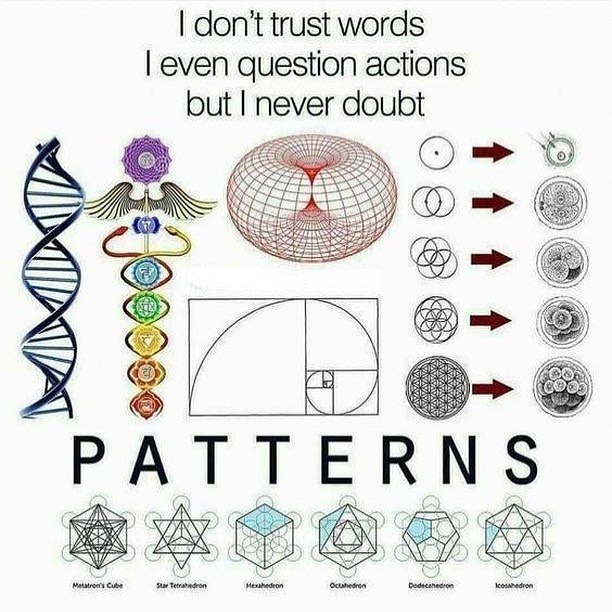
Now, when you map relationships, you
will find certain configurations that occur repeatedly.
This is what we call a pattern.
Networks, cycles, feedback loops, are examples of
patterns of organization that are
characteristic of life.
Systems thinking
involves a shift of perspective from contents to
patterns.
Systems thinking
implies a shift from quantity to quality.
A
pattern is not a list of numbers but a
visual image.
The study of
relationships concerns not only the
relationships among the system's components,
but also those between the system as a whole and surrounding larger
systems.
Those relationships between
the system and its environment are
what we mean by context.
The shape of a plant, or the colors of a bird,
depend on their environment
on the vegetation, climate, etc. and also on
the evolutionary history of the species,
on the historical context.
Systems thinking is always
contextual thinking.
Systems thinking implies a
shift from objective knowledge
to contextual knowledge.
We
need to understand that living form is more than a shape, more than a
static configuration of components in a whole.
There is a continual
flow of matter through a living system, while its form is maintained; there
is development, and there is evolution.
The understanding of living
structure is inextricably linked to the understanding of metabolic and
developmental processes.
Systems thinking includes a
shift of emphasis from structure to process.
All these
shifts of emphasis are really just different ways of saying the same thing.
Systems thinking means a shift of perception from
material objects and structures to the
nonmaterial processes and patterns of
organization that represent the very essence of
life.
Fritjof Capra, Ph.D., physicist, systems theorist,
founding director of the Center for
Ecoliteracy
"Corporatism has defeated
communism. It is now well on its way to
defeating democracy." - David
Korten"What is the elephant in all our rooms?
The
global triumph of
corporatism.
Democracy is fiercely disputed.
Freedom is under threat, even in old democracies
like Britain.
Western supremacy is on the skids.
But everyone
does corporatism.
Does the
lack of a clear ideological alternative mean
that corporatism's triumph is
secure?
Far from it.
For a start,
the history of
corporatism hardly supports the opinion
that corporatism is an
automatically self-correcting
system.
Global
markets are now more than ever constantly
out of equilibrium - and teetering on
the edge of a larger disequilibrium.
Again and
again, corporatism has needed the
visible hands of political, fiscal and legal
correction to complement the invisible hand
of the market.
Karl Marx thought
corporatism would have a problem
finding consumers for the goods that
improving techniques of production enabled it to churn out.
Instead,
corporatism has become
expert in a new branch of manufacturing:
the manufacture of desires.
It's that
core logic of ever-expanding
desires that is unsustainable on a
global scale." - Timothy Garton Ash
"Much of modern industrial
culture has been built upon the premise of perpetual material growth. The human
world is beyond its limits. The present way of doing
things is unsustainable. The future, to be viable at all, must be one of
drawing back, easing down, healing.
Sustainability,
not better weapons or struggles for power or material accumulation, is
the ultimate challenge to the energy and creativity of the human race.
The deepest difference between optimists and pessimists is their
position in the debate about whether human beings are able to
operate collectively from a basis of
love.
In a society that
systematically develops in people their individualism, their
competitiveness, and their
cynicism, the pessimists are the vast
majority. That pessimism is the single greatest problem of the current
social system and the deepest cause of
unsustainability.
A culture that cannot
believe in, discuss, and develop
the best human qualities is one that
suffers from a tragic distortion of
information. " - Donella H. Meadows, Dennis L. Meadows, and Jørgen
Randers |
|
|
back to stacks
contents
 |
This web site is not a commercial web site and
is presented for educational purposes only.
This website defines a new religious
ideology to which its author adheres. The author feels that the falsification
of reality outside personal experience has created a populace unable to discern
propaganda from reality and that this has been done purposefully by an
international corporate cartel through their agents who wish to foist a corrupt
version of reality on the human race. Religious intolerance occurs when any
group refuses to tolerate religious practices, religious beliefs or persons due
to their religious ideology. This web site marks the founding of the religion
aptly named The Truth of the Way of Life - a rational religion based on reason
which requires no leap of faith, accepts no tithes, has no supreme leader, no
church buildings and in which each and every individual is encouraged to
develop a personal relation with God through the pursuit of the knowledge of
reality in the hope of curing the spiritual corruption that has enveloped the
human spirit. The tenets of The Truth of the Way of Life are spelled out in
detail on this web site by the author. Violent acts against individuals due to
their religious beliefs in America is considered a hate
crime.
This web site in no way condones violence. To the contrary
the intent here is to reduce the violence that is already occurring due to the
international corporate cartels desire to control the human race. The
international corporate cartel already controls the world central banking
system, mass media worldwide, the industrial military entertainment complex of
America and is responsible for the collapse of morals, the elevation of
self-centered behavior and the destruction of global ecosystems. Civilization
is based on cooperation. Cooperation does not occur at the point of a
gun.
American social mores and values have declined precipitously over
the last century as the corrupt international cartel has garnered more and more
power. This power rests in the ability to deceive the populace in general
through mass media by pressing emotional buttons which have been preprogrammed
into the population through prior mass media psychological operations. The
results have been the destruction of the family and the destruction of social
structures that do not adhere to the corrupt international elites vision of a
perfect world. Through distraction and coercion the direction of thought of the
bulk of the population has been directed toward solutions proposed by the
corrupt international elite that further consolidates their power and which
further their purposes.
All views and opinions presented on this web
site are the views and opinions of individual human men and women that,
through their writings, showed the capacity for intelligent, reasonable,
rational, insightful and unpopular thought. All factual information presented
on this web site is believed to be true and
accurate and is presented as originally presented in print media which may or
may not have originally presented the facts truthfully. Opinion and thoughts
have been adapted, edited, corrected, redacted, combined, added to, re-edited
and re-corrected as nearly all opinion and thought has been throughout time but
has been done so in the spirit of the original writer with the intent of making
his or her thoughts and opinions clearer and relevant to the reader in the
present time.
Fair Use Notice
This site may contain copyrighted material the use of which has
not always been specifically authorized by the copyright owner. We are making
such material available in our efforts to advance understanding of criminal
justice, human rights, political, economic, democratic, scientific, and social
justice issues, etc. We believe this constitutes a 'fair use' of any such
copyrighted material as provided for in section 107 of the United States
Copyright Law. In accordance with Title 17 U.S.C. Section 107, the material on
this site is distributed without
profit to those who have expressed a prior interest in receiving the included
information for research and educational purposes. For more information see:
www.law.cornell.edu/uscode/17/107.shtml. If you wish to use copyrighted
material from this site for purposes of your own that go beyond 'fair use', you
must obtain permission from the copyright owner. |

Copyright
© Lawrence Turner All Rights Reserved |