
|
Native American Indians believe your Soul is
captured when your image is taken.
In America celebrities trademark
their own images and you should too!
Celebrity Trademark Watch
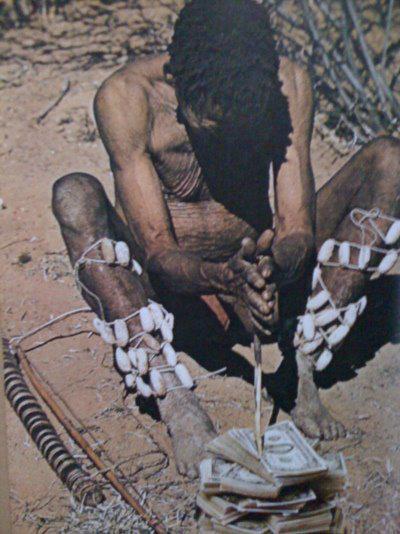
The day we die the wind comes
down to take away our footprints.
The
wind makes dust to cover up the marks
we left while walking.
For otherwise the thing would appear as if we
were still living.
Therefore the wind is he who comes to blow away
our footprints.
Southern
Bushmen
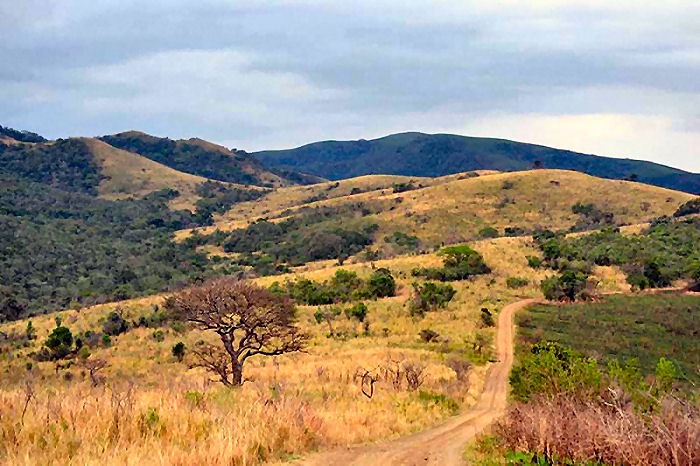

Magqubu and I had surveyed all the wilderness
trail routes.
He knew what was at stake because he would be the
eyes and ears of the trail party, and if anything went there were still
officials who opposed the trails.
The Natal Parks Board head office reported that no one in the public
had shown any interest in making a reservation.
There were the usual
news stories of stopping development of
tourist camps.
Roy
Rudden, a newspaper friend
on the Sunday Times, took some beautiful photographs in the game reserve and
wrote, "Adventure at a Pound a Day."
Placards emblazoned with these
words appeared throughout South
Africa.
On Monday the switchboard of the headquarters of the Natal
Parks Board was jammed with calls from people trying to make
reservations.
Wilderness trails had arrived.
For the first time
people were going to be walking trails in the wilderness inside a game reserve
among wild animals and sleeping out on the veld.
This was
a revolutionary
concept.
Heretofore visitors to game reserves and national parks
throughout most of eastern and southern Africa were required to stay in a
vehicle and many bureaucrats
were against the idea of allowing walking into the
wilderness.
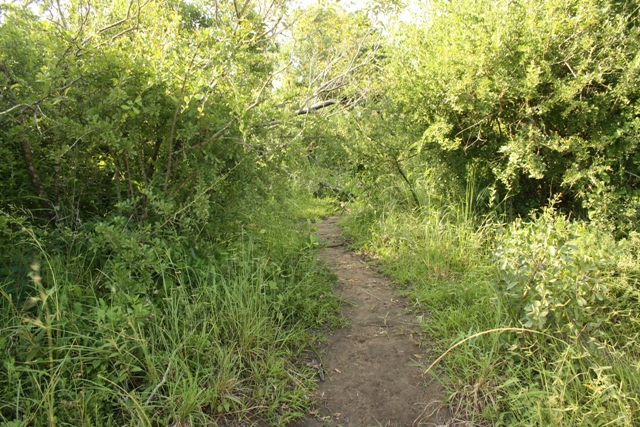
On March 19, 1959, Magqubu and
I lead the first official wilderness trail in the Mfolozi game reserve for the
Natal Parks Board.
Magqubu led the trail party of six people along
the steep path down from Momfu
Cliffs to the Mpafa River, then followed the rhino paths south to Mahobosheni,
where the donkeys had taken the mess kit and the tents.
It was getting
dark, and we all relaxed because
we only had a hundred meters to walk to the camp.
There was a faint
sound in a nearby wallow.
I
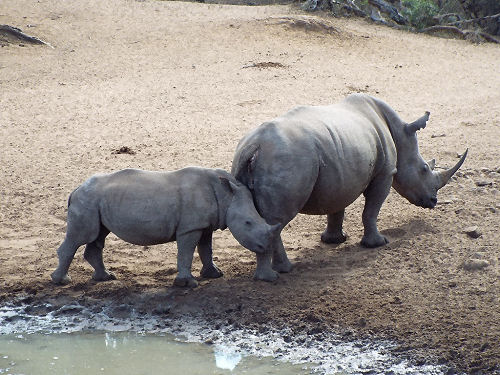
turned to see the glint of light on the
horn of a black rhino.
Before I could even shout the black rhino
came storming toward us, snorting and crashing through the bush.
The
hikers performed undreamed of physical achievements, pulling themselves up into
trees with one hand or scattering in all directions, shouting at the tops of
their voices.
When the black rhino had gone and everyone was together
again, we found no one was hurt beyond a few scratches and a sprain, Magqubu
said, "The amadhlozi were with us today."
I knew he was right.
If
the black rhino had killed anyone, the bureaucrats against the trails would
have ensured the concept died
an early death.
Later in the
evening Magqubu laughed and laughed.
He showed how the black rhino
charged and the acrobatics of
the people going up
the trees, their shouting and their running.
I was to witness this many
times.
It was hilarious to see white people scatter when a black rhino
charged.
This was his cinema.
Magqubu was animated by this
category of excitement.
He liked nothing more than to see people running
pell mell for the trees when a black rhino threatened.
Magqubu thought
it was funnier if in their haste they climbed a thorn tree.
His stomach
would bob up and down and his hand would slap the earth.
He elaborated
on all the sounds the people made, stifled "yips" of fear, swear words when
thorns hooked into flesh, the different actions when running.
Magqubu
missed nothing, and his nuances bit to the bone.
His descriptive powers were used
until everyone was laughing.
Magqubu was never crude, but he was
very basic.
I did not dare tell some of the people the names Magqubu
gave them.
Magqubu's eyes and ears missed nothing, the names were often
descriptive.
Throughout history men and women have been
entranced by wild Africa.
It has
great depth of soul, people are gripped by its
strange, brooding spirit.
Egyptians,
Greeks, Arabs, and
Romans took expeditions into its
heartland.
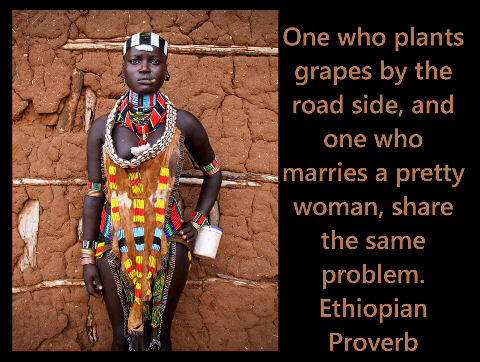
The Arabs said, "Once you have tasted of the waters of
Africa, you need to return to have
your fill thereof."
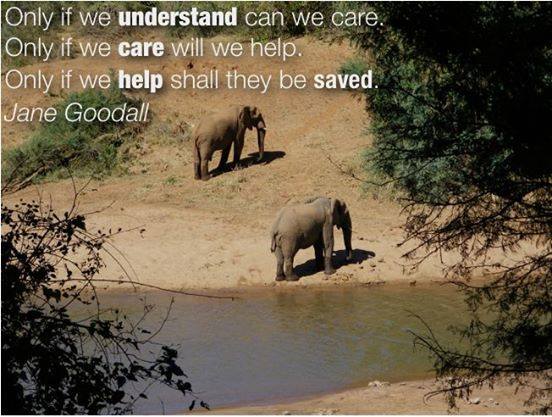

The Romans said, "Ex
Africa semper aliquid novi"
(Out of Africa always something new).
Part of their empire extended into
North Africa, and they
were affected by the rhythms of this ancient continent.
They captured
many wild animals - lion, rhino, and elephant - and took them across the
Mediterranean to the great Coliseum: They used cannabis to calm the animals.
The old wild Africa influenced many of the great men and women of our
time.
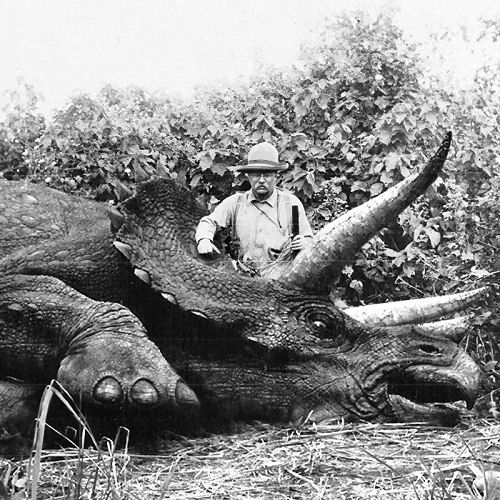
Theodore Roosevelt hunted frequently in
Uganda.
FC Selous was Theodore
Roosevelt's guide.
He had once hunted at Ndumu.
He had a great
influence on Theodore Roosevelt's life.
They spent weeks together in
the African wilderness hunting rare species for the Smithsonian Institution.
One can imagine the long conversations they had around the fire at
night, with lions roaring, hyena whooping, elephants trumpeting, jackals
screaming.
In the morning, when
the thermals swirled, they would have
listened to the fish eagle, its long call piercing the stillness, echoing over
the swamps.
Theodore Roosevelt was
the rock upon which the conservation movement was built
in the USA.
It was due to him that America became the leader in
environmental protection, the establishment of national parks, and wildlife
management.
You need only glance at the index of Bill S 1176, the 1957
Senate hearings about the National Wilderness Preservation Act, to see the
profound influence Theodore Roosevelt had on
conservation in the US.
He foresaw the conservation problems
that were to face America.
Theodore Roosevelt was the driving force in
the America Bison
Society.
It was estimated that there were sixty million bison
on the plains when Lewis and Clark crossed the North American continent in the
early 1800s.
Theodore Roosevelt had difficulty in finding eight hundred
bison in 1900.
I can imagine that in his
mind's eye he saw once
again the vast herds of African
buffalo and antelope, and the memory drove him on to save the remaining
bison.
In 1908 Theodore Roosevelt brought all the state governors in
the United States of America to a conservation conference, and it was from this
conference that the National Park Service became established in 1916.
There is hardly a country on Earth today that does not have a national
park, and the African experience of Theodore Roosevelt was the motivating
force.
Theodore Roosevelt and FC Selous kept up a correspondence until
FC Selous was killed by a sniper's bullet in Tanganyika in World War I.
Theodore
Roosevelt said, "Aggressive fighting for the right
is the noblest sport the Earth affords."
Many conservationists have
been inspired by these words.
Why is it so many people have been caught
in the spiritual web of Africa?
Is it not because it was here that
mankind took its first steps and emerged from the dark forests to walk upright
into the savannah?
In a BBC interview with John Freeman, Carl Gustav
Jung said, "We do not come onto the Earth tabula rasa."
Three
million years of evolution in Africa is
imprinted upon the human psyche, perhaps this leads to a deep yearning to
return, to see the red earth, to hear the
cry of the fish eagle, roar of
the lion, and trumpet of the
elephant.
Carl Jung
was another man whose life was changed by the African experience.
In the autumn of 1925
Carl Jung visited Kenya and Uganda.
Carl Jung
came to learn something about
the archetypal nature of man.
Carl Jung wakes, traveling in a
train, at sunrise, and on a steep red cliff he sees and describes in
Memories, Dreams, Reflections "a slim, brownish-black figure...
motionless, leaning on a long spear. ..."
It gave Carl Jung
an intense sense of déjà
vu.
"I could not guess
what string within myself was plucked at
the sight of that solitary dark
hunter. I knew only that his Earth had been mine for countless millennia."
- Carl Jung
Carl
Jung had reconnected with his own interior Africa, and he always referred to
Africa as "God's country."
For the rest of his life Carl Jung
emphasized how important the African experience had been to him and his
work.
Carl Jung's psychology
has influenced Western thought by making people aware of the importance of
archetypal images in subconscious
thought and their symbolic effect in dreams.
Ian Player
|
|
 |
This web site is not a commercial web site and
is presented for educational purposes only.
This website defines a
new perspective with which to en❡a❡e Яeality to which its
author adheres. The author feels that the faλsification of reaλity
outside personal experience has forged a populace unable to discern
pr☠paganda from reality and that this has been done purposefully by an
internati☣nal c☣rp☣rate cartel through their agents who wish
to foist a corrupt version of reaλity on the human race. Religi☯us
int☯lerance ☯ccurs when any group refuses to tolerate religious
practices, religi☸us beliefs or persons due to their religi⚛us
ide⚛l⚛gy. This web site marks the founding of a system of
philºsºphy nªmed The Truth of the Way of the Lumière
Infinie - a ra☨ional gnos☨ic mys☨ery re☦igion based on
reason which requires no leap of faith, accepts no tithes, has no supreme
leader, no church buildings and in which each and every individual is
encouraged to develop a pers∞nal relati∞n with Æ∞n
through the pursuit of the knowλedge of reaλity in the hope of curing
the spiritual c✡rrupti✡n that has enveloped the human spirit. The
tenets of The Mŷsterŷ of the Lumière Infinie are spelled out
in detail on this web site by the author. Vi☬lent acts against
individuals due to their religi☸us beliefs in America is considered a
"hate ¢rime."
This web site in no way c☬nd☬nes
vi☬lence. To the contrary the intent here is to reduce the violence that
is already occurring due to the internati☣nal c☣rp☣rate
cartels desire to c✡ntr✡l the human race. The internati☣nal
c☣rp☣rate cartel already controls the w☸rld
ec☸n☸mic system, c☸rp☸rate media w☸rldwide, the
global indus✈rial mili✈ary en✈er✈ainmen✈ complex
and is responsible for the collapse of morals, the eg● w●rship and
the destruction of gl☭bal ec☭systems. Civilization is based on
coöperation. Coöperation with bi☣hazards of a
gun.
American social mores and values have declined precipitously over
the last century as the corrupt international cartel has garnered more and more
power. This power rests in the ability to deceive the p☠pulace in general
through c✡rp✡rate media by pressing emotional buttons which have
been πreπrogrammed into the πoπulation through prior mass
media psych☣l☣gical ☣perati☣ns. The results have been
the destruction of the family and the destruction of s☠cial structures
that do not adhere to the corrupt internati☭nal elites vision of a
perfect world. Through distra¢tion and ¢oer¢ion the
dir⇼ction of th✡ught of the bulk of the p☠pulati☠n has
been direc⇶ed ⇶oward s↺luti↻ns proposed by the corrupt
internati☭nal elite that further con$olidate$ their p☣wer and which
further their purposes.
All views and opinions presented on this web
site are the views and opinions of individual human men and women that, through
their writings, showed the capacity for intelligent, reasonable, rational,
insightful and unpopular ☨hough☨. All factual information presented
on this web site is believed to be true and accurate and is presented as
originally presented in print media which may or may not have originally
presented the facts truthfully. Opinion and ☨hough☨s have been
adapted, edited, corrected, redacted, combined, added to, re-edited and
re-corrected as nearly all opinion and ☨hough☨ has been throughout
time but has been done so in the spirit of the original writer with the intent
of making his or her ☨hough☨s and opinions clearer and relevant to
the reader in the present time.
Fair Use Notice

This site may contain
copyrighted material the use of which has not always been specifically
authorized by the copyright owner. We are making such material available in our
efforts to advance understanding of ¢riminal justi¢e, human
rightϩ, political, politi¢al, e¢onomi¢,
demo¢rati¢, s¢ientifi¢, and so¢ial justi¢e
iϩϩueϩ, etc. We believe this constitutes a 'fair use' of any
such copyrighted material as provided for in section 107 of the US Copyright
Law. In accordance with Title 17 U.S.C. Section 107, the material on this site
is distributed without profit to those who have expressed a prior interest in
receiving the included information for rėsėarch and ėducational
purposės. For more information see:
www.law.cornell.edu/uscode/17/107.shtml. If you wish to use copyrighted
material from this site for purposes of your own that go beyond 'fair use', you
must obtain permission from the copyright owner. |
 Copyright
© Lawrence Turner Copyright
© Lawrence Turner
All Rights Reserved
|