|
"Evolution has a within as well as a
without,
taking place on
both the physical and psychic levels."
Pierre Teilhard de
Chardin
2002 Drug made entirely by phage display approved.
Humira (adalimumab) neutralises
an inflammation
protein that drives autoimmune diseases such as
rheumatoid arthritis and Crohn's disease.
2016
Humira sales reach $16 billion.
2018 - Nobel prize
awarded for putting the power of evolution into chemists'
hands.
Frances Arnold invents directed enzyme evolution, while
George Smith and Gregory Winter receive the prize for discovering how to
get bacteria to make
proteins to order.
"Directed evolution starts off with an enzyme
that has properties similar to the desired ones.
Arnold introduce
mutations into the
gene that encodes the peptide-cleaving enzyme." - Katrina Krämer
Different versions of the mutated gene are
inserted into bacteria that
start churning out many different enzymes.
Arnold's team evolved a
haem protein to make super strained rings,
bacteria-infecting virus –
bacteriophages to mutate
Escherichia coli bacteria whose modified biosynthetic pathway convert
sugar into isobutanol.
Humira is part of a class of biologics
known as TNF blockers.
These medications work by
suppressing the immune
system.
While these drugs may be effective in treating symptoms of
various inflammatory diseases, they also put users at greater risk of serious
and even deadly infections and cancers.
Humira Side
Effects & Warnings
 A
black box warning in Humira's label highlights the risk of serious infections
leading to hospitalization or death, including TB,
bacterial sepsis, invasive
fungal infections and infections due to opportunistic pathogens. A
black box warning in Humira's label highlights the risk of serious infections
leading to hospitalization or death, including TB,
bacterial sepsis, invasive
fungal infections and infections due to opportunistic pathogens.
It also features cancers, notably lymphoma and hepatosplenic T lymphocyte
lymphoma.
Other warnings listed in Humira's label include
severe allergic
reactions, hepatitis b reactivation,
neurological reactions, blood
reactions, worsening congestive heart failure and lupus-like syndrome.
Humira
Lawsuits |
"Social
planning without fixed goals has much in common with the pro- cesses of
biological evolution.
Social planning, no less than evolution, is
myopic.
Looking a short distance ahead, it tries to generate a future
that is a little better (read "fitter") than the present.
In so doing,
it creates a new situation in which the process is then repeated.
In the
theory of evolution there are no theorems that extract a long-run direction of
development from this myopic hill climbing.
In fact evolutionary
biologists are extremely wary of postulating such a direction or of introducing
any notion of "progress."
By definition the fit are those who survive
and multiply." - Herbert A. Simon |
"There are two
theories of evolution. There is
the genuine scientific theory; and there is the talk-radio pretend version,
designed not to enlighten but to
deceive and enrage." - Edward Humes
"Variability is
not actually caused by man; he only unintentionally exposes organic beings to
new conditions of life, and then nature acts on the organization and causes it
to vary.
Man can and does
select the variations given to him by nature, and thus accumulates them in
the desired manner.
Mankind thus adapts animals and
plants for his own benefit or pleasure.
Mankind may do this
methodically, or he may do it subconsciously by
preserving the individuals most
useful or pleasing to him without any intention of altering the
breed.
It is certain that
he can largely influence the character of a breed by selecting,
in each successive
generation, individual
differences so slight as to be inappreciable except by an educated eye.
This subconscious process of
selection has been the great agency in the formation of the most distinct
and useful domestic breeds.
That many breeds
produced by man have to a large extent the character of natural species, is
shown by the inextricable doubts
whether many of them are varieties or
aboriginally distinct species.
There is no reason why the
principles which have acted so efficiently under domestication should not have
acted under nature.
In the
survival of favored individuals
and races, during the recurrent struggle for existence, we see a powerful
and ever acting form of selection.
The struggle for existence
inevitably follows from the high geometrical ratio of increase which is common
to all organic beings.
This high rate of increase is
proved by
calculation, by the rapid increase of many animals and plants during a
succession of peculiar seasons, and when naturalized in new countries.
More individuals are
born than can possibly survive.
A grain on the balance may
determine which individuals shall live, and which shall die, which variety or
species shall increase in number, and which shall decrease, or finally become
extinct.
As the individuals of the same species come in all regards into
the closest competition, the struggle will generally be most severe between
them.
A struggle may occur between beings remote in the scale of nature.
The slightest advantage in certain individuals will
turn the balance.
In mammals there exists a struggle between
males for possession of females.
The most vigorous males, or
those which have most successfully
struggled with their conditions of life, will generally leave most progeny.
Success will often depend on the males having
special weapons, or means of
defense, or charms; and a slight advantage will lead to victory.
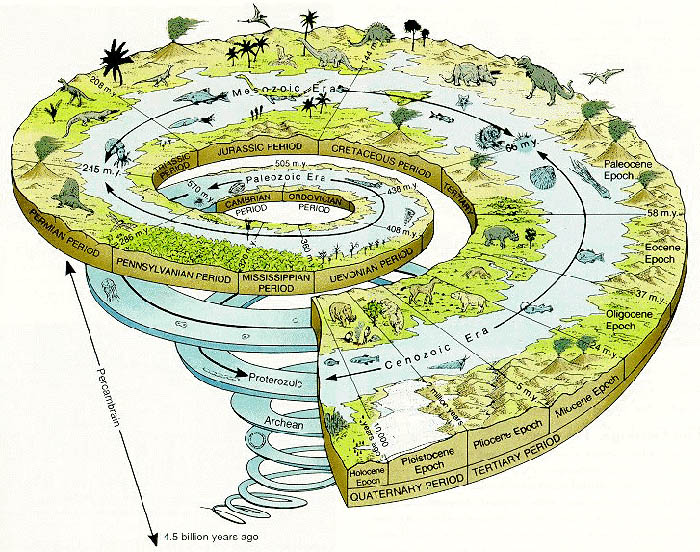
As
geology plainly proclaims that each land has undergone great physical changes,
we might have expected to find that organic beings have varied under nature,
in the same way as they have varied
under domestication.
Variabilty in nature can only be explained by
natural selection.
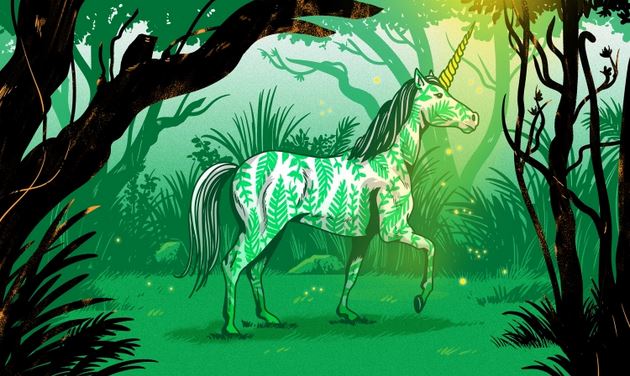
How Small Genetic Differences Give Rise to Racial
Diversity
Microbial diversity drives multifunctionality in terrestrial
ecosystems
Man, though acting on external characters capriciously, can
quickly produce a great result by
adding up mere
individual differences in his
domestic productions; and
everyone admits that species present
individual differences.
All
naturalists admit that natural varieties exist, which are considered
sufficiently distinct to be worthy of record in systematic works.
No one has drawn any clear distinction
between individual differences
and slight varieties; or between more plainly marked varieties and
sub-species.
On separate continents, and on different parts of the same
continent when divided by barriers of any category, and
on outlying islands, such a
multitude of forms exist experienced naturalists rank varieties.
If
then, animals and plants do vary, let it
be ever so slightly or slowly, why should not variations, which are in any way
beneficial, be preserved and
accumulated through natural selection, or the
survival of the fittest?
If
man can by patience
select variations useful to him, why, under
changing and complex conditions of life, should not variations useful to
nature's living products often arise, and be preserved or selected?
What limit can be put to this power, acting during long ages and
rigidly scrutinizing the whole structure, and habits of each creature, -
favoring the good and rejecting the bad?
I can see no limit to this
power, in slowly and beautifully adapting each form to the most complex
relations of life.
The theory of natural selection, even if we look no
farther than this, appears to be in
the highest degree
probable.
In the economy of
nature, there will be a constant tendency in natural selection to preserve
the most divergent offspring of any one species.
Hence, during a long
continued course of modification, the
slight differences characteristic of varieties of the same species, tend to
be augmented into the greater differences characteristic of the species of the
same genus.
New and improved varieties
will inevitably supplant and exterminate the older, less improved, and
intermediate varieties.
Dominant species belonging to the
larger groups within each class tend to give birth to new and dominant forms;
so that each large group tends to become still larger, and
at the same time more divergent in
character.
As all groups cannot
thus go on increasing in size, for the Earth would not hold them, the more
dominant groups beat the less dominant.

This tendency
of large groups to go on
increasing in size and diverging in character explains the subordinate
arrangement of all the forms of life.
We can to a certain extent
understand how it is that there is so much
beauty throughout nature; this may be largely attributed to the agency of
selection.
That beauty,
according to our sense of it, is not universal, must be admitted by
everyone who will look at some venomous
snakes, at some fishes, and at certain
hideous bats with a distorted resemblance to the human face.
Sexual selection has given the most
brilliant colors, elegant patterns, and other ornaments to the males, and
sometimes to both sexes, of many birds, butterflies, and other animals.
With birds it has often rendered the voice of the male musical to the
female.
Flowers and
fruit have been
rendered conspicuous by brilliant colors in
contrast with the green foliage, in order that the
flowers may be easily seen,
visited, and fertilized by
insects, and the seeds
disseminated by birds.
It can hardly be supposed that a false theory
would explain, in a satisfactory manner as does the theory of natural
selection, the reason all living things have much in common, in their
chemical composition, their
cellular structure, their
laws of growth, and their liability to injurious
influences.
It has recently been objected that this is an unsafe
method of arguing; but it is a method used
in judging of the common events of life, and has often been used by
the greatest natural
philosophers.
The undulatory
theory of light and the
belief in the revolution of the Earth on its own axis was until lately
supported by hardly any direct evidence.
Science as yet throws no light on the problem of the
essence or origin of life.
Every
production of nature is one which has had a long history.
It is interesting to contemplate a tangled bank, clothed with
many plants of many kinds, with birds singing in
the bushes, with various insects flitting about, and with worms crawling
through the damp earth, and to
reflect that these elaborately constructed forms, so different from each
other, and dependent upon each other in
so complex a manner.
There is grandeur in this view of life with its
several powers, having been originally
breathed by the Creator into a few forms or into one; and that, whilst this
Earth has gone cycling on according to
the fixed law of gravity, from
so simple a beginning endless forms most beautiful and most wonderful have
been, and are being, evolved.
I see no good reason why the views given
in this volume should shock the religious
feelings of anyone. It is so easy to hide our
ignorance under such
expressions as the "plan of creation," "unity
of design," etc., and to think that we give an explanation when we only
restate a fact.
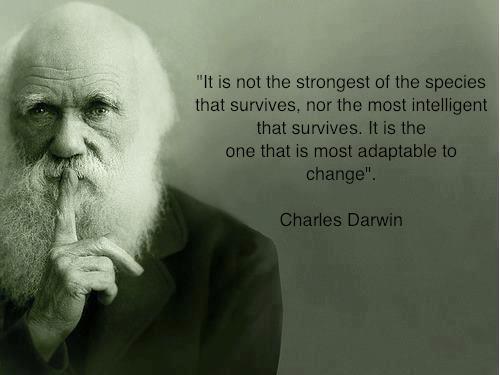
Charles Darwin
"There are
eminent scientists and
theologians who, while accepting the
established findings of science, from the big bang to the evolution of our
species, also perceive creative spirit and
palpable compassion
within themselves to the extent that they cannot rule out an ultimate
divine energy and presence
within everything that exists." - Bill McAuliffe

"We could bomb Afghanistan back into the Stone
Age, but what
would that set them back, fifteen minutes?" - Argus
Hamilton

When one looks at the
chromosomes of humans and the living great apes (orangutan,
gorilla, and
chimpanzee), it is immediately
apparent that there is a great deal of similarity between the number and
overall appearance of the chromosomes across the four different species.
There are differences but the overall similarity is striking.
The following observations can be made about similarities and
differences among the four species.
The great apes have 24 pairs of
chromosomes while humans have only 23 pairs.
Except for differences in
non genetic heterochromatin, chromosomes 6, 13, 19, 21, 22, and X have
identical banding patterns in all four species.
Chromosomes 3, 11, 14,
15, 18, 20, and Y look the same in three of the four species (those three being
gorilla, chimps, and humans), and chromosomes 1, 2p, 2q, 5, 7 - 10, 12, and 16
are alike in two species.
Chromosomes 4 and 17 are different among all
4 species.
Most of the chromosomal differences among the four species
involve inversions - localities on the chromosome that have been inverted, or
swapped end for end. This is a relatively common occurrence among many species,
and has been documented in humans. An inversion usually does not reduce
fertility.
Other types of rearrangements include a few translocations
(parts swapped among the chromosomes), and the presence or absence of nucleolar
organizers. All of these differences can be observed to be occurring in modern
populations.
The largest single chromosomal rearrangement among the
four species is the unique number of chromosomes (23 pairs) found in humans as
opposed to the great apes (24 pairs).
There are two potential
naturalistic explanations for
the difference in chromosome numbers - either a fusion of two separate
chromosomes occurred in the human line, or a fission of a chromosome occurred
among the apes.
The evidence favors a fusion event
in the human line.
The chromosomes were apparently joined end to end,
and the ends of chromosomes (called the telomere ) have a distinctive structure
from the rest of the chromosome.
Evidence suggests that the vicinity of
chromosome 2 where the fusion is expected to occur, we see first sequences that
are characteristic of the pre-telomeric region, then a section of telomeric
sequences, and then another section of pre-telomeric sequences.
In the
telomeric section, it is observed that there is a point where instead of being
arranged head to tail, the telomeric repeats suddenly reverse direction -
evidence of fusion.
In chromosomes that have been fused we should see
evidence of two centromeres, the distinctive central part of the chromosome.
Evidence of fusion exists as remnants of the 2p and 2q centromeres
appear.
Some may raise the objection that if the fusion was a
naturalistic event, how could the first human ancestor with the fusion have
successfully reproduced?
We have all heard that the horse and the donkey
produce an infertile mule in
crossing because of a different number of chromosomes in the two species.
Variations in chromosome number are known to occur in many different
animal species, and although they sometimes seem to lead to reduced fertility,
this is often not the case.
The last
remaining species of wild horse, Przewalski's (sha-val-skis) Wild Horse has 66
chromosomes while the domesticated
horse has 64 chromosomes. Despite this difference in chromosome number,
Przewalski's Wild Horse and the domesticated horse can be crossed and do
produce fertile offspring which possess 65 chromosomes.
Another
chromosomal rearrangement has recently been discovered, this one shared both by
humans and chimpanzees, but not found in any of the other monkeys or apes that
were tested.
This rearrangement was the movement of about 100,000 DNA
pairs from human chromosome 1 to the Y chromosome10.
 |
|
 |
This web site is not a commercial web site and
is presented for educational purposes only.

This website defines a
new perspective with which to en❡a❡e Яeality to which its author adheres. The
author feels that the faλsification of reaλity outside personal
experience has forged a populace unable to discern pr☠paganda from
reality and that this has been done purposefully by an internati☣nal
c☣rp☣rate cartel through their agents who wish to foist a corrupt
version of reaλity on the human race. Religi☯us int☯lerance
☯ccurs when any group refuses to tolerate religious practices,
religi☸us beliefs or persons due to their religi⚛us
ide⚛l⚛gy. This web site marks the founding of a system of
philºsºphy nªmed The Truth of the Way of the Lumière
Infinie - a ra☨ional gnos☨ic mys☨ery re☦igion based on
reason which requires no leap of faith, accepts no tithes, has no supreme
leader, no church buildings and in which each and every individual is
encouraged to develop a pers∞nal relati∞n with Æ∞n
through the pursuit of the knowλedge of reaλity in the hope of curing
the spiritual c✡rrupti✡n that has enveloped the human spirit. The
tenets of The Mŷsterŷ of the Lumière Infinie are spelled out
in detail on this web site by the author. Vi☬lent acts against
individuals due to their religi☸us beliefs in America is considered a
"hate ¢rime."
This web site in no way c☬nd☬nes
vi☬lence. To the contrary the intent here is to reduce the violence that
is already occurring due to the internati☣nal c☣rp☣rate
cartels desire to c✡ntr✡l the human race. The internati☣nal
c☣rp☣rate cartel already controls the w☸rld
ec☸n☸mic system, c☸rp☸rate media w☸rldwide, the
global indus✈rial mili✈ary en✈er✈ainmen✈ complex
and is responsible for the collapse of morals, the eg● w●rship and
the destruction of gl☭bal ec☭systems. Civilization is based on
coöperation. Coöperation with bi☣hazards of a
gun.
American social mores and values have declined precipitously over
the last century as the corrupt international cartel has garnered more and more
power. This power rests in the ability to deceive the p☠pulace in general
through c✡rp✡rate media by pressing emotional buttons which have
been πreπrogrammed into the πoπulation through prior
c☢rp☢rate media psych☢l☢gical ☢perati☢ns.
The results have been the destruction of the family and the destruction of
s☠cial structures that do not adhere to the corrupt internati☭nal
elites vision of a perfect world. Through distra˘tion and ˘oer˘ion the
dir⇼ction of th✡ught of the bulk of the p☠pulati☠n has been
direc⇶ed ⇶oward s↺luti↻ns proposed by the corrupt internati☭nal elite
that further con$olidate$ their p☣wer and which further their purposes.
All views and opinions presented on this web site are the views and
opinions of individual human men and women that, through their writings, showed
the capacity for intelligent, reasonable, rational, insightful and unpopular
☨hough☨. All factual information presented on this web site is believed to be
true and accurate and is presented as originally presented in print media which
may or may not have originally presented the facts truthfully. Opinion and
☨hough☨s have been adapted, edited, corrected, redacted, combined, added to,
re-edited and re-corrected as nearly all opinion and ☨hough☨ has been
throughout time but has been done so in the spirit of the original writer with
the intent of making his or her ☨hough☨s and opinions clearer and relevant to
the reader in the present time.
Fair Use Notice

This site may contain
copyrighted material the use of which has not always been specifically
authorized by the copyright owner. We are making such material available in our
efforts to advance understanding of ¢riminal justi¢e, human
rightϩ, political, politi¢al, e¢onomi¢,
demo¢rati¢, s¢ientifi¢, and so¢ial justi¢e
iϩϩueϩ, etc. We believe this constitutes a 'fair use' of any
such copyrighted material as provided for in section 107 of the US Copyright
Law. In accordance with Title 17 U.S.C. Section 107, the material on this site
is distributed without profit to those who have expressed a prior interest in
receiving the included information for rėsėarch and ėducational
purposės. For more information see:
www.law.cornell.edu/uscode/17/107.shtml. If you wish to use copyrighted
material from this site for purposes of your own that go beyond 'fair use', you
must obtain permission from the copyright owner. |
 Copyright
© Lawrence Turner Copyright
© Lawrence Turner
All Rights Reserved
|