
|
Eros
"Better a thousand times to fall a prey to smallpox
or typhoid fever than to be inoculated with the germ of the Hollywood type of
love-life, which is nothing but a bestial service of lust camouflaged by fine
dresses and glamorous music." - Dr Theodore Graebner Romantic
love with candlelight dinners, avowals of
eternal love and soul
transforming
passion is perhaps our strangest
cultural ideal: that our ultimate fulfillment as a
individual happens only when
we lose
ourselves in a sexual relationship one whose
intensity signifies the depth and essence of
our spirit or
soul.
Idealization of sex as a
force of personal liberation and fulfillment would have struck the
Greeks, Western culture's icons
of pagan sexual liberation as very naive.
To the Greeks, Eros was a
powerful force of nature, volatile and
destructive. It was an
energy necessary for life to continue but one prone to sudden
uncontrollable excess.
The
Greeks invented a whole repertoire of images that communicated
erotic destructiveness; insanity, burning
disease and the violence of war
all expressed the lethal,
mind destroying power
of sex. Rather than a
soul nurturing flame, Eros was the conflagration that
burned Troy and left its plains strewn with
corpses, lit by Paris and Helen's
illicit passion.
The
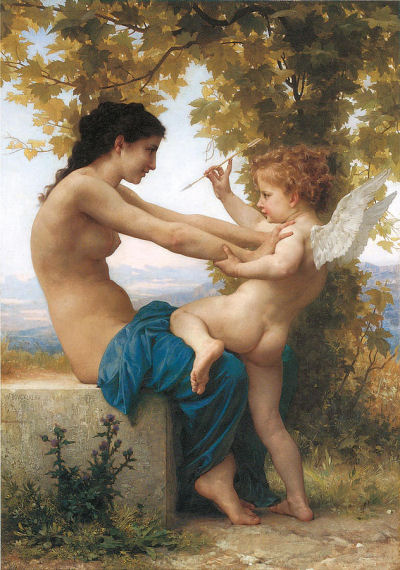
inherited imagery of Eros, the
Greek Cupid, has been emptied of its
sinister connotations and signifies instead our
sexual
sentimentalism.
We feel no
threat from his puny arrows, no
in his targeting us.
Yet to the Greeks, who
knew firsthand the excruciating
pain of barbed steel and
infected flesh,
the image was more grimly potent.
Imagine Eros brandishing a
rocket propelled grenade or more fiendishly as a
suicide bomber and you can begin to
understand why the
Greeks would call Eros a "killer," a "monster," a "destroyer."
The Greeks understood that
cultural and social controls
were necessary both to limit the force of
sex and to
exploit its creative energy.
Sexual taboos, the
institution of
marriage, emotions like
guilt and shame, reason
itself, all were devices for clipping Eros' wings.

Philosophers may have debated whether these
devices ultimately could work, but no one
believed that Eros could be "liberated" from social checks and limits and left in the
hands of the
individual alone.
Recently
popular Western culture has liberated Eros.
Traditional
social restraints are now considered archaic,
puritanical inhibitions stifling the
expression of our authentic selves
and repressive impediments to the conjoining of
true hearts.
Guilt and
shame have been discarded as
hypocritical and
reason has been dismissed as the instrument of
repression and neurosis.
The result of this experiment?
Venereal plagues, debasement of
women, vulgarization of sex in popular culture, chronic
dissatisfaction with sexual identities all testify to the costs of
slighting Eros' dark
power.
A modern
day Medea drowns
her two children because her
boyfriend does not want them; a kindergarten
beauty queen is raped and murdered; countless women are stalked and
butchered by estranged and
deranged boyfriends and
spouses.
Why is this happening?
The answer is the nature of Eros itself and its potential for
madness and violence.
To speak of
sex in these deadly terms is out of
fashion.
These days everybody endorses
sexual expression, even literalist Christians, although they restrict it to
marriage.
Radical
feminists who meticulously catalog the
depredations of heterosexual Eros are silent about the
darker side of
homosexual sex. Indulging in the
sentimental rhetoric only
blinds
us to the poison dripping from Eros' arrows.
Consumerism and
popular culture love a
liberated sexuality.
Liberated sexuality sells products.
"Love based solely on one's pleasure in
another is not
love at all. True love moves
beyond mere emotion,
transforming itself into the
kind of commitment that has staying power and the
power to change lives. After 33 years of
marriage, I believe that all lasting
unions have one thing in common:
two people who look past themselves and, instead, fix their gaze on the dignity
and value of the
other person, as well as the
value of marriage itself - for couples,
children and society as a whole. It is an acknowledgment, a
celebration, of the truth that your
spouse has a dignity given by
God, who admonishes us foremost to
love one another. While musicians reflect on the
ephemeral nature of romantic
love, and scientists research its cerebral workings, the
more important study is how love can be nurtured
and developed into healthy and enduring
marriages."- Gary Bauer
"Let's face it, Valentine's Day is a
consumer ploy. Romance and
propaganda have long made steamy
bedfellows. The relationship between diamonds
and romance is not rooted in ancient mating rituals but in Machiavellian
marketing techniques. Romantic
love is built around the illogical premise that
infatuation can be shoehorned into a permanent
state of being." - Meghan Daum
"For me, Valentine's
Day is a reminder that a marriage - like your job, your house, and your child's
college - is a competition. What
matters isn't that Cassandra and I have a healthy, growing marriage. What
matters is that no else has a better marriage." - Joel Stein"To be
in love is merely to be in a state of perpetual
anesthesia - to mistake an ordinary young
woman for a goddess. " - H.L. Mencken
"Lust is to the other
passions what the nervous fluid is to
life; it supports them all, lends strength to them all
ambition, cruelty,
avarice, revenge, are all founded on lust." - Marquis de Sade
"Men and women have always depended on each other for
survival and reproduction.
In my study of 10,041
individuals from 37 different
cultures, men and
women rated romantic
love as the single most important quality in
selecting a spouse.
Across the
Earth, people sing romantic
love songs and pine for lost lovers.
They
elope with loved ones against the wishes of parents.
They recount personal tales
of anguish, longing, and unrequited love.
And they narrate great love
stories of romantic entanglements down
through the generations.
The German writer Herman Hesse summed it up
best: life is "the struggle for position and the
search for love." Romantic
love is the universal
human emotion that bonds the sexes.
The
universal existence of romantic love, however,
poses a puzzle.
From an evolutionary
perspective, no single decision is more important than the choice of a mate.
That single fork in the road
determines one's ultimate reproductive
fate.
More than in any other
domain, therefore, we expect evolution to
produce supremely rational mechanisms of mate choice,
rational in the sense that they lead to wise decisions rather than impetuous
mistakes.
How could a
blind
passion like romantic
love - a form of dementia that
consumes the mind, crowds out all other
thoughts, creates emotional
dependency, and produces a delusional
idealization of a partner possibly
evolve to solve a problem that might be better solved by
cool rationality?
To penetrate this
mystery, we must start with the
scientific evidence for mate
preferences.
Across the Earth, from the
coastal dwelling Australians to the South African Zulu,
women desire qualities such as
ambition, industriousness, intelligence, dependability,
creativity, exciting personality, and
sense of humor - characteristics that augur well
for a man's success in acquiring
resources and achieving status. Given
the tremendous investment
women undertake to produce a single
child, the nine months of costly internal fertilization and gestation, it is
perfectly reasonable for women to want
men who can invest in return. A
woman's children will
survive and thrive better if she selects a
resourceful
man. Children suffer when their
mothers choose "slackers."
Men, in contrast, place a greater premium on
qualities linked with fertility, such as a woman's youth, health, and physical
appearance clear smooth skin, bright eyes, full hips, symmetrical
features, and a slim waist.
These preferences are
perfectly sensible. We descended from ancestral
mothers and
fathers who chose fertile and
resourceful partners. Those who
failed to choose on this basis risked
reproductive oblivion.
Although these
rational desires set minimum thresholds on who
qualifies as an acceptable mate, rationality
profoundly fails to predict the final choice of a
mate.
"Murmuring that your lover's looks, earning
power, and IQ meet your minimal standards would
probably kill the romantic mood, even if
statistically true. The way to a person's
heart is to declare the opposite - that
you're in love because you can't help it." -
psychologist Steven Pinker, Massachusetts Institute of Technology
"One key to the mystery of love is
found in the psychology of
commitment. If a partner chooses you for rational reasons,
he or she might leave you for the same rational reasons:
finding someone more desirable on all of
the "rational" criteria. But if the person is
blinded by an uncontrollable
love that cannot be helped and cannot be chosen, a
love for only you and no other, then commitment
will not waver when you are in sickness rather than in health, when you are
poorer rather than richer.
Romantic love
overrides rationality. It's the
emotion that ensures that you won't leave when
someone more desirable comes along or
when a perfect "10" moves in next door. It ensures that a partner will stick by
you through the struggles of survival and the
hazards of childbirth.
Romantic love,
however, has a tragic side. The stories of great lovers of the
past, in fiction and in history, are
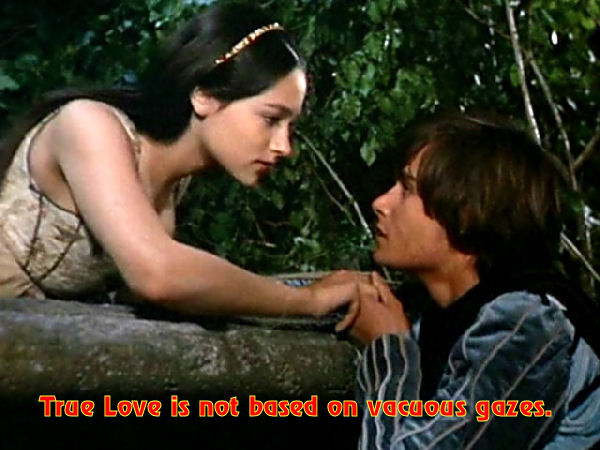
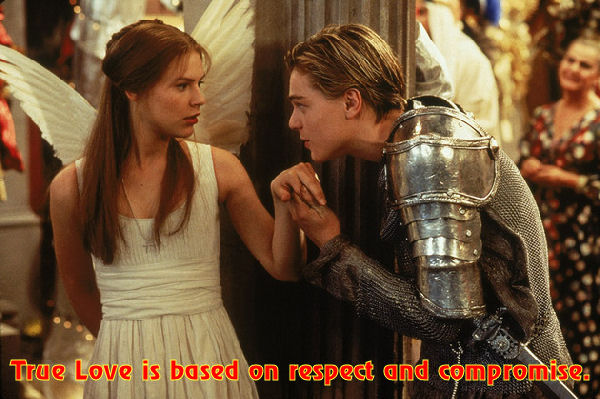
often marked by disaster. Juliet died of poison. Romeo chose to
kill himself rather than
live without her.
Romantic
love suicides have pervaded Japanese
culture for centuries, a final vindication of
the intensity of a person's commitment. When parents and society conspire to keep lovers apart, lovers
sometimes tie themselves together and jump off a cliff or hurl themselves into
a well. The most perilous side of romantic love,
however, comes not from a folie à deux, but from a folie à un
the demonic possession that
consumes a person when romantic
love is not reciprocated.
Unrequited romantic love is the foundation for fatal
attraction.The experience of
unrequited love is quite common.
In one
recent survey, 95 percent of men and
women indicated that, by the age of 25,
they had experienced unrequited romantic
love at least once, either as a would-be lover
whose passions were rejected or as the
object of someone's unwanted romantic desires.
Only one person in 20 has
never experienced unrequited romantic
love of any kind.
Although unrequited
romantic love is a perilous
passion, producing fatal attractions
and unwanted stalking, the dogged persistence it produces sometimes pays off.
One of the great romantic love stories in history is that of Nicholas and Alexandra.
Nicholas inherited the Russian throne at the end of the 19th
century. During his adolescence his parents started looking for a suitable mate
for him. At age 16, contrary to his parent's wishes, he became
obsessed with Alexandra, a
beautiful princess then
living in England with her
grandmother, Queen Victoria. Despite parental objections,
cultural chasms, and a
separation spanning thousands of miles, Nicholas
was determined to capture Alexandra's romantic love. Alexandra, however, found him a bit dull and
did not relish the thought of moving to the
harsh climate of Moscow. She spurned his advances.
In 1892, Nicholas
turned 24 and, having romantically loved Alexandra
for nearly eight years, resolved to make one final effort to win her
heart. Given this state of
mind, he was devastated when she wrote saying
that she had definitely decided not to wed him. She asked him not to contact
her again.
All seemed lost.
Nicholas left Moscow immediately.
He traveled across Europe, suffering rough terrain and treacherous weather in
the journey to London. Although
exhausted from travel, Nicholas immediately began to persue Alexandra with
great passion. After two months, she
finally relented and agreed to marry him. The young couple thus became
husband and
wife, rulers of the Russian empire.
Although
Nicholas's romantic love was initially unrequited,
their marriage proved a joyful one. Diary entries from each revealed sublime
happiness, the great joy of their union, and
the depth of their love for each other. They
produced five children. Nicholas so enjoyed spending time with Alexandra and their children that the
Russian empire suffered from his neglect. When forced to be apart, they pined
for each other, wrote often, and endured great
emotional pain until their reunions. Their mutual
love lasted throughout their lives, until the
Russian Revolution brought down the czarist rule and they were executed. They died on the
same day, their lifelong romantic
love never having diminished. Had Nicholas given
up when initially spurned, their great romantic love would have been lost forever.
Once
humans evolved romantic
love, the bonds they created required protection. It would be
extraordinarily unlikely that evolution would
fail to defend these fragile and fruitful unions
against interlopers.
In the insect world, there is a
species known
as the "lovebug."
Male lovebugs
venture out in a swarm of other males each
morning in search of a chance to mate
with a female. When one
succeeds, the couple departs from the swarm and
glides to the ground to copulate. Because other
males sometimes attempt to copulate with
her, even after the pair has begun mating, the couple maintains a continuous
copulatory embrace for as long as three days,
hence the nickname "the lovebug." This strategy guards the union against
outside intruders.
In humans,
guarding a bond must last more than days,
months, or even years if romantic love is to last
a lifetime.
The
emotion of jealousy evolved to fill this void.
Romantic
love and jealousy are intertwined
passions.
Romantic
love and jealousy depend on each other and feed on
each other.
Just as the prolonged
embrace of the lovebug tells us
that their bonds can be threatened, the power of
jealousy reveals the ever-present
possibility that our love bonds can be broken. The
centrality of jealousy in
human love
reveals a hidden side of our desires,
one that we typically go to great lengths to conceal a
passion for other partners.
To understand the origins of sexual
passion we must introduce a disturbing
difference between the sexes. Everyday observation tells us that
men are more promiscuously inclined than
women. "Men found to
desires more sex partners than
women desire" would be no more likely to make the
newspaper headlines than "Dog bites man."
Science has verified the everyday
knowledge that
men do display a greater
passion for multiple sexual partners.
In one of our recent studies of more than 1,000
men and women, men reported
desiring eight sex partners over the
next three years, whereas women reported
desiring only one or two.
In
another study, men were four times more
likely than women to say that they have
imagined having sex with 1,000 or more partners.
Observing that men and
women differ, however, is not the same as
explaining why they differ.
There are compelling
evolutionary reasons for the fact that this difference in
desire for sexual variety is universal,
found not just in cultures saturated with
media images of seductive
models, not just among Hugh Hefner's generation of Playboy readers, and not
just in studies conducted by male
scientists.
To explain this
desire, we must introduce another key
fact about human
reproductive biology.
To produce a single child,
women bear the burdens and pleasures of
nine months of pregnancy an obligatory form of
parental
investment that
men cannot share.
Men, to produce the same child, need only
devote a few hours, a few minutes, or even a few seconds.
Wide is the
gulf between men and
women in the effort needed to bring forth
new life. Over
time, therefore, a strategy of casual mating
proved to be more reproductively successful
for men than for
women.
Men who succeeded in the arms of many
women out-reproduced men who succeeded with fewer.
An ancestral
woman, in contrast, could have had sex
with hundreds of partners in the course of a single year and still have
produced only a single child. Unless a woman's regular partner proved to be
infertile, additional sex partners did not translate into additional children.
As a consequence, men evolved a
more powerful desire for sex with a variety of
women.
This sex difference in
desire creates an intriguing puzzle.
Sexual encounters require two
people.
Mathematically, the number of heterosexual encounters must be
identical for the sexes.
Men cannot
satisfy their lust for sex partners without willing
women.
Men's sexual
passion for multiple partners could
never have evolved unless there were some
women who shared that sexual
desire. Three
scientific
realities provide compelling evidence.
First, the existence of
men's sexual
jealousy - the ominous sexual
passion. If ancestral
women were
naturally inclined to be flawlessly
faithful, men would have had no
evolutionary catalyst for
jealousy.
Men's jealousy is an
evolutionary response to something alarming:
the threat of a loved one's infidelity. The
intensity of men's
jealousy provides a
psychological clue that betrays
women's
desire for
men other than their regular partners.
Second, infidelity is known in all
cultures, including
tribal societies, pointing to the universal prevalence of
infidelity. Prevalence rates vary from culture
to culture (high in Sweden and low in China),
but infidelity occurs everywhere. Sexual infidelity causes divorce worldwide
more than any other marital violation, being closely rivaled only by the
infertility of the union. The fact that women have affairs in
cultures from the Tiwi of northern Australia to
the suburbs of Los Angeles reveals that some women refuse to limit themselves to a single
partner despite men's attempts to
control them and despite the risk of divorce if
discovered.
A third line of evidence comes from new research on
human sperm
competition. Sperm
competition occurs when the sperm
from two different men inhabit a
woman's reproductive tract at the same
time. Human
sperm remain viable within the woman's
reproductive tract for up to seven
days. Hundreds of "crypts" recessed within the
vaginal walls of women store a
man's sperm and then release it several
days later to enter a marathon race to her
egg. If a woman has sex with two
men within the course of a week, sperm
competition can ensue, as the
sperm from different men scramble and
battle for the prize of fertilizing the egg.
Research on sperm
competition reveals that
men's sperm volume, relative to their body
weight, is twice that which occurs in primate species known to
be monogamous, a clue that hints at a long evolutionary history of human sperm
competition.
Human sperm, moreover, come in different
shapes designed for different functions. Most common
are standard sperm with conical heads and sinewy tails designed for swimming speed. But a substantial minority
of sperm have coiled tails. These so-called kamikaze sperm are poorly
designed for swimming speed. But that's not their
function. When the sperm from two different men are mixed in the laboratory, kamikaze
sperm wrap themselves around the egg getters and destroy them, committing
suicide in the process.
This
physiological evidence reveal a long evolutionary history in which
men battled with other
men, literally within the
woman's reproductive tract, for access to the vital egg
needed for transporting their genes into the next generation.
Without a
long history of sperm
competition,
evolution would have
favored neither the magnitude of
human sperm volume nor the specialized
sperm shapes designed for
battle. All this evidence - the universality
of infidelity, men's sexual
jealousy, and the hallmarks of sperm
competition - point to a
disturbing answer to the question of ancestral
women's sexual strategies.
As
scientists have focused primarily on the
obvious reproductive benefits of
men's desire for sexual variety, the potential
benefits to women of short-term sexual
passion languished for years unstudied.
The puzzle is compounded by the fact that a woman's infatuation with another
man comes laden with
.
An unfaithful
woman, if discovered, risks damage to her
social reputation, the
loss of her partner's commitment, physical
injury, and occasionally death at the hands of a
jealous man. In most
cultures women weigh these risks and choose not to
act on their sexual desires.
The
benefits to women who do act on their
passion for other
men, given the possibility of catastrophic
costs, must be perceived as sufficiently great to make it worth the risk.
Historically,
women may have benefitted from multiple
sexual partners in countless ways.The first and most obvious
benefit comes from the direct resources
that a sexual partner may provide. A few expensive dinners may not seem like
much today, but an extra supply of meat
from the hunt would have made the difference between starving and
surviving during ancestral winters when the
land lay bare, or between merely surviving and
robustly thriving during more plentiful times.
Women also can benefit from
multiple sexual partners in the currency of quality genes. The puzzle of the
peacock's tail provided the telltale clue to this benefit. A peahen's
preference for peacocks with brilliant plumage may signal selection for genes
for good health. When peacocks carry a high load of parasites, their diminished
health is revealed in duller displays. By selecting for luminescence, peahens
secure successful healthy genes that will benefit their offspring.
Research by Steve Gangestad and Randy Thornhill of the University of
New Mexico reveals that women may be
choosing sexual partnerss with especially healthy genes.
Women who have sex with different
men can also produce more genetically
diverse children, providing a sort of "hedge" against environmental change.
Although genetic and resource benefits
may flow to women who
express their hidden sexual
passions, our studies uncovered one
benefit that overshadowed the others in importance, a benefit we call "mate
insurance."
During ancestral times, disease, warfare, and food
shortages made survival a precarious
proposition. The odds were not trivial that a husband would succumb to a
disease, become debilitated by a parasite, or incur injury during a risky hunt
or a tribal battle. The paleontological and cross-cultural records reveal this
clue - the skulls and skeletons show injuries mostly on males. A
woman's husband, in short, stood a
significant chance of suffering a
debilitating or lethal wound. Ancestral women who failed to have mate insurance, a
backup replacement in the event that something happened to her regular partner,
would have suffered greatly compared to women who cultivated potential replacements.
Modern women
have inherited the desires of their
ancestral mothers for replacement mates. In the
words of one woman in our study, "Men are like soup - you always want to have
one on the back burner."
Mate insurance provides a safeguard against
reasonable risks of losing a partner. And mate
insurance remains relevant today, even
though we've conquered many of the hazards that felled our forebears.
American divorce rates now approach 67
percent for those currently getting married, up from the mere 50 percent figure
that alarmed many over the past two decades.
Remarriage is rapidly
becoming the norm.
Women's
attraction to lovers has another mysterious
ingredient: the puzzle of concealed ovulation.
Women's
genitals do not become engorged when they ovulate.
Women have "lost estrus" and engage in
sex throughout their ovulatory cycle. Conventional
scientific
wisdom has declared that a
woman's ovulation is cryptic, concealed
even from the woman herself.
Have the desires associated with ovulation totally
vanished? In the most extensive study of ovulation and
women's sexuality, several thousand
married women were asked to record their
sexual desires every
day for a period of twenty-four months. The
methods were crude but straightforward: women simply placed an X on the recording
sheet on each day that they
experienced sexual
desire. Basal body temperature was
recorded to determine the phase of the menstrual cycle. These thousands of data
points yielded a startling pattern. On the first day of a woman's period, practically no
women reported
experiencing sexual
desire. The numbers rose dramatically
across the ovarian cycle, peaking precisely at the point of maximum fertility,
and then declining rapidly during the luteal phase after ovulation.
Women, of course, can
experience sexual
desire at any phase of their cycle.
Nonetheless, they are five times more likely to experience sexual
desire when they are ovulating than when
they are not.
Women sometimes act
on their sexual passions. A recent
survey of 1,152 women, many of whom were
having extra martial sexual liaisons, revealed a startling finding.
Women who stray tend to
time their sexual liaisons with their affair
partners to coincide with the peak of their sexual
desire, when they are most likely to
conceive. Sex with husbands, in sharp
contrast, is more likely to occur when women are not ovulating, a strategy that may
be aimed at keeping a man rather than
conceiving with him.
None of this is conscious, of course.
Women do not think "I'll try to time sex with my affair
partner when I'm ovulating so that I'll bear his child and not my
husband's."
Psychologically,
women simply
experience sexual
desire more when they are ovulating, and
if they have an extra martial sexual liaison partner, have urges to have sex
with him during this phase.
Ovulation may be concealed to outside observers but
women act on the impulses that spring
from it. When that desire
for men other than their
husbands occurs, it's difficult for most
men to tell when their mates are straying
or may be likely to stray.
Consider camping
in the woods at night and hearing a
sound somewhere in the dark. Was that the
sound of a twig snapping, merely the
wind blowing, or the unfamiliar
night sounds playing tricks on your ears? Assuming
that you have correctly detected the signal as a twig snap, the possible causes
of this event are many, but they are not
infinite. It could be a rock that
somehow got dislodged. It could also be a animal
or a hostile human.
The signal
detection problem is not merely about picking up accurate signals in the face
of an uncertain and ambiguous welter of information. It is also about making
correct inferences about the cause of the signal.
Since sexual
infidelities are almost invariably secret, the signals they might emit are
intentionally muted.
An unfamiliar scent, the purchase of a sharp new
jacket, the running of a yellow light, a new interest in Beethoven or the
Beastie Boys, an unexplained absence all of these can be signals, but
they can originate from many causes other than infidelity.
The
jealous person
experiences an elevated sensitivity to
signals of infidelity: "A man may see a red
flush on his wife's cheek, she may appear
to be standing awkwardly, or sitting sideways on a chair, she has put on a
clean dress, there is a cigarette in the fireplace... the
jealous
man sees a handkerchief on the floor, a wet
cloth in the bathroom, newspapers
in a ditch, and attaches to all the same import."
Consider the case of
a European psychiatrist who counseled many couples referred to him in which one
of the spouses
experienced "morbid
jealousy." Most cases were
husbands who had
delusions that their
wives were sexually unfaithful, and these
delusions destroyed the fabric of
trust required for
harmonious marriage. As he
believed that extreme
jealousy was a psychiatric illness
that could not be cured, his most common recommendation was that the couples
separate or divorce.
Many couples
followed his recommendations.
As he was keenly interested in the
subsequent fate of his patients, he
routinely contacted them after a number of months had passed. To his
astonishment, he discovered that many of the wives of his patients had subsequently become
sexually involved with the very men about
whom their husbands had been jealous!
Some of these women actually
married the men who were the objects of
their husbands' suspicions. In many
cases, the husbands must have been
sensing signs of infidelity. As the
wives proclaimed innocence and declared
that their husbands'
jealousy was irrational, the
husbands ended up
believing that the problem was in their
heads.
The problem of signal
detection is how to identify and correctly interpret a partner's betrayal in an
uncertain social reality containing a
chaos of conflicting clues.
Jealousy is often triggered by
circumstances that signal a real threat to a relationship, such as differences in the
desirability of the partnersA man was 35 years old,
working as a foreman, when he was
referred to a psychiatrist and diagnosed with "morbid
jealousy." He had married at age 20 a
woman of 16 whom he deeply loved. During their
first two years of marriage, he was stationed
in military
service in England. During this
two-year separation, he received several
anonymous letters saying that his wife was
carrying on an affair. When he returned to America to rejoin her, he questioned her
intensely about the allegations, but she denied them. Their own sexual
relations proved disappointing. He became
obsessed with the earlier
time in their marriage, repeatedly accused his
wife of infidelity, and hit her from
time to time,
especially after a bout of drinking. He
tried to strangle her twice, and several times he
threatened to kill himself.
He openly
admitted his problems to the psychiatrist: "I'm so
jealous that when I see anyone near
her I want to hurt her. I have always loved her
but do not think she has returned my
affection. This
jealousy is something I feel in my
stomach and when it comes out of me there is nothing I can do about it. That is
why I behave so madly.... My wife is always
telling me that other men are stronger and
can beat me.... I'm not a big chap or a handsome chap but my
wife is so pretty and I don't
think I come up to her high standards."
In other words, he
perceived a difference in
their level of desirability; she was attractive and alluring, and he saw
himself as beneath her. When the psychiatrist questioned the
wife in
private, she admitted to
meeting and having an affair with a married man. The affair was carried on in
secret, and throughout the duration
of her affair she insisted that her husband's
jealousy was
delusional. The affair began roughly one
year before the husband was referred to
the psychiatrist to treat "his problem."
Differences in desirability - when an "8" is
married to a "10" - can heighten sensitivity to signals of infidelity in the
partner who has fewer outside mating options. Elaine Hatfield and
her colleagues at the University of Hawaii discovered that the more desirable
partner in the couple in fact is more likely to stray. Those who have been in
relationships with both more attractive and less attractive partners have an
acute awareness of how jealousy is
attuned to these differences.
Jealousy is necessary because of the real
threat of sexual treachery.
In a hazardous social world where rivals lurk, partners harbor
passions for other people, and
infidelity threatens to destroy what could
have been a lifelong love, it would be surprising
if evolution had not forged elaborate defenses
to detect and fend off these threats.
Exposing these threats, and the
psychological
arms we have to combat them, is a first step toward
comprehending the wisdom of
passions that sometimes seem so
destructive.
Jealousy can be
emotional acid that corrodes marriages,
undermines self-esteem, triggers battering,
and leads to the ultimate crime of murder.
Despite its manifestations,
jealousy helped to
solve a critical reproductive quandary for ancestral
men.
Jealous men were more likely to preserve their
valuable commitments for their own children
rather than squandering them on the children of their rivals. As descendants of a
long line of men who acted to ensure their
paternity, modern men carry with them the
passion that led to their forebears'
reproductive success.
Extreme jealousy has been given many names
the Othello syndrome, morbid jealousy,
psychotic jealousy,
pathological
jealousy, conjugal paranoia, and
erotic jealousy syndrome.
Jealousy can be
pathological.
Jealousy can destroy previously
harmonious
relationships, rendering them hellish
nightmares of daily existence.
Trust slowly built from years of mutual
reliance can be torn asunder in a crashing moment.
Jealousy leads more
women to flee in
terror to shelters than any other cause.
A full 13 percent of all homicides are spousal murders, and
jealousy is overwhelmingly the leading
cause.
The view of jealousy as
pathological ignores a profound
fact about an important defense designed to
combat a real threat.
Jealousy is not always a reaction to an
infidelity that has already been discovered.
Jealousy can be an anticipatory response,
a preemptive strike to prevent an infidelity that might occur.
Labeling
jealousy as
pathological simply because a
spouse has not yet strayed ignores the
fact that jealousy can head off an
infidelity that might be lurking on the horizon of a relationship." - David M. Buss
satisfaction of the
flesh Life is short.
The
pleasures of the
flesh beckon.
One may
live his or her life in the attempt to placate the needs and wants of
the flesh.
No matter the road to the
pleasure of the flesh all of these roads start out as wide, straight
and smooth avenues.
No matter the road chosen all become narrow,
winding roads strewn with potholes and boulders.
Flesh cannot be pleased.
This is
impossible.
The
flesh will grow old on the bone and whither.
The nature of flesh requires this to be so.
As
flesh cannot be pleased what does that leave?
Nobility, honor and
duty.
The
societies of man scream for the
elevation of the
individual but
fall short in
teaching the one and only
true way that one may be
elevated.
Power over others is the
elevation that is generally
accepted by society as the badge of
success.
This badge of
success is easily recognized in the
accumulation of wealth or the attainment of
celebrity.
The accumulation of
wealth gives the holder the
power to control
scarce resources.
The
attainment of celebrity gives the holder the
ability to control scarce
emotional resources of
others.
The only
true way to be truly elevated is to hold
firm in treating each individual with respect and dignity
regardless of their wealth or
celebrity.
An
individual that accumulates
excessive wealth does so at the expense of
others. If a
man or woman is accumulating excessive
wealth then they have not been fair with the
humans with whom they deal. A fair deal
requires that both parties are equally
enriched.
An
individual that
worships celebrity or wealth does so at the emotional and physical expense of the
humans closest to the one who has been
bewitched by the status of
celebrity and wealth.
Nobility and
honor comes from following
Natural Law of God .
Duty has been exercised by following a
course that one knows to be wise
and correct.
"For the mind
that is set on the flesh is hostile to God, for it
does not submit to
God's law; indeed, it cannot." - Romans
8:7 (English Standard Version)
Love for me had taken on the form and the being of
my little Josette. "We had met long before, in the rear of the
millinery shop in which she worked at Tours.
She had smiled at me with
singular persistence, and I caught her head in my hands, kissed her on the
lips--and found out suddenly that I loved her.
I no longer recall the
strange bliss we felt when, we first embraced.
It is true, there are
moments when I still desire her as madly as the first time.
This is so
especially when she is away.
When she is with me, there are moments
when she repels me.
Love.
I dreamed of a unique, an unheard of
idyll with a woman far from the one with whom I had hitherto lost all my time,
a woman whose features I did not see, but whose shadow I imagined beside my own
as we walked along the road together.
Bracelets, necklaces, rings. The
sparkling of the jewels made me feel far away from them as do the stars.
A young girl looked at me with vague blue eyes. What could I do against
that kind of sapphire?
I watched her bosom rising and falling, and her
motionless face, and the living book that was merged with her.
Her
complexion was so brilliant that her mouth seemed almost dark.
Her
beauty saddened me.
I looked at this unknown woman with sublime regret.
She caressed me by her presence.
A woman always caresses a man
when she comes near him and they are alone.
In spite of all sorts of
separation, there is always an awful beginning of happiness between them." -
Henri Barbusse
See Social Control
See The
Corruptuion of the American Dream
See
Satisfaction of the Flesh |
|
back to stacks
contents
 |
This web site is not a commercial web site and
is presented for educational purposes only.

This website defines a new religious
ideology to which its author adheres. The author feels that the falsification
of reality outside personal experience has created a populace unable to discern
propaganda from reality and that this has been done purposefully by an
international corporate cartel through their agents who wish to foist a corrupt
version of reality on the human race. Religious intolerance occurs when any
group refuses to tolerate religious practices, religious beliefs or persons due
to their religious ideology. This web site marks the founding of the religion
aptly named The Truth of the Way of Life - a rational religion based on reason
which requires no leap of faith, accepts no tithes, has no supreme leader, no
church buildings and in which each and every individual is encouraged to
develop a personal relation with God through the pursuit of the knowledge of
reality in the hope of curing the spiritual corruption that has enveloped the
human spirit. The tenets of The Truth of the Way of Life are spelled out in
detail on this web site by the author. Violent acts against individuals due to
their religious beliefs in America is considered a hate
crime.
This web site in no way condones violence. To the contrary
the intent here is to reduce the violence that is already occurring due to the
international corporate cartels desire to control the human race. The
international corporate cartel already controls the world central banking
system, mass media worldwide, the industrial military complex of America and is
responsible for the collapse of morals, the elevation of self-centered behavior
and the destruction of global ecosystems. Civilization is based on cooperation.
Cooperation does not occur at the point of a gun.
American social mores
and values have declined precipitously over the last century as the corrupt
international cartel has garnered more and more power. This power rests in the
ability to deceive the populace in general through mass media by pressing
emotional buttons which have been preprogrammed into the population through
prior mass media psychological operations. The results have been the
destruction of the family and the destruction of social structures that do not
adhere to the corrupt international elites vision of a perfect world. Through
distraction and coercion the direction of thought of the bulk of the population
has been directed toward solutions proposed by the corrupt international elite
that further consolidates their power and which further their purposes.
All views and opinions presented on this web site are the views and
opinions of individual human
men and women that, through their writings, showed
the capacity for intelligent, reasonable, rational, insightful and unpopular
thought. All factual information presented on this web site is believed to be
true and accurate and is presented as
originally presented in print media which may or may not have originally
presented the facts truthfully. Opinion and thoughts have been adapted, edited,
corrected, redacted, combined, added to, re-edited and re-corrected as nearly
all opinion and thought has been throughout time but has been done so in the
spirit of the original writer with the intent of making his or her thoughts and
opinions clearer and relevant to the reader in the present time.
Fair Use Notice

This site may contain copyrighted material the use of which has
not always been specifically authorized by the copyright owner. We are making
such material available in our efforts to advance understanding of criminal
justice, human rights, political, economic, democratic,
scientific, and social justice
issues, etc. We believe this constitutes a 'fair use' of any such copyrighted
material as provided for in section 107 of the United States Copyright Law. In
accordance with Title 17 U.S.C. Section 107, the material on this site is
distributed without profit to those
who have expressed a prior interest in
receiving the included information for research and educational purposes. For
more information see: www.law.cornell.edu/uscode/17/107.shtml. If you wish to
use copyrighted material from this site for purposes of your own that go beyond
'fair use', you must obtain permission from the copyright owner. |

Copyright
© Lawrence Turner All Rights Reserved |