|

"If you refuse to pay unjust taxes,
your property will be confiscated.
If you
defend your property,
you will be
arrested.
If you resist arrest,
you will be clubbed.
If
you defend yourself against clubbing,
you
will be shot dead."
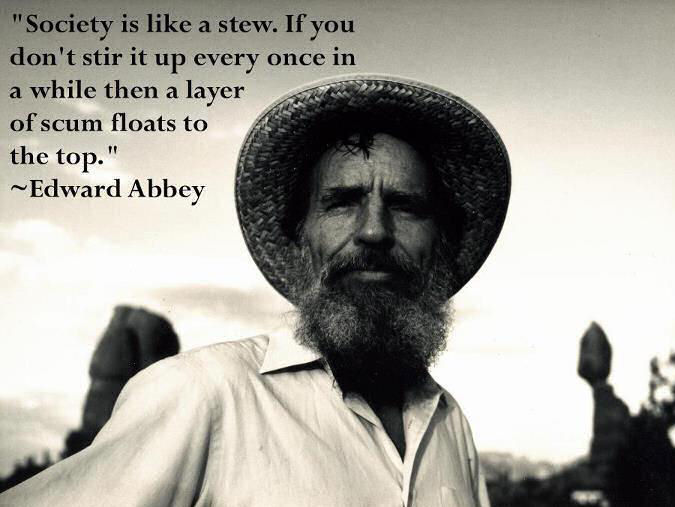
November 6, 1980
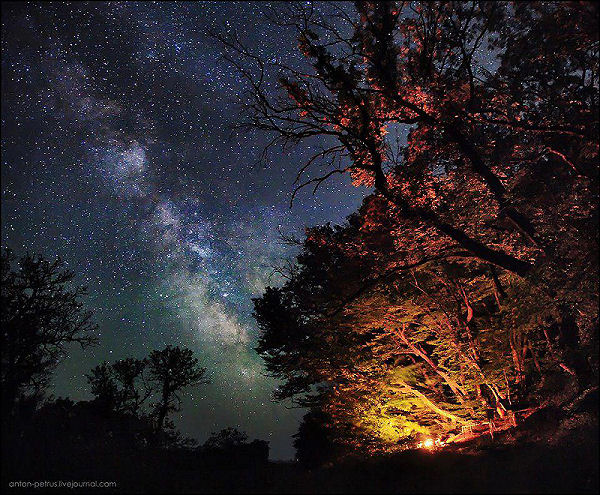
Awaking as usual sometime before
the dawn, frost on my beard and sleeping bag, I see four powerful lights
standing in a vertical row on the eastern sky.
Saturn, Jupiter, Mars, and, pale
crescent on a darkened disc, the old moon.
The three great planets
appear to be rising from the cusps of the moon.
I stare for a long time
at this strange, startling apparition,
a spectacle I have
never before seen in all my years on planet Earth.
What does it mean?
If ever I have seen a
portent in the sky this must be it.
Spirit both forms and informs
the universe, agreed the New England transcendentalists, of whom
Henry David Thoreau was one.
All
Nature is but
symbolic of a greater spiritual
reality beyond, and within.
Watching the
planets, I stumble about the campfire, breaking twigs, filling the
coffeepot.
I dip
water out of buckets in this world; the water chills my hands.
I stare
long at the beautiful dimming lights in the sky and find there no meaning other
than intrinsic beauty.
"Reality is
fabulous," said Henry David Thoreau; "be
it life or death, we crave
nothing but Reality."
The forest
spread below us in summer in
seventeen different shades of green.
There were yellow pine and
pinon pine, blue spruce and Engelmann spruce,
white fir and Douglas fir, quaking aspen, New Mexican locust, alligator
juniper, and four kinds of oak.
Along the rimrock of the
escarpment, where warm air rose from the canyons beneath, grew manzanita,
agave, sotol, and several species of cactus - prickly pear, pincushion,
fishhook.
Far down in the canyons, where water flowed, though not
always on the surface, we could see sycamore, alder, cottonwood, walnut,
hackberry, wild cherry, and wild grape.
The
naming of things is a useful
mnemonic device, enabling us to distinguish and utilize and remember what
otherwise might remain an undifferentiated sensory blur, but names do not tell
us much of character, essence, meaning.
Albert Einstein thought that
the most mysterious aspect of the
universe is what he called its "comprehensibility".
To me
the most mysterious thing about the
universe is not its comprehensibility but the fact that it exists.
And the same mystery attaches to everything within it.
The
Earth is permeated through and through by
mystery.
Modern
science and technology have
given us the social engineering
techniques to measure, analyze, and
take apart the immediate neighborhood,
including the neighbors.
But this knowledge adds not much to our understanding of things.
"Knowledge is
power," said Francis Bacon.
But
power does not lead to
wisdom, even less to
understanding.
Sympathy,
physical contact -
touch - are better means to so fine an
end.
I believe in nothing that I cannot touch, kiss, embrace - whether
a woman, a
child, a rock, a
tree, a bear, a shaggy dog.
The rest is hearsay.
If there is a
heaven,
an ideal realm beyond space and
time, it must contain the hermit thrush.
Otherwise, what good is
it?
And there must be trees too, of course.
And mountains.
And
a sun that sets each
evening and rises each morning.
And winding through the woods, a trail
with pine needles, stones, oak leaves, fresh bear shit.
Naturally.
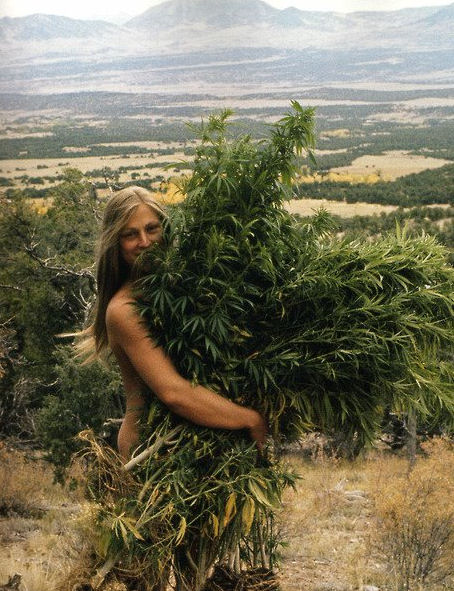
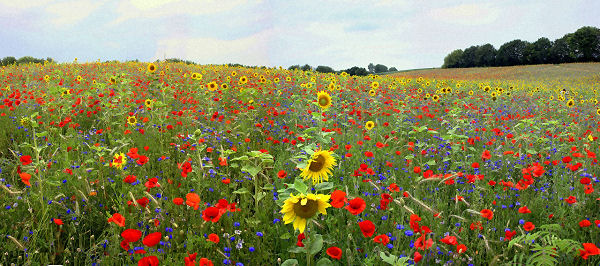
We lie in
the sunshine, on the
warm grass, and stare at the mountains, the
endless snow-covered mountains,
range after range, standing beyond the dark forest.
The glaciers wink
and glitter, running with streams of melted ice.
Flowers and ice,
sunlight and snow.
On
this bright afternoon, in a
field of flowers, Alaska seems to me a cold and somber land.
After
thirty-four years in the American Southwest, after too much time spent dawdling
about in places like Grand Canyon, Death Valley, the Maze, the Superstition
Mountains, the San Rafael Reef and the Waterpocket Fold, the San Juan Mountains
and the Gran Desierto, Baja California, Glen Canyon and the Dirty Devil River,
Desolation Canyon and the Pariah River, the Book Cliffs and the Kaiparowits
Plateau and Big Bend and White Sands, the Red Desert and Black Rock and
Barranca del Cobre, Factory Butte and Monument Valley, Slickhorn Gulch,
Buckskin Gulch, Thieves' Mountain, Montezuma's Head, Cabeza de Prieta, Cabezon,
Telluride and Lone Pine and the Smoke Creek Desert, Moab and Upheaval Dome,
White Rim and Druid Arch - to name but a few - and seeing
the full moon rise over the
13,000-foot peaks of Sierra La Sal, while the setting sun turns watermelon pink
a 2,000-foot vertical wall of sandstone in the foreground, then - and I'll
admit I'm spoiled - then by comparison Alaska seems, well, sort of . . .
banal.
My
theory is that a
vigorous, free, outdoors life is good for humans.
It fills them with cheer and
high spirits, leading to health
and a long life.
Despite the claims of medical technicians such as Dr.
Lewis Thomas, official spokesman for the cancer industry, it is not more and newer
drugs we need, not better living
through chemotherapy, but rather clean air.
Clean water.
Good fresh real food. And
plenty of self-directed
physical activity.
Medical science has succeeded in reducing infant
mortality rates, thus creating the catastrophe of
overpopulation, but it has not - despite medical myth - lengthened the
normal life span.
"Three score years and ten," now as in biblical
times, remains the norm.
And in fact the longest lived humans on Earth
are the primitive peasants of places like Ecuador, the
Caucasus Mountains,
Afghanistan.
Certainly
not the inhabitants of Dr. Lewis Thomas's
Sloan-Kettering Memorial Hospital
in New York City.
We emerge from one
nightmare only to find another
threatening to engulf us: the
technological superstate, densely populated,
centrally controlled,
nuclear-powered,
computer-directed, firmly and
thoroughly policed.
Call it the Anthill State, the Beehive Society,
a technocratic despotism - perhaps
benevolent, perhaps not, but in either case the enemy of
personal liberty, family
independence, and community
sovereignty, shutting off for a long
time to come the freedom to choose among alternate ways of living.
The domination of
nature made possible by misapplied science leads to the
domination of humans; to
a dreary and totalitarian
uniformity.
That
which today calls itself science gives us
more and
more information, an indigestible glut of
information, and less and less understanding.
Thoreau knew of this tendency and foresaw its
fatal consequences.
A
frantic 'busyness' pervades America wherever we look - in city and country,
among young and old and middle-aged, married and unmarried, all races, classes,
sexes, in work and play, in
religion,
the arts and the
sciences.
We hear a demand by
conventional economists for
increased 'productivity'.
Productivity of what? For whose benefit?
To what end?
By what means and
at what cost?
Those questions are not
considered.
We are belabored by the
insistence on the part of our
politicians, businessmen
and military leaders, and
the claque of scriveners who serve
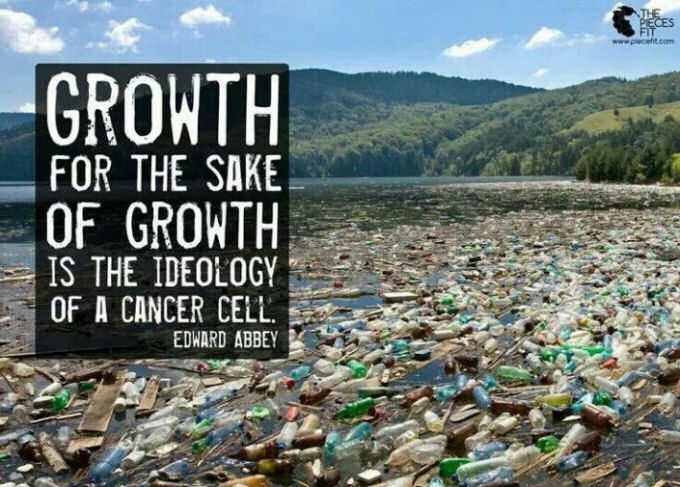
them, that "growth" and "power" are intrinsically good, of which we can
never have enough, or even too much.
As if gigantism were an end in
itself.
The
reason so many people
flee the cities at every
opportunity to go camping, canoeing, skiing in the wilds is that wilderness
offers a taste of
adventure, a chance for the
rediscovery of pre-agricultural,
pre-industrial freedom.
Forest and
desert,
mountain when ventured
upon in primitive terms, allow us Proustian recapture, superficial and brief,
of rich sensations of former
existence, basic heritage of a
million years of hunting, gathering, wandering.
This elemental
impulse still survives in nerves,
dreams and
desires.
Suppressed but
not destroyed by the five thousand years of
monocultural and two hundred years of
industrial peonage, imposed on what evolution designed as a
feeling, thinking, freedom
loving animal.
I say culture; civilization remains an
ideal, an integrated realization of
intellectual, emotional, and physical gifts which humankind has as a
whole.
The modern
urban-industrial world - like
the feudal world - offers
freedom and
adventure to
a certain elite aristocracy:
the star athlete,
the superstar entertainer,
the
techno-warrior, the artist
arrivi, the
successful politician.
The overwhelming majority
condemned to the role of
spectators, servitors.
One exception remains
to the iron rule of oligarchy.
In America one relic of our ancient and rightful liberty has survived.
And that is -
a walk
into the woods; a journey on foot into the uninhabited interior;
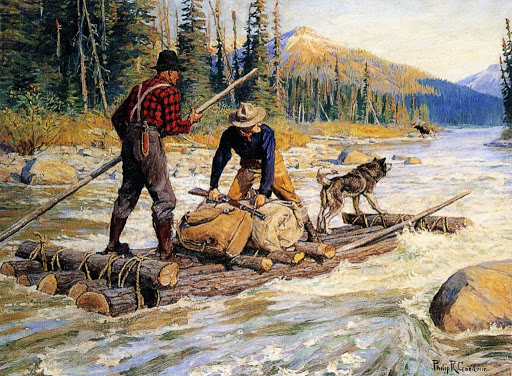
a voyage down the river of no
return.
Hunters,
fishermen, hikers,
climbers,
white-water boatmen,
red-rock explorers know what I
mean.
This category of
experience remains open and available to all.
It is my fear that if
we allow the freedom of the hills and the last wilderness to be taken from us,
then the very idea of freedom may die with it.
We see a white egret.
Another blue heron.
Beaver, buzzards, and bullfrogs.
White
clouds passing beyond remote red walls.
From deep in the entrenched
meanders of the endless Goosenecks, looking upriver, I catch a glimpse of
Muley Point on the rim of Cedar Mesa, three thousand feet above.
We round Mendenhall Bend, where the river winds eight linear
miles to advance one-half mile on the map.
On the neck of the stone
goose is a little stone cabin, built by a gold prospector named Mendenhall
eighty years ago.
Nobody lives there now.
Looking at
petroglyphs on a rosy mural wall, I think of the
legend of Kokopelli, the
hunch-backed flute player of the Anasazi, who visited - when the men were
away at war - all the villages
of Indian America, from the Yukon to Tierra del Fuego, and left behind a
spawn of syphilitic mutants.
"Bill," I
say, "what are you so happy
about?"
"Nothing in particular," he says. "Everything in general."
I know exactly what he means. The magic of a boat.
The splendor of a flowing river.
The freedom of the desert.
Of course a happy man's true
paradise is his own good nature.
We pass the mouth of John's
Canyon, a hanging canyon, as John Wesley Powell would have labeled it; the
pour-off is a limestone ledge fifty feet above the grade of the river.
Two years ago in March there was a double waterfall pouring from that
ledge; this time barely a
trickle.
Evenings I spend by a little bed of mesquite coals, under
a growing moon,
listen for coyote, horned
owls, whippoorwills, things go bump in the night.
Quietly exultant, we
drift on together, not a team but a family, a human family bound by
human compassion, through
the golden canyons of the River of Sorrows.
So named, it appears, by a
Spanish priest three centuries ago, a man of God who saw in our physical world
(is there another?) only a
theater of suffering.
He was right! He was wrong!
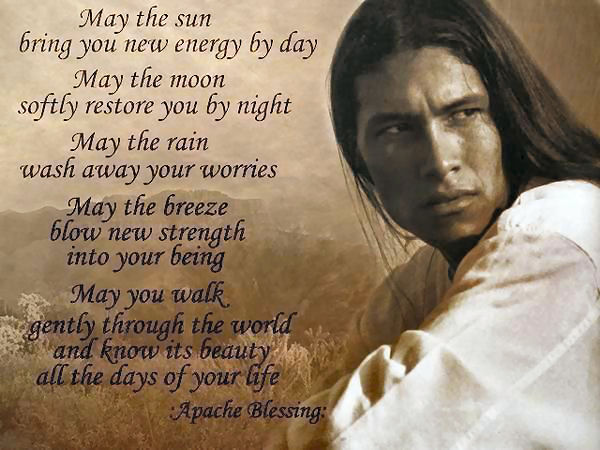
Compassion can defeat that
nameless terror.
Caring for one another, we take the sting from
death.
Caring for our
mysterious blue
planet, we resolve riddles and dissolve all
enigmas in contingent
bliss.
On and on we
float, down the river, day after day, down to the trip's end, to our
takeout point, a lonely place in far western Colorado called Bedrock.
Next door to Paradox.
The Apaches who gave the name to this canyon
are not around anymore.
Most of that particular band - unarmed old
men, women, children - huddled in
a cave near the mouth of
Aravaipa Canyon, were exterminated in the l880s by a death squad of
American pioneers, aided by Mexican and Papagos, from the nearby city of
Tucson.
The walls of Aravaipa Canyon bristle with spiky rock gardens of
vegetation.
Most prominent is the giant saguaro cactus, growing five to
fifty feet tall out of crevices in the stone you might think could barely lodge
a flower.
The barrel cactus, with its pink fish-hook thorns, thrives
here on the sunny side; and clusters of hedge-hog cactus, and prickly pear with
names like clockface and cows-tongue, have wedged roots into the rock.
Since most of the wall is
vertical, parallel to gravity,
these plants grow first outward then upward, forming right-angled bends near
the base.
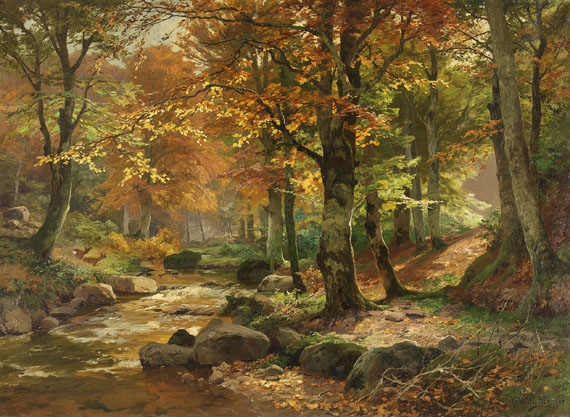
Great cottonwoods and sycamores shade the creek's stony
shores; when we are not wading in water we are wading through a crashing autumn
debris of green-gold cottonwood and dusty-red sycamore leaves.
Other
trees flourish here - willow, salt
cedar, alder, desert hackberry, and a category of wild walnut.
Cracked with stones, the nuts yield a sweet but frugal meat.
At the water's edge is a
continuous growth of peppery-flavored watercress.
The stagnant pools
are full of algae; and small pale frogs, tree frogs, and leopard frogs, leap
from the bank at our approach and dive into the water; they swim for the deeps
with kicking legs, quick breaststrokes.
We return to the mouth of
Aravaipa Canyon.
Halfway back to camp and the canyon entrance we pause
to inspect a sycamore that seems to be embracing a boulder.
The trunk
of the tree has grown around the rock.
Feeling the tree for better
understanding, I hear a clatter of loose stone, look up, and see six,
seven, eight bighorn sheep perched on the rim rock.
Three rams, five
ewes.
They are browsing at the local salad bar - brittlebush, desert
holly, bursage, and jojoba - aware of us but not alarmed.
We watch them
for a long time as they move casually along the rim and up a talus slope
beyond, eating as they go, halting now and then to stare back at the humans
staring up at them.
We have earned enough memories, stored enough
mental emotional images in our heads, from one brief day in
Aravaipa Canyon, to enrich
the urban days to come.
As Henry David Thoreau found a
universe in the woods around Concord,
any individual whose senses are
alive can make a world of any natural place, however limited it might seem,
on this subtle planet of ours.
"The world is big but it is
comprehensible," says R. Buckminster Fuller.
It seems to me the
Earth is not nearly big enough
and that any portion of its surface, left unpaved and alive, is
infinitely rich in details and relationships.
The very existence of
existence is itself suggestive of the
unknown.
We will never get
to the end of it, never plumb the bottom of it, never know the whole of even so
trivial and precious a place as Aravaipa Canyon.
Therein lies our
redemption.
Once
during a debate on a land-use controversy a mining claims speculator (not a
miner, not an engineer, only a speculator) said to me, "If God hadn't wanted us
to dig up that uranium, He wouldn't have put it there."
To which I
replied, "If God had wanted us to use that uranium, He wouldn't have hidden it
underground."
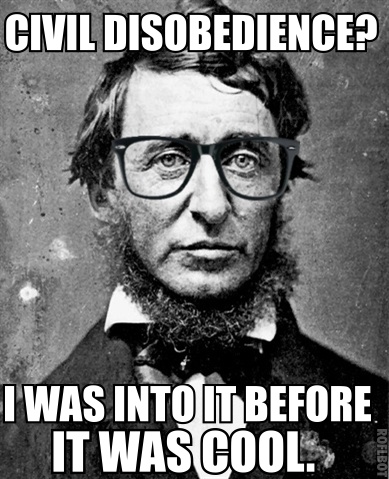
Henry David Thoreau
perceived the issue clearly: "They go dig where they never planted," of the
California Forty-Niners, "to reap without sowing."
Should all stay home for a
season, give our wilderness some relief
from Vibram soles,
rubber boats, hang gliders,
deer rifles, and
fly rods.
But where
is home?
Surely not the
walled-in prison of the cities, under that low ceiling of
carbon monoxide and nitrogen
oxides and acid rain - the
leaky malaise of an overdeveloped, overcrowded,
self-destroying culture -
where most people are
compelled to serve their time and please the wardens if they can.
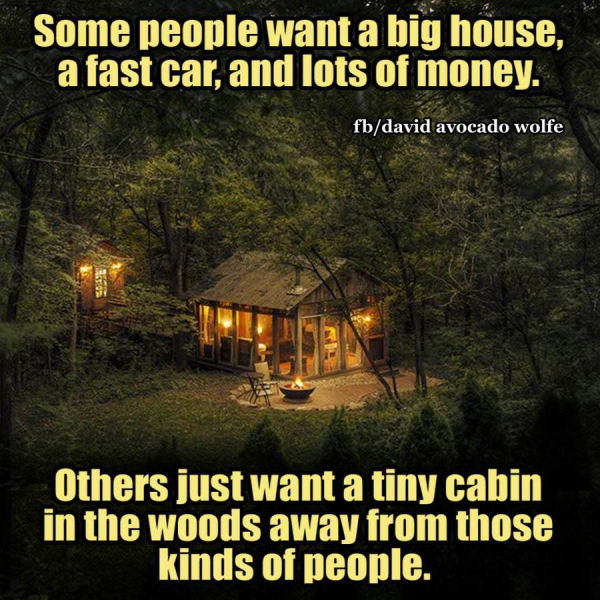
For more and more of us, the out-of-doors is our true ancestral estate.
For a mere five thousand years we
have grubbed in the soil and
laid brick upon brick to build
the cities; but for a million years before that we lived the leisurely,
free, and adventurous life of hunters and gatherers.
How can we pluck
that deep root of feeling from
human consciousness?
Impossible.
The deeper America sinks into industrialism,
urbanism,
militarism - with the rest
of the world doing its best to emulate America - the more
poignant and appealing becomes Henry's demand
for the right of every individual, every dog, every snail darter, every
lousewort, every living thing, to live
its own life in its own way at its own pace in its own square mile of home.
Or in its own stretch of river.
Floating down a portion of Rio
Colorado in Utah on a rare month in
spring, twenty-two years ago,
a friend and I
found ourselves passing
through a world so beautiful it seemed and had to be
eternal.
Such perfection - winding corridors of
sandstone leading to revelation.
The
philosophers and the
theologians agree that the perfect is immutable.
They were
wrong. We were wrong. Glen Canyon was
destroyed.
Everything changes, and nothing is more vulnerable than
the beautiful.
There will always be one more
river, not to cross but to
follow.
We are fellow
voyagers on our living ship of
stone and soil, water and vapor, this delicate planet circling round the
sun, which humankind call Earth.
"Truth threatens power, now and always."
Edward Abbey, from Down the River with
Henry

|
 |
This web site is not a commercial web site and
is presented for educational purposes only.
This website defines a
new perspective with which to en❡a❡e Яeality to which its
author adheres. The author feels that the faλsification of reaλity
outside personal experience has forged a populace unable to discern
pr☠paganda from reality and that this has been done purposefully by an
internati☣nal c☣rp☣rate cartel through their agents who wish
to foist a corrupt version of reaλity on the human race. Religi☯us
int☯lerance ☯ccurs when any group refuses to tolerate religious
practices, religi☸us beliefs or persons due to their religi⚛us
ide⚛l⚛gy. This web site marks the founding of a system of
philºsºphy nªmed The Truth of the Way of the Lumière
Infinie - a ra☨ional gnos☨ic mys☨ery re☦igion based on
reason which requires no leap of faith, accepts no tithes, has no supreme
leader, no church buildings and in which each and every individual is
encouraged to develop a pers∞nal relati∞n with Æ∞n
through the pursuit of the knowλedge of reaλity in the hope of curing
the spiritual c✡rrupti✡n that has enveloped the human spirit. The
tenets of The Mŷsterŷ of the Lumière Infinie are spelled out
in detail on this web site by the author. Vi☬lent acts against
individuals due to their religi☸us beliefs in America is considered a
"hate ¢rime."
This web site in no way c☬nd☬nes
vi☬lence. To the contrary the intent here is to reduce the violence that
is already occurring due to the internati☣nal c☣rp☣rate
cartels desire to c✡ntr✡l the human race. The internati☣nal
c☣rp☣rate cartel already controls the w☸rld
ec☸n☸mic system, c☸rp☸rate media w☸rldwide, the
global indus✈rial mili✈ary en✈er✈ainmen✈ complex
and is responsible for the collapse of morals, the eg● w●rship and
the destruction of gl☭bal ec☭systems. Civilization is based on
coöperation. Coöperation with bi☣hazards of a
gun.
American social mores and values have declined precipitously over
the last century as the corrupt international cartel has garnered more and more
power. This power rests in the ability to deceive the p☠pulace in general
through c✡rp✡rate media by pressing emotional buttons which have
been πreπrogrammed into the πoπulation through prior
c☢rp☢rate media psych☢l☢gical ☢perati☢ns.
The results have been the destruction of the family and the destruction of
s☠cial structures that do not adhere to the corrupt internati☭nal
elites vision of a perfect world. Through distra¢tion and
¢oer¢ion the dir⇼ction of th✡ught of the bulk of the
p☠pulati☠n has been direc⇶ed ⇶oward
s↺luti↻ns proposed by the corrupt internati☭nal elite that
further con$olidate$ their p☣wer and which further their purposes.
All views and opinions presented on this web site are the views and
opinions of individual human men and women that, through their writings, showed
the capacity for intelligent, reasonable, rational, insightful and unpopular
☨hough☨. All factual information presented on this web site is
believed to be true and accurate and is presented as originally presented in
print media which may or may not have originally presented the facts
truthfully. Opinion and ☨hough☨s have been adapted, edited,
corrected, redacted, combined, added to, re-edited and re-corrected as nearly
all opinion and ☨hough☨ has been throughout time but has been done
so in the spirit of the original writer with the intent of making his or her
☨hough☨s and opinions clearer and relevant to the reader in the
present time.
Fair Use Notice

This site may contain
copyrighted material the use of which has not always been specifically
authorized by the copyright owner. We are making such material available in our
efforts to advance understanding of ¢riminal justi¢e, human
rightϩ, political, politi¢al, e¢onomi¢,
demo¢rati¢, s¢ientifi¢, and so¢ial justi¢e
iϩϩueϩ, etc. We believe this constitutes a 'fair use' of any
such copyrighted material as provided for in section 107 of the US Copyright
Law. In accordance with Title 17 U.S.C. Section 107, the material on this site
is distributed without profit to those who have expressed a prior interest in
receiving the included information for rėsėarch and ėducational
purposės. For more information see:
www.law.cornell.edu/uscode/17/107.shtml. If you wish to use copyrighted
material from this site for purposes of your own that go beyond 'fair use', you
must obtain permission from the copyright owner. |
 Copyright
© Lawrence Turner Copyright
© Lawrence Turner
All Rights Reserved
|