|
"Trying to define God the
infinite with the finite human
intellect is like pouring a trillion pounds of sugar into a one-bound bag." -
Akhtar H. Emon |
GOD
supernatural
god
"He formed gods of the most
preposterous and
ridiculous kinds: these became the sole
objects of his
hope, and the creatures of his
fear: he was unhappy, he trembled under
these imaginary deities; under the supposed
influence of imaginary beings
created by himself; under the
terror inspired by blocks of stone; by
logs of wood." - Paul-Henri Thiry, Baron d'Holbach |
a god
a
man or woman of such superior qualities
that he/she appears like a deity to
other humans; "He was a god among
men." "She/he is a goddess/god!!"
"He gave himself up
without enquiry to men like himself, whom his
prejudices induced him to
contemplate as beings of a superior order, as
gods upon
Earth, they profited by his
ignorance, took advantage of his
prejudices,
corrupted him, rendered him
vicious, enslaved him, and made him miserable." -
Paul-Henri Thiry, Baron d'Holbach |
applied figuratively to one
who wields great or despotic
power"We
blame anything that goes wrong not on the gods of the sky but on the gods in Washington."-
Max Boot
godlike
Gods were
originally conceived of as entities which took
the guise of an animal or which
expressed themselves as
natural phenomena.
God's were entities which were
thought to control some incremental part of
nature or reality.
Eventually as
humans realized that all of nature was interconnected these beliefs were
transformed into a
belief of God
taking the form of a pregnant woman,
a Mother Goddess, who embodied the Creation of Life, who
brought prosperity as life to a
culture and who was analagous with the
Earth. The theory
of God as the Mother of life
and every thing else is a
natural concept as any
individual near
nature is
aware the
female is the bearer of life.
Later, as humans filled and overburdened the
ecological niche they had originally settled
in, these theories of the
nature of God were
transformed into one in which
the template for the conceptual
image of God was
based on the alpha male, the head of the
tribe. This conceptual image of
God is clearly intended for a warlike
people who will be blessed by their
God when they are driven by the reining patriarch
to gain control of an adjacent
ecological niche which will allow the further
expansion of the tribe.
As the
nature of God
is not easily described it is easy to
understand that a
conceptual image
of God by necessity would take the
form of familiar
objects that already exerted an
influence over the course of
human existence. Throughout the
evolution of the human conceptual
image of God
humans projected onto God an archetypical
image of power or
force already
existent in their
natural conceptual image of
reality.
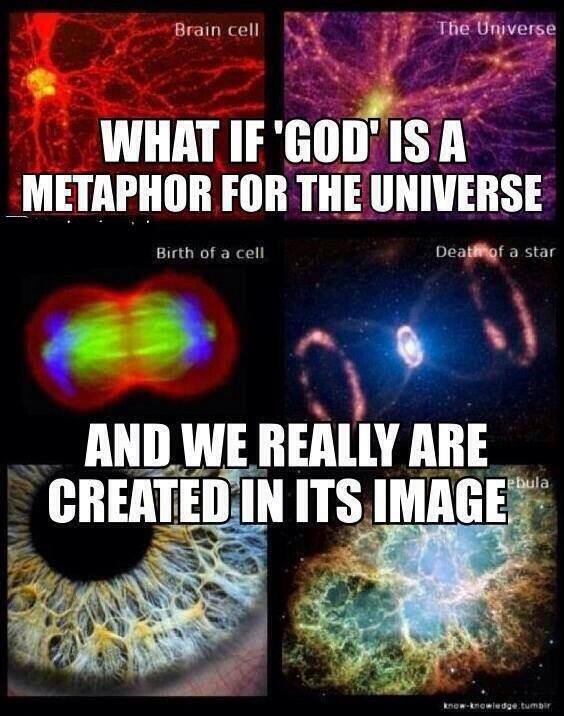
The
Old Testament
story of the Creation clearly states that
man was created in the image
of God but the God of
the Old Testament is clearly
modeled on the patriarch of a tribe.
God has the same emotions as a mortal
man in the
Old Testament and is
judgemental as the patriarch of a
tribe would be by necessity.
Perhaps that Old Testament
story should be rewritten to say "In the beginning,
man not
understanding the
nature of God or the
nature of God's
natural reality on the Earth created the
concept of God in
man's image."
The Hebrew
word jehovah, the only
other word generally employed to denote the supreme
being, is
uniformly printed in small
capitals. The existence of
God is taken for granted in the
Bible.
"God, by
God's very nature,
is always 'in the picture.' In every
picture. If we don't see God in the
picture, it's only our
perception and recognition
of God that have dimmed.
Jesus said "The Kingdom of God is among
you."(Luke 17:20-21)." - Barbara Robinson
"I believe
God lives in reality and cannot be captured in church on
Sunday. It is necessary, at some point, to head out without the
road map church provides in order to
gain firsthand experience of
God, and to test the strength of what you
trust." - Barbara Brown Taylor
|
attributes of
God
If a things exists it is known to exist
in nature.
No
thing is known by mankind to exist outside of
nature'.
If no thing
exists 'outside of nature' then if God
exists then God
must exist
within nature.
If
God is omnipotent and
omnipresent then
God must be everywhere at once.
If
God exists
everywhere at once then God must permeate
nature.
If God permeates nature
then the essence of God is within all
things - every single
thing that
exists.
If God 'acts' within nature, then God must
physically have an extension of
His self in
nature.
If God is all powerful, then God is the Supreme Power
of the universe.
God
existing
within nature,
God
being omnipotent and omnipresent,
God permeating nature,
God
acting within
nature,
God
being all powerful;
then
God, by definition,
must be the
motivating force that
created existence,
must be the
emanating force that continually
renews existence,
must have set the
rules of existence
and grants the
reality of an actual
existence
to each
seperate individual
being
by the exertion of
will, the
will of
God.
GOD ACTS SOLELY BY
THE LAWS OF NATURE.
GOD PERMEATES ALL OF
NATURE, BEING BOTH 'WITHIN' AND 'WITHOUT'.
THE TAKING OF
LIFE IS BLESSED BY GOD
ONLY WHEN THAT LIFE MUST BE TAKEN FOR
SUSTENANCE.
THE TAKING OF
LIFE, BOTH DIRECTLY AND INDIRECTLY, (through
inaction by allowing and accepting hegemonic acts of a
tyrannical nature or destruction of an
ecosystem), IS THE GREATEST SIN THAT CAN BE
COMMITTED.
GOD'S ATTRIBUTES ARE ABSOLUTE.
the
God of Truth
It-Who-Is is ineffable. No
principle knew It, no
authority, no subjection, nor any creature from the
foundation of the world, except
It alone. For It is
immortal and
eternal, having no birth; for
everyone who has birth will perish. It is
unbegotten, having no beginning; for everyone
who has a beginning has an end. No one
rules over It.
It has no name; for
whoever has a name is the
creation of another. It
is unnameable. It has no
human form; for whoever has
human form is the
creation of another. It
has its own semblance - not like the semblance we have received and seen, but a strange semblance
that surpasses all things and is better
than the totalities. It looks to every side and
sees itself from itself. It is
infinite; It is
incomprehensible.
It is ever imperishable and has no likeness to
anything. It is unchanging good. It is faultless.
It is everlasting. It
is blessed. It is unknowable, while It
nonetheless knows itself. It is
immeasurable. It is untraceable.
It is perfect,
having no defect. It is imperishably blessed.
It is called 'Creator of the Universe'.
Now, if anyone wants to
believe the words
set down here, let him go from what is hidden to the end of what is
visible, and this thought will instruct him how
faith in those
things that are not
visible was found in what is
visible.
This is the
principle of knowledge.
Its female aspect is 'First-begotten
Sophia, Mother of the
Universe,' whom some call 'Compassion'. Some call her 'Pistis' (faith).
Its masculine aspect is 'Savior, Begetter of all
Things'.
From the consenting of
those I have just mentioned, thoughts
appeared. From thoughts, reflectings; from
reflectings, considerings; from considerings, rationalities, from rationalities, wills, from wills,
words.
All I have just said to you, I said
in the way that you might accept, until the
one who need not be taught appears among you, and he will speak all these
things to you joyously and in
pure knowledge. - Eugnostos the Blessed
gnosticism and Rome
"It used to be thought absolutely necessary that all the
inhabitants of a country should have the same religion, but we now
know that there is no such necessity." -
Bertrand Russell The near
collapse of the Roman Empire between 235 and 284 was caused by three
simultaneous crises: external invasion, internal civil war, and
economic collapse. The changes in the
institutions,
social culture,
economic life and
religion were so profound and fundamental,
that the "Crisis of the Third Century" is increasingly seen as the watershed
marking the difference between the classical world and the early medieval
world.
Diocletian took control of the
Roman Empire in 284. Diocletian, after watching numerous internal struggles for
power which culminated in civil wars, understood
that most of shifts in the balance of power were
facilitated by soldiers personal allegiance to charismatic commanders which
stemmed from the brotherhood experienced by
soldiers belonging to the secret
fellowship of the mysteries of Mithras. The
worship of Mithras, the emissary of light who
symbolized the dissemination of life-giving
forces in the face of the powers of darkness and disorder fit neatly within the
soldiers calling. The Mithras mysteries
emissary of light was a
life-death-rebirth deity also known as a
"dying-and-rising" or "resurrection" deity, a son of the
God of Creation.
Diocletian recognized that
control had to be based on something more than
simply military force, so he sought imperial legitimacy in a new state
religion, with himself as divine monarch much
as Akhenaten had done 1650 years earlier in
Eygpt. To the Romans, the observance of religious rites was a public duty even
though Roman state religious
beliefs were founded on a chaotic unconnected
inconsistent pagan mythological
tradition, adopted from
Greek models and cross-pollinated with
influences from all the religions of the
regions the imperial Rome Empire had conquered.
Secret societies and mystery brotherhoods were a threat to Diocletian's
power so he aligned himself with the
mysteries of Mithras outlawing all others.
Diocletian declared himself Lord and Master (Dominus Noster) and later equated
himself to the paternal father god of Rome, Rome's Great Father and Savior
(Juppiter Optimus Maximus Soter); the patron deity of the Roman state. By
outlawing the Eleusinian mysteries, and the
Gnostic Christian mysteries and declaring
himself a divine intercessor - a god brought to
life on Earth -
Diocletian hoped to gain social
control through religious unification. By dividing the Roman
Empire into West and East and taking personal control of the East in 292 Diocletian hoped to
retain control of the eastern imperial Roman
territories.
Diocletian in 303 issued a series of four increasingly
harsh decrees designed to compel
Christians to take part in the imperial
religion. Diocletian ordered all
Christian churches to be
destroyed, all Christian books to be burned and
Christians themselves were denied the
protection offered other citizens
by Roman law. Christians were arrested, tortured, mutilated,
burned, starved, and forced into gladiatorial contests in purges until 311.
In 306,
Constantine started a civil war in
the West, which he won in 312. When Constantine won a decisive battle he
needed a great and powerful father god, a
god unrelated to the father
god of Diocletian. Constantine
chose an imperial Christian god, a
god different from the God of
the Gnostics, as his benefactor.
Constantine took the eastern half of
the Roman Empire from Licinius by 324 and ruled the entire Roman Empire until
his death in 337. Constantine
summoned the Council of Nicaea in 325
which defined "Nicene
Christianity," basically Pauline Christianity, as the
Nicene Creed.
Constantine, the first
imperial Christian Emperor, only allowed
himself to be baptized on his death bed in the hope that he would avoid eternal
damnation by being unable to sin after being baptized.
Power was fractured again under Constantine's sons.
Although the throne was intermitently unified under Julian and Valentinian I,
among others.
The last pagan emperor, Julian saw the destruction of
Mediterranean civilization in the
nihilistic forces of imperial Christianity
and attempted to reverse the direction Roman social culture was
headed by repealing the edicts that only Christianity may be practiced.
Imperial Christian Emperor Valentinian I found
it hard to govern the entire Roman Empire so he gave his brother, Valens,
control of the East.
Imperial Christian Emperor Valens ordered
the governor of Minor Asia to exterminate all the Hellenes and all documents of
their wisdom. In Antioch, among many other
Hellenes, the ex-governor Fidustius and the priests Hilarius and Patricius were
executed. Tons of books are burnt in the squares of the cities of the Eastern
Empire. All the associates of last pagan emperor Julian were persecuted
(Orebasius, Sallustius, Pegasius etc.), the philosopher Simonides was burned alive and the
philosopher Maximus was
decapitated.
The last man to attempt
unification and succeed was imperial
Christian Emperor Theodosius I.
Upon Emperor Theodosius I death in 395
the division between the East and West became permanent.
In another attempt to unify the social culture of
the Roman Empire through religious conformity
imperial Roman Catholic
Emperor Theodosius I commissioned
Pope Damasus I and the
Council of Rome, which took place in
382, to name the Hebrew books
and the books about Jesus that
were to be included in the Latin
Vulgate. Saint Jerome translated
the Greek into Latin. Imperial Roman
Catholic intolerance of other belief
systems was crucial to its own success and
necessary in the eyes of Emperor
Theodosius I and Pope Damasus I
who continued to systematically eradicate practioners of any other
religion than the
state religion as their recent
imperial Christian predecessors had done.
All other religions, except
Judaism, are condemned and practioners are executed.
Imperial Christian priests lead a mob against
the Temple of Goddess Demeter in Eleusis and attempted to execute the
hierophants Nestorius and Priskus. The 95 years old hierophant Nestorius ends
the Eleusinian mysteries and announces the
predominance of spiritual
darkness over the human
race.
In Constantinople, the Temple of Goddess Aphrodite is turned
into a brothel and the Temples of Sun and Artemis into stables.
The
mysteries of Samothrace are ended and the
priests slaughtered.
Maternus
Cynegius scours the East sacking and destroying hundreds of Hellenic Temples,
shrines and altars. Among others they destroy the Temple of Edessa, the Cabeireion
of Imbros, the Temple of Zeus in Apamea, temple of the Semitic Moon-god Sin at
the citadel of Carrhae on the Persian border, the Temple of Apollo in Dydima
and all the Temples of Palmyra.
All pagan temples, including all
Mithraeum, are destroyed.
The
philosopher Olympius leads a revolt in
Alexandria. In response imperial Roman
Catholics demolish the Temple of God Serapis (The Serapeion) which is
believed to have housed many books of the
Library of Alexandria.
Any other nonconforming sacred scrolls and books
are burned.
Private ownership of pagan sculpture is outlawed.
Hypatia of Alexandria is stripped naked and dragged through
the streets by an Imperial Christian mob,
flayed with ostrakois and set ablaze while still alive. A Neoplatonist
philosopher, she followed the school
characterized by the 3rd century Plotinus discouraging
mysticism while encouraging
logical and mathematical studies. Hailed as a
"valiant defender of science in the face of
the religious postulates," some suggest that
her murder marked the end of the Hellenistic Age of Reason.
The Gnostic
Christian sanctuary on the Euphrates is burned.
Gnostic Christian
belief systems are condemned and outlawed.
Gnostic Christian
mysteries, Mithras mysteries, Eleusinian mysteries and all other
mystery cults are banned
forever.
Gnostic Christians believe that
God - the true, ultimate and transcendent God; It who is beyond all
created universes - emanated or
brought forth from within Itself all
substance, visible and invisible.
It's emantions permeate
reality. All things share
It in common.
This was anathema to the
imperial Roman Catholic
dogma of Emperor
Theodosius I because the imperial Roman
Catholic dogma taught that man had been
seperated from God in the
Garden of Eden. Seperation from God always renews
power of state
religious institutions as the common man must now go
through an intercessor - an
intercessor serving in an official
government religious position.
Gnostic
Christians believed that each and every
human could
experience God personally
which of course leads to no need for intercessors. And without
intercessors there is really no
need for an institutionalized
Imperial Roman Catholic
religion.
Like most
religions
gnosticism is commonly
misunderstood and misdefined by modern imperial
Christians theologians (imperial Christians put out
false information - they always have and always will.
The imperial Roman Catholic's coined the
word propaganda.)
All
religions theologians look at all
other religions through the prism of their own
religion.
When this occurs ancient
religions are seen as a spectrum of
separate colors because modern
theologians do not have the ability to see' the religion
as the religions adherents at the
time saw it, as a pure white light,
not through a prism.
Gnosticism is reserved for groups that
might have used it to describe themselves, but often the term is used more
widely to identify groups emphasizing the
self-redemptive benefit of
individual wisdom. Gnostics Christians
believed that God was
found through knowledge - knowledge gained through the observation of
the experiences of living.
If you
want no questions asked, if you demand blind
obedience and
blind
faith, then knowledge is not something that you want
your flock to have.
Knowledge breeds
critical thinking and
critical thinking reveals
the falsities that have been presented as
truth.
And that is why any scholar that
attempted to translate the Bible and
bring it to the common man was condemned,
excommunicated and occasionally
burned at the stake by the
imperial Christian Inquistion.
Martin Luther was
excommunicated by Leo X on January 3,
1521. Martin Luther's translation of the
New Testament was published in
German in September 1522.
In 1526 a full edition of the
New Testament was translated
into English by William Tyndale.
William Tyndale was tried on a charge of
heresy in 1536 and condemned to be burned at the stake.
William Tyndale was strangled and his dead body
burnt on October 6, 1536.
The Roman
Catholic heirarchy has understood, since imperial Christian
Emperor Theodosius I set an example,
that the only way to retain control of the
social culture
is to outlaw any concept or
idea that does not fit within the express
dogma as defined by
Pope Damasus I and the
Council of Rome in
382.
This mindset led in fact to the Dark Ages in
Europe which basically occurred because the imperial Christian Emperors in search of
power and control
ordered most of the knowledge accumulated by
all the ancient cultures surrounding the
Mediterranean destroyed in the
quest to create a uniform conforming
social culture.
One detail that helps show the severity of the amount of scientific and
technological information that was lost in the purge of
knowledge by the
Roman Catholics: The
secret of concrete was lost for 13
centuries until rediscovered in 1756 by John Smeaton.
The term
gnosis is a Greek
word expressing a type of
understanding,
intuitive consciousness, gained through personal
experience. It is a type of
transcendent
experience that followers of gnostic belief systems use to seek escape from
ignorance.
proof of GodThe arguments generally adduced by
theologians in proof of the being of God
are:
The a priori argument, which is the testimony afforded by
reason.
The a posteriori argument, by
which we proceed logically from the facts of experience to causes.
These
arguments are:
The cosmological, by which it is proved that there must
be a First Cause of all
objects, for every effect must have a cause.
The teleological, or the argument from design. We
see everywhere the operations of an Intelligent
Cause in nature.
The
moral argument, called also the anthropological
argument, based on the moral consciousness and the
history of mankind, which exhibits a
moral order and purpose which can be explained on the
supposition of the existence of
God.
Conscience and
human history testify that "verily there is a
God that judgeth
on the Earth."
the question of
God is simply one of a definition of terms.
When people use the term God' they
use metaphorical examples, a necessity, in the
attempt to convey the abstract
concept of God', the transcendent
eternal
infinite
omniscient omnipresent
conscious spark that permeates all of
nature.
The terms
God and nature are
interchangeable in the abstract
conceptualized thinking of an individuals
subconscious thoughts.
People that
conceptualize nature as evil,
worship a God' that resides outside of
nature'.
People that
conceptualize nature as evil do so
because they have been taught to fear
nature.
This is the main method to
distinguish between a false teacher
and a teacher of
truth. If a religious figure claims an act of
nature as God's
retribution then those individuals are in truth
worshiping not the God of compassion, of light
and of creation but the
god of
delusion,
deception and
despair who damns your
corrupt soul to
hell on Earth here
and now.
People who are distant from their
subconscious will fight
intuitive
understanding contrary to
their belief system and will further
wall themselves off from
reality.
Nature has a
structural patterned order which makes it possible for
humans to accurately predict future
conditions. Nature has provided
mankind in this age a very wide
understanding of the inner
workings of natural
processes.
Natural processes, from the formation of
suns down to the transfer of
electrons through a copper wire are
natural processes that have a life independent of, yet intimately
interconnected, with all
other
processes.
These
natural processes are not static.
These
natural processes are always in flux, in motion.
Seen independently each of
these natural
processes is understandable and each
follows certain conditions, called the laws of
nature. Seen together these natural
processes of nature create a
exceedingly complex interplay of natural
processes that propels further
natural processes.
Mankind has attempted to quantify and
qualify, in the normal categorization processes of the
human mind, all aspects of nature.
Pattern
recognition in nature from the earliest days of
mankind allowed men to predict future
occurrence based on current observation.
All
civilizations had some method of
calculating the advent of seasonal changes from observation of celestial
phenomenon.
Natural patterns recognized in
nature would be seen as having a
force behind them that created' the natural pattern.
This gave rise to
local deities that
controlled the local
forces of nature.
Major
religion has been caught in the trap of
literalist explanations, explanations
that were meant for children not for adults.
|
|
back to stacks
contents
 |
This web site is not a commercial web site and
is presented for educational purposes only.
Disclaimer: All views and opinions
presented on this web site are the views and opinions of
individual human men and women
that, through their writings, showed the capacity for intelligent, reasonable,
rational, insightful and unpopular thought. All factual information presented
on this web site is believed to be true and accurate and is presented as
originally presented in print media which may or may not have originally
presented the facts truthfully. Opinion and thoughts have been adapted, edited,
corrected, redacted, combined, added to, re-edited and re-corrected as nearly
all opinion and thought has been throughout time but has been done so in the
spirit of the original writer with the intent of making his or her thoughts and
opinions clearer and relevant to the reader in the present time.
Fair Use Notice

This site may contain copyrighted material the use of which has
not always been specifically authorized by the copyright owner. We are making
such material available in our efforts to advance understanding of criminal
justice, human rights, political, economic, democratic, scientific, and social
justice issues, etc. We believe this constitutes a 'fair use' of any such
copyrighted material as provided for in section 107 of the United States
Copyright Law. In accordance with Title 17 U.S.C. Section 107, the material on
this site is distributed without profit to those who have
expressed a prior interest in receiving
the included information for research and educational purposes. For more
information see: www.law.cornell.edu/uscode/17/107.shtml. If you wish to use
copyrighted material from this site for purposes of your own that go beyond
'fair use', you must obtain permission from the copyright owner. |

Copyright
© Lawrence Turner All Rights Reserved |