|
Terrorist
attacks
create terror
because from the victim's
perspective there is no easily
identifiable enemy, no sovereign state to
bombard or invade, no
territory to conquer, no easily
identifiable specific force to overwhelm
and no clear
strategic objective to attain.
In response to the attack on September 11, 2001
America invaded
Afghanistan to dispossess the Taliban and to capture
Osama bin Laden.
An
identifiable enemy
army, a sovereign state to
bombard and invade, a
territory to conquer, and a
clear objective.
Although
America
shocked and
awed the Afgani's and later the
Iraqi's they
failed to realize
that besides fighting a physical
enemy (insurgents,
terrorists, gorilla
fighters,
rebels,
revolutionaries,
tribal elements, et al) they are fighting a deeply set
tribal religious way of knowing.
This may be the very first
conflict to be fought over
epistemology.
Epistemology is the branch of
science and
philosophy that concerns
knowledge, specifically,
how we know what we know.
There are
many 'ways of knowing,' but the religious historian
Karen Armstrong, in her study
of religious fundamentalism, The
Battle for God,
identified two primary systems of
knowledge that have special relevance for the
current conflict.
Karen Armstrong called one 'mythos.' With its roots in ancient
time when gods, heroes and
other fanciful forces provided the
answers for the
questions of existence.
Mythos relies on intuition,
superstition,
emotion, traditional non-rational 'ways of knowing'.
Mythos embodies a form of mental artistry which
symbolically and aesthetically resonates with an
individual's past
conscious experiences of personal
enlightenment.
The
other system is 'logos.' As the name implies, logos relies on reason and logic,
on what we call
rational ways of knowing, a
form of
science.
The
battle on Earth is evolving into a battle
between mythos and
logos.
The Taliban and their Islamic
literalist allies
live
within mythos and have subordinated themselves to mythos.
They see themselves
not as individuals with desires,
which is a relatively modern notion, but as
operatives of Allah. They strive for 'immortality' in
the tales,
legends and eventually
myths, of their
tribal 'group'.
For them,
everything is
glorious
legend, everything is based on a
religious faith in tradition.
In
fact they do not acknowledge any
other legitimate way
of conceptualizing the
reality of life on
Earth.
The Taliban
and their Islamic literalist allies are essentially pre-modern
and a-historical, believing only in what
has been passed down to them by their religious teachers.
In the
madrasas, the Islamic religious
schools in Pakistan and
Afghanistan, students are strictly forbidden from
learning anything except the
Koran. Taught as a
literal text,
without an
understanding of
metaphor, symbolic archetypes and socio-cultural
bias, the Koran presents a
corrupted mythos.
When neo-con
zealots talked about bombing Afghanistan back to
the Stone Age, it is futile not only because the Taliban
are already there physically(opium resurgance) but because they are also there
epistemologically.
The
spiritual and the rational can exist together in society, they do in every
society, but literalists do not see it that way. As pre-modernists, they believe the two worldviews are mutually exclusive
and must remain so. Their grievance is that their
way of thinking is being destroyed by the inundation of Western
materialistic
influences, which
globalization has made nearly
impossible to escape.
Literalists of Christianity, Judaism and Islam
do not want reason, critical
thinking or
intellectual pursuits to
challenge tradition; they demand
blind faith and
obedience to
tradition.
Religious literalists do not want their
culture radically modified by the purveyors of
materialistic consumerism
which worships only Mammon.
Religious literalists demand
obedience to
traditional modes of thought as
prescribed by previous religious literalists.
Since religious literalists are
unwilling to acknowledge any way of
living
other than their
traditionally prescribed
way and since they do not
believe in
tolerance, personal choice or
persuasion, all of which are secular rationalist notions, their only option is to
eradicate the purveyors of logos before
logos eradicates their
mythos.
Religious literalists are attempting to turn back
the clock to a time when
reason was not and
superstition prevailed.
America is entangled in this struggle because
of American combat troops stationed in Islamic countries.
America has been called the "Great Satan" because
America is the symbol of a corrupt
logos -
materialistic consumerism -
the worship of Mammon.
America has attracted
students from everwhere on
Earth, including Islamic countries.
When those students return they bring back
with them American
popular culture steeped in the worship of
Mammon.
Butrus Elias, a
communications major at the
University of Cairo, admits to being a
democracy advocate. Butrus Elias owns the DVD of
the movie Forrest Gump. Butrus
Elias favorite scenes are the surreal handshakes between Forrest Gump, played by
Tom Hanks, and an assortment of
smiling American presidents who are juxtaposed
with evidence of their political
dark sides.
"Forrest Gump
helped me understand that my country's leaders are not in accord with
reality. I saw in the
movie Forrest Gump how a
politician would
behave dishonestly just to
influence the
society around him, and I identified with the
simple character who could be so easily manipulated by falsehood.
It helped me to look at my own country and see
our leadership through a similar lens."-
Butrus Elias
Religious literalists would
prefer it if the population
remained passive and did not employ the halo of
critical thinking.
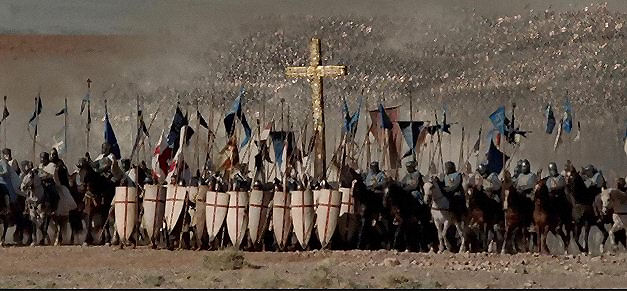
In 1095, Pope Urban II lauched the
First Crusade
knowing that the Great Seljuk empire had
dissolved with infighting and therefore the balance of
power in the Central Asia was overturned.
After Ghengis Khan conquered most of Asia there was
religious discord as Mongols were
shamanists acknowledged the
existence of one God, but also venerating forces of
nature, the sun, moon, Earth, and water.
In response to the the Crusades and the Mongol
invasion Islam turned from the
path of
enlightenment towards
religious zealotry much as Christianity had done 700 years earlier.
The
path of religious zealotry creates
cultural stagnation as
thought outside
traditional
patterns was and still is forbidden. The
stagnation in Islam mirrors the stagnation that occured in the
Christian countries of the dissolved
Roman Empire during the time that was properly
titled the Dark Ages. The stagnation of which was
only broken in the Christian countries of the
West by renewed contact with the
East.
"If
Allah's grace and
mercy are present, then surely one
reforms, otherwise, the person just wanders around in the desert of
knowledge and intellectualism. After studying the
educational history of the Earth, this point becomes very clear that all the
mischief and chaos that were
created, were all at the
hands of
intellectuals and geniuses.
During the period of Ilm (knowledge) a
greater portion of Fitna (mischief) appeared by
the way of Ilm. Even among the Ulama-e-Haqq, many geniuses due to their sharp
intelligence and accentricity became
victims of their wrong
thoughts and ideas." - Moulana Muhammad Yusuf
Binnori
The Taliban and their
Islamic literalist allies are still
fighting the proclamation of
Pope Urban in 1095 stating, "Christians, hasten to help your
brothers in the East, for they are being
attacked. Arm for the rescue of Jerusalem under your
captain, Jesus. Wear his
cross as your badge! If you are
killed your sins will
be pardoned."
Pope Urban's 'request' to
European Christianity is a perfect example of
imperial Christianity. This
myth of saving the Byzantine empire was made with
the intent of stopping the internecine warfare among knights of the feudalistic
European social culture which cut into the tithes made to the
Holy Roman Catholic Empire as well as taking
advantage of divisions in the
East.
Osama bin Laden
understands the application of myth well and has
used myth to rally literalist Islamic
religious zealots.
Islamic religious
literalists have been
fighting Talmudic
thought and power for almost a millineum.
The
reality of American political opinion
of foreign relations depends on a cold
calculation of the interests of
American Zionists who
control American exports and imports.
Islamic religious
literalists see
that America supports
corrupt regimes
that suppress
religious literalist's as threats to the corrupt regimes
existence and believe this involvement to be for
American Zionists own narrow and
selfish needs.
Islamic
literalists insist that
Islamic governments be based on the Sharia, or Islamic law. Sharia, Shari-'ah,
Shari'a,
Shariah or
Syariah is the Arabic
word for Islamic
law, also known
as the Law of Allah. Islam classically draws no distinction between
religious, and secular
life. Sharia covers not only
religious rituals, but many aspects of
day-to-day
life, politics,
economics, banking, business or contract
law, and social
issues much in the same way that the
Torah does. As a matter of fact the real
reason that that Zionists oppose Sharia is that contracts can be found
null and void if deception has occurred
whereas in Talmudism
deception in contracting for
self-enrichment at the expense of
others, especially contracts made with goy, is looked upon as the ultimate
success.
To the
devout religious literalists -
Talmudist,
Islamist or Christian - the most abhorrent effects of
rationality has been the growing
secularism, that has
separated religion from popular social culture throughout
most of the social cultures of Earth.
The
American system of government, born of
reason with the hope of
freedom and liberty for all men, is under
assault from
American Zionists,
imperial Christians and the
false prophets of (neo)evangilism.
Literalists mistakenly
believe that America, through its economic, intellectual and
military might, is the
logos, or reason, capital of the Earth, not realizing that America is run on a
Talmudic worldview of strict laws.
It was the ability of
Osama bin Laden to tap into
the epistemological
nature of Islamic literalist
myth that frightend
American Zionists.
When one is
fighting for territory the terms of
battle are relatively
clear.
In this new
conflict, literalist zealots
have many targets, virtually anything
and everything that does not fit within the literalist worldview, but
American Zionists,
imperial Christians and the
false prophets of (neo)evangilism, have no
military targets to hit.
The
enemy is not easily identifiable.
The
enemy could be the guy next door. (He could
very well harbor heretical
thoughts.)
The
enemy is a non-conforming
way of thinking.
This new
enemy of
critical thought, of
reason, of logos is mythos,
an intuitive
way of knowing different from
rational thought based on
interpretations of
myths by religious literalist zealots.
To the
rational mind major terrorist acts make no
sense as rational minds
have been conditioned to accept only
materialistic reasons for
destructive action. Major
terrorist acts falsely appear to not have a
materialistic
goal, such as
conquering territory for example, and
falsely seem to be commited simply out of malice or
spite when in fact they are committed for the very same purpose all acts of
terror have been committed - to sow fear terror.
The
George W. Bush administration claimed to
believe that a major terrorist attack on American soil
would never occur. (Which seems a little disingenious considering the World
Trade Center had already been bombed once.)
The
terrorists may destroy logos but not in the manner that
rational minds are likely to concieve of. The terrorists are more likely to
destroy logos if, in response to the threat,
Americans
embrace their our own
historic mythos, a mythos closely
aligned with the mythos of
American Zionists,
imperial Christians and the
false prophets of
(neo)evangilism.
"Western
civilization is supposed to be based on
free and rational thought. Closed-minded
fundamentalism of any sort,
whether denying empirical scientific evidence or blowing up
abortion clinics, seems more akin to the ancient,
mindless ways of the Middle East than the
civilization that brought you
Thomas Jefferson,
Benjamin Franklin and the
Enlightenment." - Dirik
Lolkus
Islamic fundamentalism, in the form of Mawdudi and
the Jamaat-e-Islami, have existed in Pakistan
for over a half century. Recent events have increased the fortunes of
Islamic fundamentalism.
The
Iranian revolution, in which
the Shah was deposed, elevated the
Shiite
religious leader Ayatollah Khomeini to the center of
power. The Shah had come back to
power after the democratically elected
government of
Iran was dispossessed with the
help of the Central Intelligence
Agency.
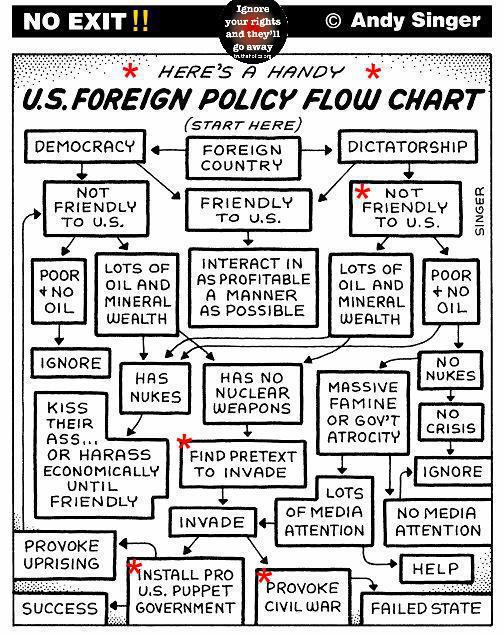
US Foreign
Policy Towards Iran
The civil war
in Afghanistan, fought between
Islamic literalists and the United
Soviet Socialist Republic, proved to Islamic literalists
that they could gain control of a country by
evicting a world superpower. The civil war in Afghanistan was
the straw that broke the camel's back' of the United Soviet Socialist Republic(not Ronald Reagan's
'Starwars' program and accompanying military buildup).
Islamic
literalists were recruited to
fight in this holy' war or
jihad, struggle, from all over the Islamic
world. When the civil war ended there existed tens of thousands trained professional
guerrilla
fighters who subscribed to
Islamic literalist belief
systems and who had
successfully caused the withdrawal of a
superpower from Afghanistan. They became known as the Taliban.
The house of Saud had been powerful on the Arabian pennisula ever since the
eighteenth century, when the radical cleric Muhammad ibn Abdul Wahhab, the
founder of the puritanical Wahhabi
movement, wandered into Dar'iya, near present-day Riyadh, and made a bargain with its
ruler, Muhammad ibn Saud. The Saud
family would provide the generals, and the
Wahhabi's would provide the foot
soldiers.
In Saudi Arabia
wahhabism has been on the rise due
to a deal that the house of Saud cut with Islamic literalist
religious leaders. Islamic
literalist religious leaders promised not to speak out against the
opulent and ostentatious life style of the
royal family members of the house of Saud if they were
given funds to run their
Wahhabi Islamic literalist
schools.
Popular imams all over Saudi
Arabia have called openly for a jihad against the West. Two out of every three
Ph.D.s earned in Saudi Arabia are in Islamic
studies. Fifteen of the nineteen hijackers on September 11 were Saudis.
Until September 11, Saudis were not even required to appear at the
American embassy in Riyadh or the consulate in
Jidda for a visa interview. Under a system
called Visa Express a Saudi had only to send his passport, an application, and
the application fee to a travel agent.
All of the
wealth of the house of Saud comes from
oil sales, much of that
oil is and was sold to
America. Much of the Saudi
money was funneled into Pakistan to
support religious literalist schools in Pakistan. In 1997 Abdul Aziz, a
youngest of King Fahd's children, coordinated a $100 million aid package for
the Taliban.
Even after the 1998 attacks on the
American embassies in
Kenya and Tanzania, which
were organized by Osama bin
Laden from his bases in Afghanistan, the Saudi
royals continued to aid the
Taliban and its main supporter in the region,
Pakistan.
The Pakistanis were directly involved with the civil
war in Afghanistan
as money, supplied by the
American government through the
Central Intelligence Agency, was
funneled through the Pakistani Intelligence Service to provide
arms and ammunition to professional
guerrilla
fighters,
Osama bin Laden for one, that
were fighting the United Soviet Socialist Republic supported
marxist government of Afghanistan.
It is ironic that
America, directly and indirectly, supported
the rise of Islamic
fundamentalism -
wahhabism. Directly by supporting
the Taliban in the civil war in Afghanistan,
the despotic governments of Saudi
Arabia, Egypt, Morocco, Jordan and the military
government of Pakistan. Indirectly by
purchasing oil from the house of
Saud.
history
of conflict in
AfghanistanAfghanistan is populated with a mosaic of ethnic groups
who have subscribed to a variety of religions.
Afghanistan, an ancient focal point of trade and migration,
exists at the junction of the crossroads
between the East and West. Afghanistan has suffered an almost continuous
conflict being repeatedly
invaded throughout recorded
history.
Afghanistan's first
known invasion was by the Medians. The Medians came
from the region south of the Caspian Sea and controlled Afghanistan in the 6th century BC.
Next the Persians invaded during
the reign of the Zoroastrian Darius I
creating the Achaemenid Persian
empire which reached to the Indus river.
The Scythian empire reached its
greatest extent in the 4th century BC during the reign of Ateas and included
Bactria (present-day Balkh).
Following the
defeat of the Achaemenid Persian
empire, in 328 BC, the Greek
Alexander the Great entered the
territory of present-day Afghanistan to
capture Bactria and finally
conquered a region reaching to the Indus
river.
When Alexander the
Great's empire crumbled along came the
ruthless Indian Hindu warrior and
general Ashoka the Great who reigned from 273 BC to 232 BC as the emperor of
the Mauryan empire. The brutality of the
conquests led Ashoka the Great later in
life to adopt
Buddhism under the guidance of the
Brahmin Buddhist sages Radhaswami and
Manjushris.
The Bactrian Hellenistic Greek king Euthydemus and his son
Demetrius crossed the Hindu Kush and began the conquests of Northern Afghanistan and the
Indus valley creating the Indo-Greek
empire at the turn of the 2nd century BC.
Bactria had been populated with deported unreliable Greek colonists by the
Persian kings of the past.
The Kushan empire wrestled control of the area from the Bactrian's including
the Kabul valley, part of Qandahar and established the twin capitals near
present-day Kabul and Peshawar then
known as Kapisa and Pushklavati respectively.
The Kushans adopted elements of the Hellenistic
culture of Bactria including a writing
system that used the Greek alphabet. During
the Kushana empire
rule, Afghanistan and Gandhara became major
centers of culture and learning.
White
Huns, the Hephthalite empire, were an
agricultural people with a developed
set of laws. They displaced the Kushan and
conquered Sogdiana and Khorasan before 425.
They crossed the Syr Darya (Jaxartes) River and invaded Persia in 425. Held off
at first by Bahram Gur, they later succeeded in
making Persia a tributary in 485. After a series of wars they were driven out of Persia, permanently
lost the offensive, and were finally defeated by Khosru I in 557 . The White Huns
also invaded India and
succeeded in extending the
empire to include the Ganges river valley.
The Göktürks or Kök-Türks were
a Turkic people of ancient North and Central Asia, Eastern Europe and
northwestern China. Known in medieval Chinese
sources as Tujue, the Göktürks under the
leadership of Bumin/Tuman Khan/Khaghan and
his sons, established the first known Turkic
empire around 552 in the general area of
territory that had earlier been occupied
by the White Huns, and expanded rapidly to rule wide territories in Central Asia.
The Göktürks originated from the Ashina tribe, an Altaic
people who lived in the northern corner
of the area presently called the Xinjiang Uyghur Autonomus Region of China.
They were the first Turkic tribe to use the name "Türk" as a
political name.
The Sassanid
empire, Sassanian
empire, second Persian
empire, the fourth Iranian dynasty, and
other powers ruled the
rest of Afghanistan before the Arab Muslims invaded the entire region and introduced
Islam in 642.
The Sassanid
empire's territory encompassed all of
today's Iran,
Iraq, Armenia, Afghanistan, eastern
parts of Turkey, and parts of Syria, Pakistan, Caucasia, Central Asia and
Arabia.
Afghanistan, like all the others conquered by the Arab
Muslims, had local
rulers including the
empire of Tang China, which had extended its
influence all the way to Kabul.
The Samanids, who reigned from 875-999, founded a reemerging Persian
empire in Central Asia and eastern Iran,
named after its founder Saman Khoda. It was among the first native Iranian
dynasties in Iran and Central Asia after the Arab
conquest and the collapse of the Sassanid
Persian empire.
The Persian Samanids
empire, continued to
rule eastern Afghanistan from the mid-7th
century until they were conquered by the
Turkic invasions of Mahmud of Ghazni and,
Harun, Bughra Khan.
In 999, Bughra Khan, grandson of the paramount
tribal chief of the Turk Karluk empire,
occupied Bukhara, the capital of the
Persian Samanids empire. The Samanid domains
were split up between the Ghaznavids, who gained Khorasan and Afghanistan, and
the Karakhanids, who received Transoxania; the Oxus River thus became the
boundary between the two rival empires.
During this period the Karakhanid, Kara-Khanid Khanate, were converted to
Islam.
Mahmud of Ghazni, founder
of the Ghaznavid empire, a
Sunni Muslim state in
Khorasan in modern day Afghanistan that
existed from 962 to 1187, consolidated the conquests of his predecessors and
turned Ghazna, Ghazni, into a great cultural
center as well as a base for frequent forays into India.
Khwarezm was a
province of the Ghaznavid Empire from 992 to 1041.
In 1041 the Seljuk
Turks gained control of Khwarezm.
The
Seljuk Turks were a Muslim dynasty of originally Oghuz Turkic descent that
ruled parts of Central Asia and the Middle
East. The Seljuk Turks power was at it's zenith
under Malik Shah until 1092 when the Great Seljuk
empire stretched from Anatolia to
Pakistan.
When Malik Shah I died in 1092 the Great Seljuk
empire split, as his
brother and four sons quarrelled over the
apportioning of the empire among themselves
thus becoming the target of the
First Crusade.
In 1041 Muhammad
'Ayn ad-Dawlah took over the administration of the western branch of the
Kara-Khanid Khanate, centred at Bukhara. The unity of the Karakhanid
empire was fractured by constant internal
warfare and later served the dual suzerainty of both the Kara-Khitan
empire to the north and the Seljuk
empire to the south.
The Khitan
empire, Kara-Khitan Khanate, 1124-1218 was
founded by Yelü Dashi, who led the remnants of the Liao dynasty to Central
Asia after fleeing from the Jurchen conquest of their homeland in Manchuria. In
1141, the Seljuk Sultan Ahmed Sanjar was defeated by the Kara-Khitan Khanate and the
Great Seljuk empire fell into
chaos. Anu-sh Tigin's grandson Ala
ad-Din Aziz was forced to submit as a vassal to the Khitan
empire as was the the Kara-Khanid Khanate.
The Khwarezms expanded their territories south when the Great Slejuk
empire collapsed in 1141.
Uthman,
reigned 120411, briefly reestablished the independence of the Karakhanids
empire, but in 1211 the Karakhanids were
defeated by the Khwarezm-Shah 'Ala'
ad-Din Muhammad and the dynasty was extinguished. The Ghaznavid
empire was defeated in 1146 by the Muhammad of Ghor,
who founded the Ghurid empire. The Ghaznavid
Khans continued to live in Ghazni as the
'Nasher' until the early 20th century, but they did not regain any
power until 1709 when the Ghilzai Pashtuns's
defeated the Safavid Persians in
Kandahar.
The Ghurid Empire, between 1175 and 1192, under the
leadership of Muhammad of Ghor, stretched
over a vast area including parts of Iran, Afghanistan, Pakistan, India,
Turkistan, Iraq and parts of
other Arab countries. Muhammad of
Ghor occupied Uch, Multan, Peshawar,
Lahore, and Delhi.
In 1206, one of the Ghurid generals, Qutb-ud-din
Aybak, the conqueror of Delhi, made himself
independent and founded the first of a succession of dynasties collectively
known as the Delhi Sultanate which lasted
from 1206-1526.
In 1194, the last Sultan of Great Seljuk
empire, was
defeated and killed by the Khwarezm ruler Ala ad-Din Tekish.
In 1200, Ala
ad-Din Tekish died and was succeeded by his
son, Ala ad-Din Muhammad, who by 1205 had conquered all of Great Seljuk
empire and declared himself Shah , Persian
for king, he became known as the Kwarezmshah,
the ruler of the
empire of Khwarezm.
In 1212 Ala
ad-Din Muhammad defeated the Ghurid
empire and conquered the lands of the Kutluk, the
Gur-Khan of the Kara-Khitan Khanate, expanding the
empire of Khwarezm, ruling a territory from
the Syr Darya nearly to Baghdad, and from the Indus River to the Caspian Sea.
The empire of Khwarezm
conquered and ended both the
empires of Khitan and of Ghurid. This
continuous warfare between these empires drained the life from them making them vulnerable to
hostilities.
The Mongol
Genghis Khan
invaded Afghanistan in 1219 slaughtering
the resisters, salting fertile agricultural areas and
destroying many cities including Herat,
Ghazni, and Balkh.
"The Mongols took no
prisoners and allowed no
torture. They executed swiftly and
efficiently, including all the soldiers of
the defeated army who, they
believed, would be a constant source of future
problems if allowed to live. The first
several months of a Mongol invasion were
bloody, but once the takeover ended, the bloodshed ended." - Jack
Weatherford
To enhance the heinous legends of his conquests
Genghis Khan left
mountains of the skulls of the defenders of
those cities that would not submit throughout Central
Asia.
Following Genghis
Khan's death in 1227, a succession of petty chiefs and princes struggled
for supremacy until late in the 14th century, when one of his descendants,
Timur Lang, Tamerlane or Tamburlaine, incorporated what is
today Afghanistan into his own vast Asian
Timurid empire.
At this time there
were two factions of the ruling
class;
the Tajik, men of the pen,
wazirs in Persian, of Persian descent,
chancellors, merchants, artists and scholars.
the warriors, men of the
sword, a combination of Turk and Mongol descent.
Prince Babur, a
descendant of Timur Lang or Tamerlane, established the Moghul
empire in 1526 by
defeating Ibrahim Lodi, the last of the
Delhi Sultans, at the First Battle of Panipat. The Moghul
empire's capital was based in Kabul.
At its greatest territorial extent the Moghul
empire included most of the Indian
subcontinent, then known as Hindustan, and
parts of what is now Afghanistan and Pakistan.
The Persian
word for Mongol is Moghul, generally used to refer
to Central Asian nomads who claimed descent from the Mongol
warriors of
Genghis Khan. The Moghul
rulers were adherents of
Islam.
On the whole the
indigenous Pashtun tribes, Afgans living in the Kandahar area pitted
foreigner against foreigner, Persian against Arab against Turk against Mongol,
siding sometimes with the Persians, sometimes with the Turks, sometimes with
the Moghuls, but never with each other, they perpetuated tribal disunity
and prolonged foreign domination.
Afghanistan was divided in many parts
in the 16th, 17th and early 18th century. North were the Turkisk Uzbeks, west
was Persian Safavid's rule and east was the
Mongol's or Moghuls rule and local Pashtun
rule.
The Persian Safavid's were an
Azeri -speaking Iranian dynasty, the Safavid empire, that ruled from 1501 to 1736, and which
established Shi'a Islam as Iran 's official religion.
Much of Central
Asia was conquered by the Pashtun Sher Shah
Suri, Sher Khan, the Lion King, in the mid 15th century, during the time of
Moghul Humayun the second Moghul ruler. Sher
Khan founded the Sur empire of northern Indian.
Under Akbar the Great
the Moghul empire grew considerably, all of Hindustan and continued to grow
until the end of Aurangzeb's rule.
Jahangir, the son of Moghul Emperor
Akbar and Rajput princess Mariam-uz-Zamani, ruled the empire from 16051627.
In October
1627, Shah Jahan, the son of Moghul Emperor
Jahangir and Rajput princess Manmati, succeeded
to the throne, where he inherited a vast and rich
empire in India - at mid-century the
greatest empire on Earth. Shah Jahan commissioned the famous Taj Mahal
(between 16301653), in Agra as a tomb for his wife Mumtaz Mahal, who died
giving birth to their 14th child.
In 1709, the Pashtuns decided to rise
against the ruling Persian Safavids in
Kandahar. The Persians were defeated and
the Afghans conquered and held Isfahan,
Iran, from 1719-1729.
Nadir Shah of Persia pushed back the Afghans in
the 1729 Battle of Damghan. In 1738, Nadir Shah conquered Kandahar, in the same year he
occupied Ghazni, Kabul and Lahore.
Pashtun martial prowess has been renowned since Alexander the Great ran
up against them in the 3rd century BC. The Pashtuns were one of the few groups
that managed to impede British imperialism during the 19th century.
The
Pashtuns are the world's largest patriarchal segmentary lineage tribal group.
The total population of the group is estimated to be at least 45 million, but
an accurate count remains elusive because there has not been an official census
in Afghanistan since the 1970s, and because of the migratory nature of many
Pashtun tribes and the practice of secluding women in Pakistan.
After
Nadir Shah death in 1747, the Durrani Pashtuns became the principal Afghan
rulers.
Ahmed Shah Durrani, founder
of Afghanistan, established rule in 1747.
Ahmad Shah Durrani, a Pashtun, was elected King in a loya jirga after the
assassination of Nadir Shah.
Throughout his reign, Ahmad Shah Durrani
consolidated chieftains, petty principalities, and fragmented provinces into
one country. Ahmad Shah Durrani's rule
extended from Mashad in the west to Kashmir and Delhi in the east, and from the
Amu Darya (Oxus) River in the north to the Arabian Sea in the south.
From 1747 until the 1978 Marxist coup, all of Afghanistan's
rulers, with the exception of a 9-month
period in 1929, were from Durrani's Pashtun tribal confederation, and all were
members of that tribe's Mohammadzai clan.
In the 19th century,
Afghanistan became a battleground in the rivalry between imperial Britain and
czarist Russia for control of Central Asia.
Three Anglo-Afghan wars (1839-1842, 1878-1880,
and 1919) ended inconclusively. In 1893 Britain established an unofficial
border, the Durand Line, separating Afghanistan from British India, and London
granted full independence in 1919.
Emir Amanullah founded an Afghan
monarchy in 1926.
King Amanullah, governing from 1919 to 1929 moved to
end Afghanistan's traditional isolation
in the years following the Third Anglo-Afghan war. King Amanullah established
diplomatic relations with most major countries and introduced several reforms
intended to modernize Afghanistan. Some of these reforms, such as the abolition
of the traditional Muslim veil for women
and the opening of a number of co-educational schools, quickly alienated many tribal and
religious leaders. Faced with
overwhelming armed opposition, King
Amanullah was forced to abdicate in January 1929 after Kabul fell to forces led
by Bacha-i-Saqao, a Tajik.
Prince Mohammed Nadir Khan, a cousin of
Amanullah's, in turn defeated and
killed Bacha-i-Saqao in October of the same year,
and with considerable Pashtun tribal support he was declared King Nadir Shah.
King Nadir Shah began consolidating power
and regenerating Afghanistan. King Nadir Shah promoted a more gradual approach
to modernization and reversed the reforms of Amanullah Khan .
In 1933
King Nadir Shah was assassinated in a revenge killing by a Kabul student.
Mohammad Zahir Shah, Nadir
Khan's 19-year-old son, succeeded to the throne and reigned from 1933 to 1973.
Until 1946 Zahir Shah ruled with the
assistance of his uncle Sardar Mohammad Hashim Khan, who held the post of Prime
Minister and continued the policies of Nadir Shah. In 1946
another of Zahir Shah's uncles, Sardar
Shah Mahmud Khan, became Prime Minister.
In 1953 Sardar Shah Mahmud
Khan was replaced as Prime Minister by Mohammed Daoud Khan, the king's cousin
and brother-in-law.
Mohammed Daoud Khan sought a closer relationship
with the Soviet Union and a more hostile one towards Pakistan. The dispute with
Pakistan led to an economic crisis and Mohammed
Daoud Khan resigned in 1963.
From 1963 until 1973 Zahir Shah took a
more active role. In 1964, King Zahir Shah promulgated a
liberal constitution providing for a
bicameral legislature to which the king appointed one-third of the deputies.
The people elected another third, and
the remainder were selected indirectly by provincial tribal assemblies.
Although King Zahir Shah's "experiment in
democracy" produced few lasting reforms, it
permitted the growth of extremist parties on both the left and the right. These
included the communist People's Democratic Party of Afghanistan which had close
ideological ties to the Soviet Union.
In 1967, the People's Democratic
Party of Afghanistan split into two major rival factions: the Khalq (Masses)
faction headed by Nur Muhammad Taraki and Hafizullah Amin and supported by
elements within the military, and the Parcham
(Banner) faction led by Babrak Karmal. The split reflected ethnic, class, and
ideological divisions within Afghan
society.
Most of the following
presidents and heads of state were Ghilzai (Taraki, Amin, Najib, Mullah Omar),
once again trying to take power away from the Durrani.
Former Prime
Minister Mohammad Sardar Daoud Khan seized power
in a military coup on July 17, 1973.
King Zahir Shah fled the country.
Sardar Daoud Khan abolished the monarchy, abrogated the 1964 constitution, and
declared Afghanistan a republic with
himself as its first President and Prime Minister.
Sardar Daoud Khan
attempts to carry out economic and
social reforms met with little
success, and the new constitution promulgated
in February 1977 failed to quell chronic political instability. On April 27, 1978, the
People's Democratic Party of Afghanistan initiated a bloody coup, which
resulted in the overthrow and murder of Sardar Daoud Khan and most of his
family.
Nur Muhammad Taraki, Secretary
General of the People's Democratic Party of Afghanistan, became President of
the Revolutionary Council and Prime Minister of the newly established
Democratic Republic of Afghanistan,
strongly supported by the USSR. The People's Democratic Party of Afghanistan
implemented a socialist agenda which included decrees abolishing usury, banning
forced marriages, state recognition of women's rights to vote, replacing
religious and
traditional laws with secular and Marxist ones, banning tribal
courts, and land reform. Men were obliged to cut their beards, women couldn't
wear a burka, and mosque visiting was forbidden. These reforms and the People's
Democratic Party of Afghanistan's monopoly on power were met with a large backlash, partly led by
members of the traditional
establishment, partly by tribal elements.
Many
groups were formed in an attempt to reverse the dependence on the Soviet Union,
some resorting to violent means and sabotage of the
Afghanistan's industry and infrastructure.
The government responded with a heavy
handed military intervention and arrested,
exiled and executed many mujahideen
- "Allah's
warriors." Pashtuns played a pivotal role
in the Soviet war in Afghanistan, as many joined the ranks of the
mujahideen.
The USSR also
sent contractors to build roads, hospitals, schools and water wells; they also trained and
equipped the Afghan army. In 1979 the Afghan
army was overwhelmed with the number of
mujahideen incidents. The Soviet
Union sent troops, entering Kabul on December 25, 1979, to crush the uprising
and install a pro-Moscow government.
For over nine years the Soviet Army occupied Afghanistan while conducting
military operations against the Afghan
mujahideen rebels. The Central Intelligence Agency,
Pakistan, and Saudi Arabia assisted in the financing of the resistance because
of their anti-communist stance, and, in the case of Saudi Arabia, because of
their Islamist inclinations. Osama bin Laden was a
prominent mujahideen organizer and
financier.
The Soviet Union withdrew its troops in February 1989, but
continued to aid the government, led
by Mohammed Najibullah. Massive amounts of aid from the Central Intelligence Agency
and Saudi Arabia to the mujahideen
also continued. After the collapse of the Soviet Union, the Najibullah
government was overthrown on April
18, 1992 when Abdul Rashid Dostum mutinied, and allied himself with Ahmed Shah
Massoud, to take control of Kabul and declare
the Islamic State of
Afghanistan.
When the victorious mujahideen entered Kabul to assume
control over the city and the central
government, internecine fighting
began between the various militias, which had coexisted only uneasily during
the Soviet occupation. With the demise
of their common enemy, the militias' ethnic,
clan, religious, and personality differences surfaced,
and the civil war continued.
An interim
Islamic Jihad Council was put in place, first led by Sibghatullah Mojadeddi for
two months, then by Burhanuddin Rabbani. Fighting among rival factions
intensified.
Ahmed Shah Massoud, an ethnic Tajik became Defence
Minister under President Burhanuddin Rabbani's regime. Following the collapse
of Burhanuddin Rabbani's government
and the rise of the Taliban regime, Ahmed Shah Massoud became the
military leader of the United
Islamic Front for the Salvation of
Afghanistan.
In reaction to the anarchy and warlordism prevalent in
Afghanistan, and the lack of Pashtun representation in the Kabul
government, the Taliban, a movement
of religious scholars and former
mujahideen, emerged from the
southern province of Kandahar.
The Taliban took
control of approximately 95% of Afghanistan by
the end of 2000, limiting the opposition mostly to a small
corner in northeastern Afghanistan.
The opposition formed the Afghan Northern Alliance, which continued to
receive diplomatic recognition in the United Nations as the
government of Afghanistan. The Afghan
Northern Alliance was led by Ahmed Shah Massoud who was assassinated in late
September 2001.
In response to the September 11, 2001 attacks, the
United States and its coalition allies launched an
invasion of Afghanistan to oust the
Taliban government. Sponsored by the
United Nations, Afghan factions met in Bonn, Germany and chose a 30 member
interim authority led by Hamid Karzai, a Pashtun from Kandahar.
After
governing for 6 months, former King Zahir Shah convened a Loya Jirga, which
elected Hamid Karzai as president and gave him authority to govern for two more
years.
On October 9, 2004, Hamid Karzai was elected as president of
Afghanistan in the country's first ever direct presidential
election.
opium resurgance
In 1980 Afghanistan produced 200 metric tons of
opium. In 2006 Afghanistan produced 6,724 metric
tons of opium - more than 30 times as much
opium as in 1980. Approximately 448,000 Afghan
families cultivated opium poppy in 2005-2006. In
2006- 2007 approximately 9000 metric tons of opium were grown. "The White House says it believes that Ahmed Wali Karzai
is involved in drug trafficking, and American officials have repeatedly warned
President Karzai that his brother is a political liability, two senior Bush
administration officials said in interviews last week." - James Risen October
4, 2008
Before NATO invaded
Afghanistan the Taliban had nearly eradicated the opium trade, according to a federal
government State Department report -
trade was reduced to 1980 level. The opium trade
was denounced as immoral and would not be permitted under the
Islamic law of the
Taliban. This was due to a $90 million downpayment on the rights to an oil
pipeline deal approved by the George W. Bush
administration.
Three and a half years after
America led the
invasion of Afghanistan to oust the
Taliban regime the government of
America has issued a that
Afghanistan is in of becoming a
narcotics centered state
controlled by narcotics traffickers. The State Department
of the United States calls the
Afghanistan drug trade 'an enormous
threat to world stabilty'. The United Nations
estimated that Afghanistan produces 87% of the Earth's opium in
2004.
"Opium
production has grown exponentially since 2001 as much as 60% of the country's
GDP is either generated by or dependent on it. As many as 90% of Afghanistan's
police chiefs are reportedly involved in or
protecting the drug trade." -Chris Mason,
formerly an Afghanistan policy officer at the
State Department from 2001 through 2005 and is a senior fellow at the Center
for Advanced Defense Studies.
In the year 2006 the United Nations
anti-drug chief announced a staggering increase in Afghani
opium production of 60% over 2005. The record
crop of opium poppies yielded 6100 tons of
opium, enough to make 610 tons of pure heroin,
outstripping world demand by a third. Ten dollars worth of heroin is enough to
kill an inexperienced or
infrequent user.
The
law of unintended
consequences has been amply
fulfilled.
America
invades a country because
religious zealots have allowed terrorists to 'hang out'.
The Americans attempt to establish a
government that is pro-Western.
Although the Americans
succeed in transforming the
government of Afghanistan along
secular rational lines they fail to bring
prosperity.
In late 2006 remnants of the Taliban, with the
support of the Afghan people, begin staging more effective guerilla attacks.
"The Afghan people are
rebelling because the
American government is currently committed to
destroying 60% of their
economy.
In the name of the "war on
drugs," an American
corporation, Dyncorp, is being paid to barge into the fields of some of
the poorest people on Earth and
systematically
destroy their only livelihood.
A quarter of all Afghan babies
die before their fifth birthday.
If Western
governments continue this program of
economic destruction - and the negative
propaganda bonanza it
creates - the Taliban may be sufficiently
rejuvenated to march on Kabul.
There is an alternative to this
disastrous spiral. The
Earth is suffering
from a shortage of legal opiates.
The World Health
Organization describes it as "an unprecedented global
pain crisis."
About 80% of
the Earth's population has almost no access to
painkillers at all.
In developed
countries, for cancer care alone there
is an unmet annual need for 550 metric tons more opium to make morphine.
Instead of
destroying Afghanistan's most valuable
resource, Western governments should
buy it outright and resell it to producers of legal opiate-based
painkillers on the global market.
Both Turkey and India produce opium as
legal suppliers of opiates for pain-control purposes.
Add Afghanistan
to the legal opium producers and the Taliban
would be conquered." -
Johann
Hari In late 2006, with Dyncorp and
the American Drug Enforcement Agency
overwhelmed, the
American military is once again getting into
the business of opium poppy eradication.
This new push will destroy the
livelihood of poor Afghani people. The killing of
Afghans civilians marked as mujahideen will only cause the Afghans
to resist the occupation more intensely.
Many empires have invaded and
conquered Afghanistan throughout
history and all have eventually been
defeated.
Western
civilization has an
opportunity to
create prosperity in Afghanistan.
On
Earth there is a shortage of
painkillers and the Afghans are producing
more opium than ever.
Although different
factions will always struggle for control of
Afghanistan, just as they do everywhere else on Earth, control is
less important if all prosper.
Civil unrest always occurs when
living conditions are harsh.
Spraying opium poppy crops with
herbicide is not the answer to the Afghan problem.
Prosperity for common
Afghans could bring a peace to Afghanistan that
could endure for centuries. Unfortunately
those in power can not see the
reality of life on
Earth, the reality of life in
Afghanistan and the reality that attempts to
control Afghanistan with a foreign
occupation have failed throughout
history.
"Afghan peasants grow opium because it is the only crop they can sell for
a decent price. Will we win their hearts and
minds by burning their fields or
bombing them with
toxic
chemicals? Not likely. How then to
deal with this crop in a way that also will
advance our larger objectives? Buy it - all of it. Offer a price equal to or
slightly above what the drug lords pay.
Offer the peasants protection against drug
lords who object. We are the toughest gang in town, after all. Refine our
purchases into morphine to sell (or better, give) to hospitals. If we have any
left over, destroy it. Keep doing this year
after year until we can help the growers find an equally lucrative crop to
sustain their meager lifestyles. " - Charles
Bell
"Could someone please explain to me why a
defenseless senior citizen dying
in excruciating pain does not have a
right to die free of
pain?" - Bob Aronoff
One must question the thought process' of a social system that makes it's members
live in excruciating
pain when
pain relief is possible.
"So it is down to you and it is down to
me."
In the battle of wits between
Wesley and the Sicilian in the movie The Princess Bride the Sicilian
states, "You fell victim to one of the
classic blunders - never get involved in a land war in Asia."

As a result of high demand for tea, silk and porcelain
in Britain and the low demand for British commodities in China, Britain had a
large trade deficit with China and had to trade goods for
silver as the Chinese would only except
silver in trade.
Britain had
conquered Bengal in the Battle of Plassey in 1757 so the
British East India
Company pursued a monopoly on production and export of
opium in India. In 1773, the Governor-General of
Bengal pursued the monopoly on the sale of opium
in earnest, and abolished the old opium
syndicate at Patna. For the next 50 years, opium
would be key to the British East India
Company's hold on India.
Since importation of
opium into China was against Chinese law, the
British East India
Company would buy tea in Canton on credit, carrying no
opium, but would instead sell
opium for silver at the auctions in Calcutta leaving
it to be smuggled to China.
British exports of
opium to China skyrocketed from an estimated 15
tons in 1730, to 75 tons in 1773, shipped in over two thousand "chests", each
containing 140 pounds (64 kg) of opium.
The British crown with it's surrogate, the
corporate chartered British East India
Company, was directly responsible for the opium flood that lead to the
Opium Wars in China as they functioned
much as the Medellin Cartel of Pablo Escobar functioned in bringing
cocaine to America in the 1970s and 1980s.
Dyncorp In 2001
DynCorp oversaw an aerial fleet of forty-six helicopters and twenty-three
fixed-wing aircraft which operated from twenty-three locations spread out over
Colombia, Bolivia and Peru.
Representative Janice D. "Jan" Schakowsky,
Subcommittee on Oversight and Investigations, claimed that
American taxpayers have been
funding a
secret war that has the potential to slowly but surely
draw America further into a poorly understood
counterinsurgency conflict in South
America.
In 2002 Dyncorp,
headquartered in Reston, Virginia, was the nation's 13th largest
military contractor with $2.3 billion in
revenue until it merged with
Computer Sciences
Corporation.
According to
Federation of
American Scientists secrecy specialist
Steven
Aftergood, the State-DynCorp contract is a prime example of how the
executive branch is unilaterally
projecting power and implementing
policy without leaving a trace.
No one
knows what DynCorp specifically is contracted
to do because of claims that disclosure would compromise information
proprietary to DynCorp -
protected by the "trade secrets exemption" in the Freedom of Information Act.
"The kind of routine oversight that official
military activities would be subjected to
are evaded by contractors as a matter of course. This highlights how the whole
phenomenon of privatizing
military functions has enabled the
government to evade oversight to a
shocking degree." -
Steven
Aftergood
See
Original Sin
See
Social Control
|
|
back to stacks
contents
 |
This web site is not a commercial web site and
is presented for educational purposes only.
This website defines a new religious
ideology to which its author adheres. The author feels that the falsification
of reality outside personal experience has created a populace unable to discern
propaganda from reality and that this has been done purposefully by an
international corporate cartel through their agents who wish to foist a corrupt
version of reality on the human race. Religious intolerance occurs when any
group refuses to tolerate religious practices, religious beliefs or persons due
to their religious ideology. This web site marks the founding of the religion
aptly named The Truth of the Way of Life - a rational religion based on reason
which requires no leap of faith, accepts no tithes, has no supreme leader, no
church buildings and in which each and every individual is encouraged to
develop a personal relation with God through the pursuit of the knowledge of
reality in the hope of curing the spiritual corruption that has enveloped the
human spirit. The tenets of The Truth of the Way of Life are spelled out in
detail on this web site by the author. Violent acts against individuals due to
their religious beliefs in America is considered a hate
crime.
This web site in no way condones violence. To the contrary
the intent here is to reduce the violence that is already occurring due to the
international corporate cartels desire to control the human race. The
international corporate cartel already controls the world central banking
system, mass media worldwide, the industrial military complex of America and is
responsible for the collapse of morals, the elevation of self-centered behavior
and the destruction of global ecosystems. Civilization is based on cooperation.
Cooperation does not occur at the point of a gun.
American social mores
and values have declined precipitously over the last century as the corrupt
international cartel has garnered more and more power. This power rests in the
ability to deceive the populace in general through mass media by pressing
emotional buttons which have been preprogrammed into the population through
prior mass media psychological operations. The results have been the
destruction of the family and the destruction of social structures that do not
adhere to the corrupt international elites vision of a perfect world. Through
distraction and coercion the direction of thought of the bulk of the population
has been directed toward solutions proposed by the corrupt international elite
that further consolidates their power and which further their purposes.
All views and opinions presented on this web site are the views and
opinions of individual human men
and women that, through their writings, showed the capacity for intelligent,
reasonable, rational, insightful and unpopular thought. All factual information
presented on this web site is believed to be true and accurate and is presented as
originally presented in print media which may or may not have originally
presented the facts truthfully. Opinion and thoughts have been adapted, edited,
corrected, redacted, combined, added to, re-edited and re-corrected as nearly
all opinion and thought has been throughout time but has been done so in the
spirit of the original writer with the intent of making his or her thoughts and
opinions clearer and relevant to the reader in the present time.
Fair Use Notice

This site may contain copyrighted material the use of which has
not always been specifically authorized by the copyright owner. We are making
such material available in our efforts to advance understanding of criminal
justice, human rights, political, economic, democratic,
scientific, and social justice
issues, etc. We believe this
constitutes a 'fair use' of any such copyrighted material as provided for in
section 107 of the United States Copyright Law. In accordance with Title 17
U.S.C. Section 107, the material on this site is distributed
without profit to those who have
expressed a prior interest in receiving the included information for research
and educational purposes. For more information see:
www.law.cornell.edu/uscode/17/107.shtml. If you wish to use copyrighted
material from this site for purposes of your own that go beyond 'fair use', you
must obtain permission from the copyright owner. |

Copyright
© Lawrence Turner All Rights Reserved |