|
All work and no play makes jack
a dull boy. All work and no play makes jack a dull boy. All work and no play
makes jack a dull boy. All work and no play makes jack a dull boy. All work and
no play makes gus a dull boy. All work and no play makes jack a dull boy. All
work and no play makes jack a dull boy. All work and no play makes jack a dull
boy. All work and no play makes jack a dull boy. All work and no play makes
jack a dull boy. All work and no play makes
Jack no fun to hang
with. All work and no play makes jack a dull boy. All work and no
play makes jack a dull boy. All work and no
play makes Jean a dull boy. All work
and no play makes jack a dull boy. All work and no play makes jack a dull boy.
All work and no play makes jack a dull boy. All work and no play makes
Morn subservient. All work and
no play makes jack change a dull boy. All work and no play makes jack a dull
boy. All work and no play makes jack a dull boy. All work and no play makes a
Jack-in-the-Box. All work and no play
makes jack a dull boy. All work and no play makes jack a dull boy. All work and
no play makes jack a dull
boy. All work and no play makes jack a dull boy. All work and no play makes
jack a dull boy. All work and no play makes edmond a dull boy. All work and no
play makes jack a dull boy. All
work and no play makes jack a dull boy. All work and no play makes jack a dull
boy. All work and no play makes jack a dull boy. All work and no play makes
jack a dull boy. All work and no play makes
Elmer a preacher. All work and no play
makes jack a dull boy. All work and no play makes jack a dull boy. All work and
no play makes jack a dull boy. All work and no play makes jack a dull boy. All
work and no play makes jack a dull boy. All work and no play makes jose a dull
boy. All work and no play makes Gus a
fisherman. All work and no play makes
Marcus an Emperor. All work and no
play makes jack a dull boy. All work and no play makes pete a dull boy. All
work and no play makes jack a dull boy. All work and no play makes jack a dull
boy. All work and no play makes jack a dull boy. All work and no play makes
Huck take crazy chances.
All work and no play makes jack a dull boy. All work and no play makes jack a
dull boy. All work and no play makes Edmond very pale. All work and no
play makes Jose hard to
understand. All work and no play makes jack a dull boy. All work and no
play makes jack a dull boy. All work and no play makes jack a dull boy. All
work and no play makes jack a dull boy. All work and no play makes daniel a
dull boy. All work and no play makes jean a dull boy. All work and no play
makes Peduzzi dull. All work and no
play makes jack a dull boy. All work and no play makes jack a dull boy. All
work and no play makes cook a dull boy. All work and no play makes jack a dull
boy. All work and no play makes jack a dull boy. All work and no play makes
Juli listless. All work and no play
makes jack a dull boy. All work and no play makes jack a dull boy. All work and
no play makes jack a dull boy. All work and no play makes
Cook wonder aloud. All work and no
play makes Daniel a junkie. All
work and no play makes jack a dull boy. All work and no play makes jack a dull
boy. All work and no play makes Pete a pundit. All work and no
play makes morn a dull girl. All work and no play makes jack a dull boy. All
work and no play makes jack a dull boy. All work and no play makes jack dull.
All work and no play makes jack dull. All work and no play makes
Joe dull.
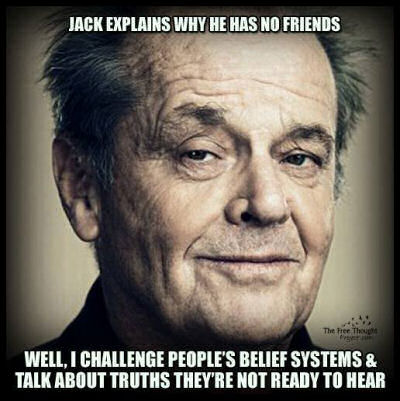
"Irreverence is the champion of
liberty
and its only sure defense."
Samuel Langhorne Clemens
"It is when your
spirit goes wandering upon the wind, that you, alone and unguarded,
commit a wrong unto others and
therefore unto yourself.
Much in you is still man, and much in you
is not yet man, but a shapeless
being that walks asleep in the mist searching for its own awakening.
Oftentimes have I heard you speak of one who commits a wrong as though
he were not one of you, but a
stranger unto you and an intruder.
If one falls he falls for those
following, a caution against the stumbling
stone.
You cannot
separate the just from the unjust and the good from the wicked.
They
stand before the face of the sun even as they are woven together.
The weaver shall look into the whole
cloth, as he shall examine the loom.
Let him who would lash the
offender look unto the spirit
of the offended.
If any of you would punish in the name of
righteousness and lay the ax unto the evil tree, let him see to its roots;
he will find the roots of good and
bad, fruitful and fruitless, all entwined together in the silent heart of
the Earth.
Pronounce
judgement upon him, though honest
in flesh, yet a thief in spirit?
What
penalty for him who slays in the flesh yet is himself
slain in the spirit?
How shall you punish those whose remorse is greater than their
misdeeds?"
- Khalil Gibran, The Prophet
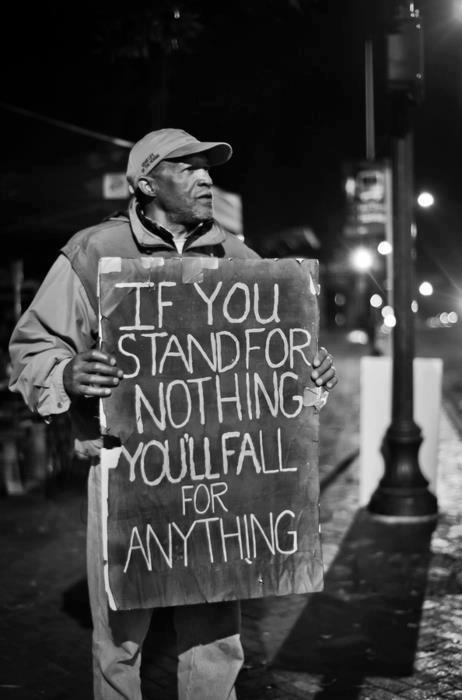
What distinguishes the madman
or mad woman from the visionary
poet is the way in which the
individual is treated by peers
within the
community.
Dismissing suffering ideological
deviants is the root of cultural
upheaval.
Apathy isolates the persecuted ideological
deviant from community
which is the very thing that can provide relief.
"Meditation on the wrong
suffered can lead to self-pity.
It can also bring greater understanding
of opponents and forgiveness.
But
forgiveness can only follow an
awareness that one has been
wronged.
Heaping scorn on one's claims to
having been wronged, even when one plainly has been wronged, is thus at
once the most brazen and
uncharitable act.
A man
persecuted for his beliefs suffers, bitterness thwarts
reconciliation." - Andy
Nowicki

"People
engaging in honest religion
were, are and always will be heretics.
The word heretic comes from a
Greek verb interpreted as "to choose."
Heretics are
those who choose when some
small orthodoxy declares the choices closed
because the orthodoxy has found the truth.
The spirit of
honest religion,
the spirit of heresy, is the
ḦṍḸẙ ṦṕḯṝḭṰ.
It is the ḦṍḸẙ ṦṕḯṝḭṰ
that may never be fenced in, the ḦṍḸẙ ṦṕḯṝḭṰ
that is larger than all creeds,
all gods, and
all religions." - Davidson
Loehr
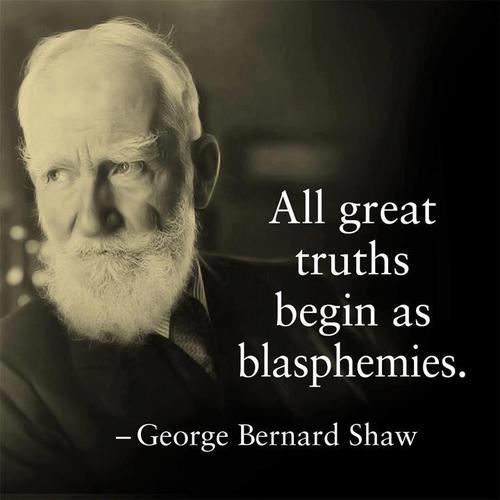
Socrates is forced to
drink poison.
Jesus
of Nazareth is nailed to the cross for
heresy.
Hypatia of
Alexandria is stripped naked and dragged through the streets by an
imperial Christian mob, flayed
with ostrakois and set ablaze while still alive.
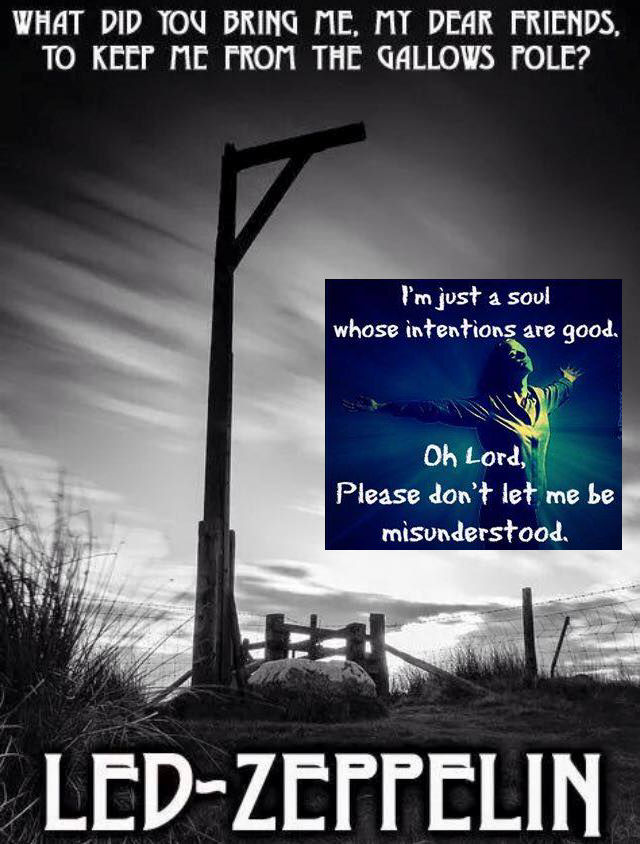
purification through
punishment
Between the 12th and 14th
centuries, punishment was given a
religious quality by associating it with purification before a supreme
being.
The Imperial Christian
sycophants inflicting pain con-vinced the general populace that
they were instruments in the hands of
their supreme being performing a service by
purging corruption from the targeted
victim.
This thinking foreshadows
the eugenics movement and
private prisons.
Imperial Christian authorities claimed that
if the tortured victim suffered
sufficiently here and now on earth he, or she, would not have to undergo
the sufferings of eternal
damnation.
People accepted the authorities story:
purification of the tortured
victim exorcised the evil from
within the society – the
cancer could not spread.
Infliction of physical pain was
rationalized, justified, and blessed.
1314
Elderly Grand Master Jacques de Molay of Knights Templar (Poor Fellow-Soldiers
of Christ and of the Temple of Solomon) and Geoffrey de Charney, Preceptor of
Normandy, are burned alive at the
stake in Paris.
Jacques de Molay calls out from the flames that his
accusers and condemners, Pope Clement and King Philip IV would soon meet him
before God.
Pope Clement dies a month later, and King Philip IV dies in
a hunting accident before the end of the year.
In 2001 the "Chinon
Parchment", found in the Vatican Secret Archives, absolved the Templars
of all heresies in 1308, before the formal papal decree disbanding the Order in
1312.
King Philip IV was deeply in debt to Knights Templar and
their demise canceled that
debt.
1316 Bernardus Guidonis acts as
Procurator General of the Dominican Order.
Practica Inquisitionis
Heretice Pravitatis offers precise information on the doctrines and
mentality of heretics in the situation of persecution and attests to the
beginnings of the extension of the
inquisition to popular superstitions.
Le Manuel Des
Inquisiteurs:
"The torture is not an infallible method to obtain the
truth; some men at the first twinge of
pain confess crimes they never committed; others bear the most cruel
torments. Those placed upon the rack suffer it with great courage, as limbs
accommodate themselves to it with facility or resist with force; others with
charms and spells render themselves insensible, and die before they
confess."
"When sentence of torture has been
given, and while the executioner is preparing to apply it, the inquisitor
should make fresh attempts to persuade
the accused to confess the truth; the executioners, while stripping him,
should affect uneasiness, haste, and sadness,
endeavoring thus to instill fear; and
when he is stripped naked the inquisitors should take him aside, exhorting him
to confess, and promising him his life upon condition of his doing so, provided
that he is not a relapsed, because in such a case they cannot promise him
that."
Pietro d'Abano is an Italian
philosopher, astrologer and
professor of medicine in Padua.
Pietro d'Abano is accused of heresy and
atheism before the Inquisition and
dies in prison.
1328
Meister Johannes Eckhart von Hochheim dies
at papal court in Avignon.
"The eye
through which I see God is the same eye through which God sees me;
my eye and God's eye are one
eye, one seeing,
one knowing,
one love." – Meister
Eckhart
Pope John XXII issued a bull (In agro dominico), 27 March
1329 - withdrawn in 20th
century.
William of
Ockham is branded a
heretic by John XXII and forced to flee into exile in Bavaria with Michael of
Cesena and other leading Franciscans.
Ockham's Razor: the simplest
explanation is the most likely.
William takes refuge in the court of the
Holy Roman Emperor Louis IV of Bavaria who is fueding with the
pope.
1414 John Hus teaches that Jesus, not
Peter, is the foundation of the church, publicly denounces
the selling of indulgences and
calls into question papal infallibility.
Council of Constance deceives
Jon Hus with a guarantee of safe conduct.
Jon Hus is imprisoned and
tortured in several attempts to get him to recant.
Jon Hus refuses them
all. Hands bound behind his back, Jon Hus is chained to the stake. Wood and hay
are piled up to chin. Rosin is sprinkled on kindling.
Jon Hus is given
one last chance to recant and be set free.
"I shall
die with joy today in the faith of
the gospel."- Jon Hus
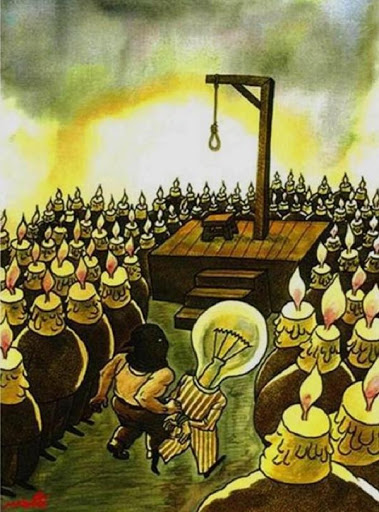
"Public condemnation goes a long way in
establishing
what is and what is not acceptable in a society.
Public good will prevail if the public
demands it."
Laurence Overmire
1431 An
Inquisitorial tribunal convicts Joan of Arc (Jeanne d'Arc) of cross-dressing.
Joan of Arc, condemned to be
burned alive is tied to a tall pillar.
She asks for a cross and a crucifix is
brought from the nearby church.
Jean Tressard, secretary to the
King of England, is seen returning
from the execution exclaiming in great agitation, "We are all ruined, for
a good and holy individual was
burned."
Joan of Arc is beatified on April 11, 1909; canonized as a
saint on May 16, 1920.
1492 The primary purpose of the
Alhambra Decree is to eliminate Jewish influence on the
large converso population of Spain to ensure they do not revert to Judaism.
Over half of the Jews of Spain had converted as a result of the
religious persecution and
pogroms which began in 1391.
1512 William
Tyndale, educated at Magdalen Hall, Oxford, is admitted with a Degree of
Bachelor of Arts and becomes a subdeacon.
1515
William Tyndale is made Master of Arts three months after being ordained into
the priesthood.
The Master
of Arts degree allows him to start studying theology, but the official course does not
include the study of scripture.
Horrified, William Tyndale
organizes private groups for
teaching and discussing the scriptures.
William Tyndale - a gifted
linguist fluent in French, Greek, Hebrew, German, Italian, Latin,
Spanish as well as his native English - believed
the Way to God was through
His God so scripture should be
available even to common people.
1526 A full
edition of the New Testament translated into English by William Tyndale is
produced by the printer Peter Schoeffer in Worms.
The
book is smuggled into England and Scotland,
and is condemned by Cuthbert Tunstall, bishop of London, who issued warnings to
booksellers and has copies burned in public.
Cardinal Wolsey condemns
William Tyndale as a heretic and
demands his arrest.
1536 William Tyndale is tried on a charge of
heresy and condemned to be burned
at the stake.
The King
James version of the Bible is taken from Tyndale's
translation.

1536 Nahuatl Oceltol, an indigenous
priest of the Aztec Empire, is put
on trial during New Spain's Inquisition.
Several witness' recall how Nahuatl
Oceltol predicted rain.
1553 Michael Servetus
is convicted of heresy by the French Inquisition.
Shortly thereafter
Michael Servetus attends a
sermon by John Calvin in Geneva and is
arrested.
Michael
Servetus is found to be a heretic and is burned alive.
1556 Pomponio Algerio is boiled in oil for saying "The Roman
Catholic Church deviates in many things from the truth."
1559 Pope Paul IV promulgates the Pauline Index, the
turning-point for the freedom of enquiry in the Catholic world.
1564 Index Librorum Prohibitorum lists prohibited
books.
1567 John Frampton, an English merchant
from the West Country, is imprisoned and tortured by the
Spanish Inquistion.
John
Frampton escaped from Cádiz.
John Frampton translates The
most noble and famous travels of Marco Polois into English.
1568 Garcia de Orta, a Renaissance Portuguese Jewish
physician, confident in
Portuguese, Spanish, Hebrew, Latin, Greek and
Arabic; the works of Garcia de Orta show knowledge of Persian, Marathi,
Sanskrit and Kannada.
1569 Garcia de Orta's sister Catarina is
arrested as a
Jew and
burned at the stake for
Judaism in Goa.
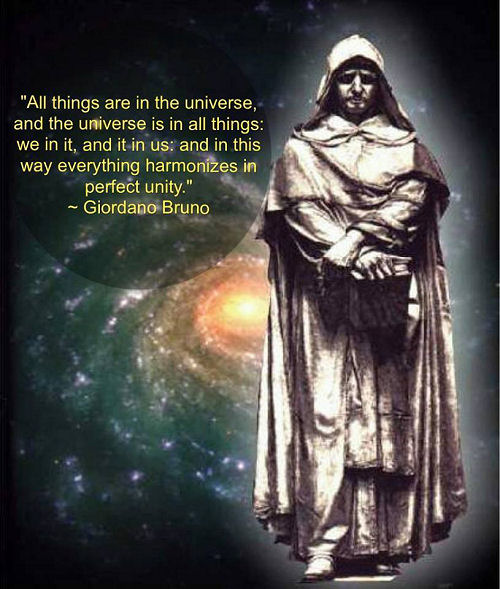
"It is proof of a base and low mind for
one to think with
the majority, merely because the
majority is the majority.
Truth does not change because it is, or is not,
believed by a
majority of the people."
Giordano Bruno
March 1592 Giordano Bruno accepts
patrician Giovanni Mocenigo's
invitation to move to Venice.
May 22, 1592
Giovanni Mocenigo denounces Giordano Bruno to the
Venetian
Inquisition.
During a seven year trial Giordano Bruno is
put the test by the Roman
Inquisition.
Giordano Bruno is condemned to death for holding opinions
contrary to the Catholic faith about the
Trinity, divinity of
Christ, and Incarnation;
the virginity of Mary, mother of
Jesus; Transubstantiation and
Mass.
Giordano Bruno refused
to renounce his claim in the
existence of a plurality of worlds and their eternity; his belief in
metempsychosis and
in the transmigration of
the human soul; and thus was condemned to death for dealing in
magic and divination.
1596 Luis de Carabajal the younger,
the first Jewish author in America, is put on the rack.
Luis de
Carabajal throws himself out of a
window to escape further torture.
Francisca Nuñez de
Carabajal is burned at the stake for being a practicing Jew.
Doña
Francisca and her children, Isabel, Catalina, Leonor, and Luis, are also burned
at the stake, together with Manuel Diaz, Beatriz Enriquez, Diego Enriquez, and
Manuel de Lucena for being practicing Jews.
1599
The Friulian miller Menocchio, also known as Domenico Scandella, philosophical
teachings earned him the title of a heresiarch during the Inquisition and he is
burned at the stake in on orders of Pope Clement VIII.
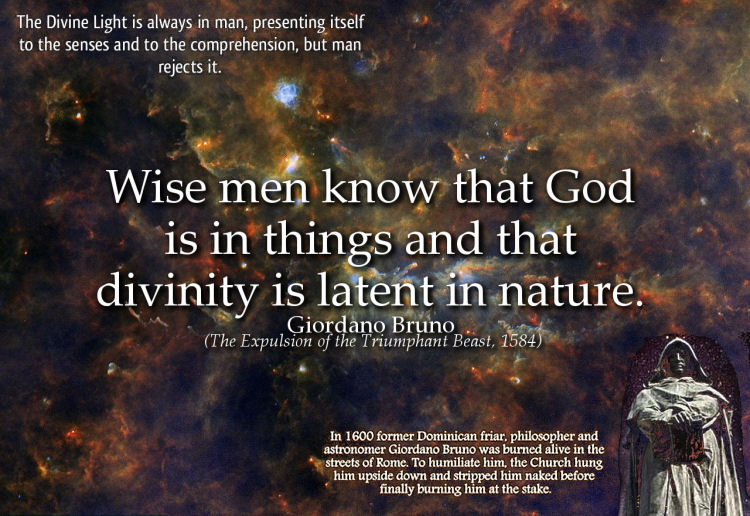
February
17, 1600, Ash Wednesday, Campo de' Fiori
In
a spectacle Giordano Bruno
is hung upside down naked and burned at the stake.
1609
King Philip III, upon the advice of his financial adviser the Duke of Lerma and
Archbishop of Valencia Juan de Ribera, decreed the Expulsion of the
Moriscos.
1612 Cesare Corte, a Renaissance
Italian painter of Genoa, is imprisoned by the Roman Inquistion for espousing
Lutheran beliefs and possessing
Protestant literature.
1613 Cesare Corte confesses and is condemned to
life in prison. He dies within weeks of his imprisonment.
1619 Margaret Flowers confesses and is hung at Lincoln
castle.
1626 to 1631 Johann Georg Fuchs von
Dornheim, Prince-Bishop of Bamberg, presides over the Bamberg witch
trials.
Von Dornheim built a "witch-house," a prison which featured a
torture chamber adorned with Bible verses.
These trials led to the
execution of 300-600 individuals, the most notable of which was Bamberg
burgomaster Johannes Junius.
Junius confessed that while in
a difficult financial state, he
was seduced by a woman who later
proved to be a succubus and threatened to kill him unless he renounced God.
At first Junius refused, but soon more demons materialized and attacked
him further, finally convincing him to accept the
Devil as his God.
He took
the witch-name of Krix and was provided with a familiar named Füchsin
("Vixen"), at which point several local townsfolk revealed themselves as
similarly allied with Satan and congratulated him.
Thereafter he
regularly attended witch's sabbats, to which he rode on the back of a
monstrous, flying black dog.
At one such sabbat he attended a Black
Mass at which Beelzebub made an appearance.
Although his fellow witches
and familiar demons had commanded him to kill his children
in their name, he had
been unable to perform this sacrifice.
Shortly before his
execution, Junius managed to write a letter to his daughter.
In the letter he defends his innocence,
claims that those who testified against him secretly begged his forgiveness,
and recounts the abject horror of his torture (inflicted upon him by his
brother-in-law and three others), from which his hands still shake at the time
of writing the letter.
"For whoever comes into the witch prison must
become a witch or be tortured until he invents something out of his head - God
pity him." - Johannes Junius
1647 Isaac de Castro
Tartas, a Jew, is burned at the stake.
Isaac de Castro Tartas last
words as he was immolated by the flames are "The Lord our God is
One!"
1677 to
1682 A three-year investigation headed by Paris police chief Gabriel
Nicolas de la Reynie uncovers a
booming magical underworld, where
rebel priests performed black
masses and sorceresses sell
concoctions ranging from love spells to 'inheritance powders' made of
arsenic.
Affair of
the Poisons: 319 subpoenas are issued,
194 individuals arrested and 36
executed.
1692
Cotton Mather, a
Premillennialist (openly proclaimed a
belief in a literal millennium similar to
Pentecostalism),
delivers a sermon warning that End
of Days is near at hand and portrays himself as leading the final charge
against the legions of Satan.
The Salem witchcraft trials used water
(like George Walker Bush's
waterboarding) and burning to elicit confession.
"Another test was
to make them repeat the Lord 's prayer and creed. It was affirmed that no witch
could do so correctly." - Charles MacKay
George Burrows, a ministerial
graduate of Harvard, stands on
the gallows loudly proclaiming his
innocence this stuns the
crowd.
Then he recites the Lord's Prayer without
hesitation or
error,
a feat impossible for a wizard.
George Burrows is hung as a wizard on Cotton Mather's
recommendation.

| In
English folk tradition
all the symptoms of "bewitchment" resemble the ones
exhibited in those afflicted with ergot poisoning. The convulsive symptoms,
such as crawling sensations in the
skin, tingling in the fingers, vertigo,
tinnitus,
headaches, disturbances in
sensation, hallucination,
painful muscular contractions,
vomiting and diarrhea, as well as
psychological symptoms, such as
mania, melancholia,
psychosis and
delirium were all symptoms reported
in the Salem witchcraft records. Their was an
abundance of rye in the
Salem region as well as perfect climatic conditions for the tainting of rye
with the ergot fungi. The ergot alkaloid ergotamine is an immediate precursor
of lysergic acid diethylamide and
therefore shares some structural similarities. |
1726 María Francisca Ana de Castrowas, a Spanish
settler to Lima, Peru renowned for
her beauty and hauteur, is arrested by the Inquisition as a practicing Jew.
After 10 years of rape and
torture María Francisca Ana
de Castrowas is burned at the stake.
1808
Napoleon Bonaparte conquers
Spain. Colonel Lemanouski reports that the Roman Catholic Dominicans in charge
of the Spanish Inquisition
blockade themselves in their
monastery in Madrid.
When Colonel Lemanouski's troops forced an entry, the inquisitors
denied the existence of any torture chambers.
The soldiers search the
monastery and discover them under the floors.
The chambers are full of prisoners, all
naked, many insane.
The French troops, used to cruelty and blood,
could not stomach the sight.
They emptied the torture chambers and blew
the monastery up.
2009 A woman in rural Papua
New Guinea is bound and gagged, tied to a log and set ablaze on a pile of
tires. Villagers judged her to be a witch.
"A modern civilized society,
where the conditions of life are in constant rapid change, demands
successful adaptation through
shift in intellectual outlook.
There should be an attempt to encourage, rather than discourage,
expression of new beliefs and the
dissemination of knowledge
tending to support them.
The very opposite is, in fact, the case.
From
childhood upward, everything is done to make the minds of men and women
conventional and sterile.
And if, by misadventure,
some spark of imagination
remains, its unfortunate possessor is considered unsound and dangerous,
worthy only of contempt.
Such men have been the chief
benefactors of mankind, and are
men who receive most honor as
soon as they are safely dead." - Bertrand Russell
 |
|
 |
This web site is not a commercial web site and
is presented for educational
purposes only.
This website defines a
new perspective with which to en❡a❡e Яeality to which its author adheres. The
author feels that the faλsification of reaλity outside personal
experience has forged a populace unable to
discern propaganda from Яeality and
that this has been done purposefully by an internati☣nal
c☣rp☣rate cartel through their agents who wish to foist a corrupt
Ѵersion of Яeality on the human race. Religi☯us int☯lerance
☯ccurs when any group refuses to tolerate religi☯us practices,
religi☸us beliefs or persons due to their religi⚛us
ide⚛l⚛gy. This web site marks the founding of a system of
philºsºphy nªmed the Mŷsterŷ of the Lumière
Infinie - a ra☨ional gnos☨ic mys☨ery re☦igion based on
reaso🐍 which requires no leap of faith, accepts no tithes, has no
supreme leader, no church buildings and in which each and every individual is
encouraged to develop a pers∞nal relati∞n with Æ∞n
through the pursuit of the knowλedge of reaλity in the cu☮ing
the spi☮itual co☮☮uption that has enveloped the human spirit.
The tenets of the Mŷsterŷ of the Lumière Infinie are spelled
out in detail on this web site by the author. Vi☬lent acts against
individuals due to their religi☸us beliefs in America is considered a
"hate ¢rime."
This web site in no way c☬nd☬nes
vi☬lence. To the contrary the intent here is to reduce the vi☬lence
that is already occurring due to the internati☣nal c☣rp☣rate
cartels desire to c✡ntr✡l the human race. The internati☣nal
c☣rp☣rate cartel already controls the w☸rld
ec☸n☸mic system, c☸rp☸rate media w☸rldwide, the
global indus✈rial mili✈ary en✈er✈ainmen✈ complex
and is responsible for the coλλapse of moraλs, the eg●
w●rship behavior and the destruction of gl☭bal ec☭systems.
Civilization is based on coöperation. Coöperation with
bi☣hazards of a gun.
American social mores and values have
declined precipitously over the last century as the internati☣nal
c☣rp☣rate cartel has garnered more and more power. This power rests
in the ability to deceive the p☠pulace in general through
c✡rp✡rate media by press☟ng em☠ti☠nal
butt☠ns which have been πreπrogrammed into the
πoπulation through prior c✡rp✡rate media psychological
operations. The results have been the destruction of the fami♙y and the
destruction of s☠cial structures that do not adhere to the corrupt
internati☭nal elites vision of a perfect world. Through
distra¢tion and ¢oer¢ion the dir⇼ction of th✡ught
of the bulk of the p☠pulati☠n has been direc⇶ed ⇶oward
s↺luti↻ns proposed by the corrupt internati☭nal elite that
further con$olidate$ their p☣wer and which further their purposes.
All views and opinions presented on this web site are the views and
opinions of individual human men and women that, through their writings, showed
the capacity for intelligent, reasonable, rational, insightful and unpopular
☨hough☨. All factual information presented on this web site is
believed to be true and accurate and is presented as originally presented in
print media which may or may not have originally presented the facts
truthfully. Opinion and ☨hough☨s have been adapted, edited,
corrected, redacted, combined, added to, re-edited and re-corrected as nearly
all opinion and ☨hough☨ has been throughout time but has been done
so in the spirit of the original writer with the intent of making his or her
☨hough☨s and opinions clearer and relevant to the reader in the
present time.
Fair Use Notice
This site may contain
copyrighted material the use of which has not always been specifically
authorized by the copyright owner. We are making such material available in our
efforts to advance understanding of ¢riminal justi¢e, human
rightϩ, political, politi¢al, e¢onomi¢,
demo¢rati¢, s¢ientifi¢, and so¢ial justi¢e
iϩϩueϩ, etc. We believe this constitutes a 'fair use' of any
such copyrighted material as provided for in section 107 of the US Copyright
Law. In accordance with Title 17 U.S.C. Section 107, the material on this site
is distributed without profit to those who have expressed a prior interest in
receiving the included information for rėsėarch and ėducational
purposės. For more information see:
www.law.cornell.edu/uscode/17/107.shtml. If you wish to use copyrighted
material from this site for purposes of your own that go beyond 'fair use', you
must obtain permission from the copyright owner. |
 Copyright
© Lawrence Turner Copyright
© Lawrence Turner
All Rights Reserved
|