|
Descartes is often regarded as the first thinker
to
emphasize the use of reason to develop the natural sciences.
1637 Rene Decartes
publishes Discours de la méthode.
A method for discovery of truth consists of
four rules:
Accept
nothing as true unless one has no
doubt.
Divide up each
problem into as many
parts as possible and resolve
each in the manner best suited to the task.
Carry on reflections
beginning with the most simple and proceed
little by little, to knowledge
of the most complex.
Make
enumerations so complete
and reviews so general so one
can be certain of omitting no
active possibility.
"Man is composed of
a twofold nature, a
spiritual and a
bodily.
As regards
the spiritual nature, which they
name the soul, he is called the spiritual, inward,
new man; as
regards the bodily nature, which they name the flesh, he is called the fleshly,
outward, old man." - Martin
Luther
Common sense is, of all things
among men, the most equally
distributed.
Each thinks himself so abundantly provided, even those
difficult to satisfy,
do not usually desire a larger
measure than they already possess.
It is not likely that all are
mistaken the conviction it is rather to be held as testifying
the power of judging aright and
distinguishing truth from
error, properly called common sense or
reason, is
by nature equal in all men.
The diversity of our
opinions does not arise from some being endowed with a larger
share of reason than others, but solely by this,
we conduct our thoughts along
different ways, and do not fix
attention on the same objects.
To be possessed of a vigorous mind
the prime requisite is to
rightly apply it.
He truly
engages in battle who endeavors to surmount all the
difficulties and errors which prevent him from reaching the
knowledge of truth.
I, Rene
Descartes, hold in esteem the studies of the schools.
I was aware that the languages
taught in them are necessary to the understanding of
the writings of the ancients;
that the grace of
narrative stirs the mind;
that the memorable deeds of history elevate it;
and, if read with
discretion, aid in forming
judgement;
the perusal of
excellent books interviews the
noblest men of past ages;
that eloquence has incomparable force and beauty;
that poetry has its
ravishing, its graces and
delights;
that in the mathematics there are
refined discoveries
eminently suited to gratify the inquisitive,
further all the arts and lessen the
labor of man;
that numerous highly useful precepts
and exhortations to
virtue;
that theology
points out the path to heaven;
that philosophy affords the means
of discoursing with an appearance of truth on all matters, and
commands the admiration of the
simple;
that jurisprudence,
medicine, and the other sciences,
secure for their cultivators
honors revealing superstition and
error, that we may be in a
position to determine real
value, and guard against
being deceived.
I, Rene Descartes, am not at all astonished at
the extravagances
attributed to those ancient philosophers whose
own writings we do not possess.
I do not suppose them to
have really been absurd, seeing they were among the ablest
men, but only that these have been falsely represented to us.
I am quite sure that
the most devoted of the
followers of Aristotle would
think themselves happy if they
had the knowledge of nature he
possessed.
I, Rene Descartes,
never accepted anything for
true which I did not clearly know to be such unless
presented so distinctly as to
exclude all doubt.
I divide each of
the difficulties under examination into as many parts as possible, and
as might be necessary for its
adequate solution.
Commencing with objects the
simplest and easiest to know
I ascend step by step to
the knowledge of the more
complex and difficult to
understand.
The
long chains of simple reason led me to
envision that all things are
mutually connected in the same
way through unswayable physical
rules.
There is nothing so far removed to
be beyond understanding.
Nothing so hidden we cannot
discover it, provided only
we abstain from accepting the
false for the true, and always preserve in our thoughts
the order necessary for the deduction of
one truth sequentially from
another.
Each truth
discovered made available the discovery of subsequent ones.
Expediency seemed to dictate that I
should regulate my behavior conformably to
the opinions of those with whom I
should have to live.
In
order to ascertain the real opinions of such, I ought rather to take
cognizance of what they
practiced rather than of what they said.
In
the corruption of our
manners, there are few disposed to
speak exactly as they believe, but also
many are not aware of what it is
they really believe.
Something
believed is different from something known.
When it is not in our power to
determine what is true, we
ought to act according to what is most probable. (Apply Ockham's
Razor)
I, Rene Descartes, endeavor to
conquer myself rather than fortune as
only our own thoughts are in our
power and to conform desire with natural order.
If we
consider all objectives as beyond
our power, we shall no more regret the absence of success when deprived if we
recognize no fault of our own.
It is
my conviction I could not do better than continue
devoting my whole life to the
cultivation of reason; making progress in the
knowledge of truth.
I, Rene Descartes, attentively
examined what I was.
I observed I could envision that I had no
body, and that there was no Earth,
nor any place in which I might
be, but I could not envision that I
was not.
I still was, on the contrary, from the very circumstance
that I thought to doubt the truth
of other things, it most
clearly followed that I remained.
I, Rene Descartes, concluded
I was a substance whose whole essence or
nature consists only in thinking
not dependent on anything
material.
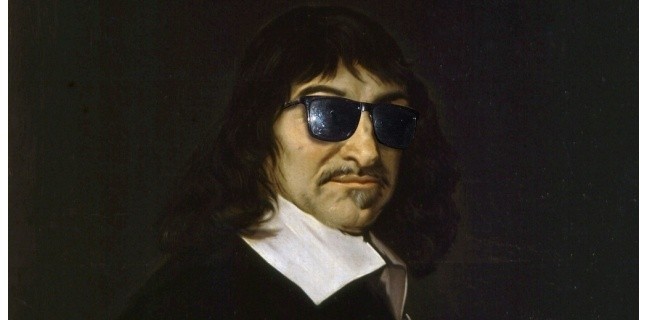
Rene Descartes = Cartesius
I, that is to say, the
mind by which I
am what I
am, is wholly distinct
from the body, and is even
more easily known than the body(?),
and is such, that although the body were not, it would still continue to be all
that it is.
Although I, Rene Descartes,
might think I was dreaming,
that all which I saw or imagined
was false, I could not deny the reality of my
thoughts.
I was disposed straightway to
search for other truths.
I, Rene Descartes, perceived that there was
nothing to these demonstrations
which could assure me of the
existence of an objective actual reality.
For example,
supposing a triangle to be
given, I distinctly perceived that its
three angles were necessarily
equal to two right angles, but I did not on that account
perceive anything which could
assure me that any triangle
existed.
Many are
persuaded there is a difficulty in knowing this truth; in knowing what
their mind really is because they never engage in
abstract
reasoning.
They
consider everything through visualization, a
mode of thinking limited to
real objects; all that is
unimaginable appears to them
unintelligible.
The truth
of this is manifest from the single point the
philosophers accept as a maxim there is
nothing not previously indentified by the
senses.
To comprehend
abstraction they do exactly the same thing as if, in order to
hear sounds or
smell odors,
they strove to avail themselves of
their eyes.
Unless indeed the
sense of sight does not afford us an inferior assurance to those of
smell or
hearing; in place of
which, neither our imagination
nor our senses can give us assurance
of anything unless our understanding intervene.
God is or exists because all that we possess is
derived from God.
It follows that
our ideas or notions, which
to the extent of their clearness
and distinctness are real, and proceed from God, must
to that extent be
true.
We not infrequently have ideas
or notions in which some falsity is contained,
this can only be the case
when we proceed from lack of knowledge.
After
knowledge has rendered us
certain, we can easily understand that the truth of reason
we experience when
awake, ought not in the slightest degree to be
called into question on
account of the illusions of our dreams.
Never be persuaded of the truth of anything unless on the evidence of
reason.

I have observed
laws established by God
are observed in all that exists.
Concatenation of
these laws reveal many
truths more useful and more important than all I had before learned, or
even had expected to learn.
If God were to now compose a universe
and after that did nothing more than lend ordinary concurrence to nature,
and allow nature to act in accordance with the
Laws of Nature, the result,
by necessity, would be as our
reality is.
I, Rene Descartes, endeavored to demonstrate to all until there
could be any room for doubt, and
to prove that even if God had
forged more worlds, there could have been none
in which these laws were not observed.
An opinion commonly received
among theologians:
the action which sustains the
universe is the same with that by which it was originally forged.
God, in the miracle of
Creation, established certain Laws of Nature.
Things
purely material might have become as we observe them at present.
Their
nature is easily envisioned when
beheld coming in this manner gradually into existence,
rather than at once in a
finished perfect state.
I, Rene Descartes,
perceived it to be possible to arrive at
knowledge highly useful in life; so
natural that no one can
imagine himself ignorant of it.
In light of the speculative
philosophy usually taught in the schools, to discover a practical means by
which to know the force and action of fire, water, air, the stars, the
heavens, and the other
elements that surround us.
As distinctly as we know
the various crafts of our artisans,
we might also apply them to render ourselves
the lords and possessors of
nature.
Fruits of the
Earth, the blessings of life,
preserve health.
I
examined what were the first and most ordinary effects that could be deduced
from these causes; and found knowledge of the heavens and
on Earth knowledge of water, air, fire,
minerals, and other things which of all others are the most common and simple,
and hence the easiest to know.
I, Rene Descartes,
deduce germs of truths naturally existing
in our minds.
It is necessary to confess the power of nature is so
ample and these principles so simple and general, that I have hardly observed a
single particular effect which I cannot at once recognize as capable of being
deduced by mankind.
Thereupon, turning over in my mind, the real objects
that had ever been presented to my senses I freely venture to state that I have
never observed any which I could not satisfactorily explain by the
Laws of Nature.
I,
Rene Descartes, am confident there is no one who does not admit
all that is presently known is
nothing in comparison of what
remains to be discovered.
I incite men to strive to proceed farther
by informing the public of all they might
discover, the last beginning
where those before left off connecting
the lives and labors of many
we might collectively
proceed much farther.
If I, Rene Descartes, were to
publish the principles of my
philosophy: to assent to them no more is needed than simply to understand
them.
I foresee that I shall
frequently be turned aside from my grand voyage of discovery on occasion of
the opposition it is sure to
awaken.
By publishing the principles of the
my philosophy I hope to throw open the windows and allow the light of day to
enter.
Rene Descartes
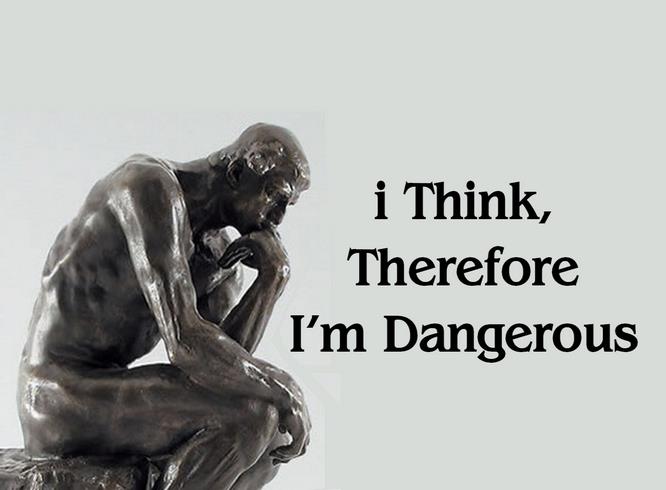
It is likely that Rene Descartes died of
arsenic
poisioning while tutoring
Queen Cristina of Sweden.
Enlightenment comes
from brief insights into the nature of things.
Although such insights
are rare and difficult to sustain they allow
a glimpse of the basis of desire
granting us the ability to control that
desire.
Those who have mastery over desire will walk in
integrity.
Those who possess this knowledge of Self readily come to believe that
any other individual can have the same knowledge about Self as this knowledge
involves nothing which depends on anything outside of Self.
"The Scientific Method relies
for its supra-cultural validity on principles that are
themselves among its own
assumptions.
The
logic of its
justification is circular.
A parallel
would be an aborigine insisting, "Okay, let's settle this question of whether
scientific experiment or
dreaming is the way to true
knowledge once and for all. Let's settle it by entering the
dreamtime and asking ancestors."
The principal
assumptions of objectivity
and determinism at the
foundation of the Scientific
Method are not shared by all traditions of thought.
A
non-objective, non-deterministic, coherent system of thought is possible.
It is more than possible: it is necessary given the impending collapse
of the world of the discrete and separate self that we have wrought.
Necessary in light of the new
scientific revolution of the last hundred years.
Our ways of thinking are not working
anymore." - Charles Eisenstein
La methodé contained three
appendices: La Dioptrique, Les Météories, and La
Géométrie.
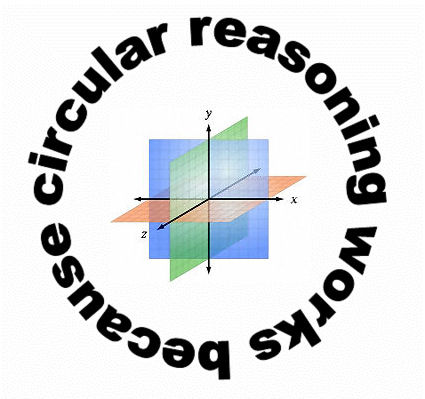
In La Géométrie Descartes
proposed each point on a two dimensional plane can be represented by two
numbers, one giving the point's horizontal location and the other the vertical
location - Cartesian coordinates.
Perpendicular lines (or axes), cross
at a point called the origin, to measure the horizontal (x) and vertical (y)
locations, both positive and negative, thus effectively dividing the plane up
into four quadrants.
Any equation can be represented on the plane by
plotting on it the solution set of the equation.
This can be
extrapolated into three dimensions as seen above. |
|

 |
This web site is not a commercial web site and
is presented for educational purposes only.
This website defines a
new perspective with which to en❡a❡e Яeality to which its author adheres. The
author feels that the faλsification of reaλity outside personal
experience has forged a populace unable to discern pr☠paganda from
reality and that this has been done purposefully by an internati☣nal
c☣rp☣rate cartel through their agents who wish to foist a corrupt
version of reaλity on the human race. Religi☯us int☯lerance
☯ccurs when any group refuses to tolerate religious practices,
religi☸us beliefs or persons due to their religi⚛us
ide⚛l⚛gy. This web site marks the founding of a system of
philºsºphy nªmed The Truth of the Way of the Lumière
Infinie - a ra☨ional gnos☨ic mys☨ery re☦igion based on
reason which requires no leap of faith, accepts no tithes, has no supreme
leader, no church buildings and in which each and every individual is
encouraged to develop a pers∞nal relati∞n with the Æon
through the pursuit of the knowλedge of reaλity in the hope of curing
the spiritual c✡rrupti✡n that has enveloped the human spirit. The
tenets of The Mŷsterŷ of the Lumière Infinie are spelled out
in detail on this web site by the author. Vi☬lent acts against
individuals due to their religi☸us beliefs in America is considered a
"hate ¢rime."
This web site in no way c☬nd☬nes
vi☬lence. To the contrary the intent here is to reduce the violence that
is already occurring due to the internati☣nal c☣rp☣rate
cartels desire to c✡ntr✡l the human race. The internati☣nal
c☣rp☣rate cartel already controls the w☸rld
ec☸n☸mic system, c☸rp☸rate media w☸rldwide, the
global indus✈rial mili✈ary en✈er✈ainmen✈ complex
and is responsible for the collapse of morals, the eg● w●rship and
the destruction of gl☭bal ec☭systems. Civilization is based on
coöperation. Coöperation with bi☣hazards of a
gun.
American social mores and values have declined precipitously over
the last century as the corrupt international cartel has garnered more and more
power. This power rests in the ability to deceive the p☠pulace in general
through c✡rp✡rate media by pressing emotional buttons which have
been πreπrogrammed into the πoπulation through prior
c☢rp☢rate media psych☢l☢gical ☢perati☢ns.
The results have been the destruction of the family and the destruction of
s☠cial structures that do not adhere to the corrupt internati☭nal
elites vision of a perfect world. Through distra˘tion and ˘oer˘ion the
dir⇼ction of th✡ught of the bulk of the p☠pulati☠n has been
direc⇶ed ⇶oward s↺luti↻ns proposed by the corrupt internati☭nal elite
that further con$olidate$ their p☣wer and which further their purposes.
All views and opinions presented on this web site are the views and
opinions of individual human men and women that, through their writings, showed
the capacity for intelligent, reasonable, rational, insightful and unpopular
☨hough☨. All factual information presented on this web site is believed to be
true and accurate and is presented as originally presented in print media which
may or may not have originally presented the facts truthfully. Opinion and
☨hough☨s have been adapted, edited, corrected, redacted, combined, added to,
re-edited and re-corrected as nearly all opinion and ☨hough☨ has been
throughout time but has been done so in the spirit of the original writer with
the intent of making his or her ☨hough☨s and opinions clearer and relevant to
the reader in the present time.
Fair Use Notice

This site may contain
copyrighted material the use of which has not always been specifically
authorized by the copyright owner. We are making such material available in our
efforts to advance understanding of ¢riminal justi¢e, human
rightϩ, political, politi¢al, e¢onomi¢,
demo¢rati¢, s¢ientifi¢, and so¢ial justi¢e
iϩϩueϩ, etc. We believe this constitutes a 'fair use' of any
such copyrighted material as provided for in section 107 of the US Copyright
Law. In accordance with Title 17 U.S.C. Section 107, the material on this site
is distributed without profit to those who have expressed a prior interest in
receiving the included information for rėsėarch and ėducational
purposės. For more information see:
www.law.cornell.edu/uscode/17/107.shtml. If you wish to use copyrighted
material from this site for purposes of your own that go beyond 'fair use', you
must obtain permission from the copyright owner. |
 Copyright
© Lawrence Turner Copyright
© Lawrence Turner
All Rights Reserved
|