|
Those who would give up essential
liberty to purchase a little
temporary safety deserve neither
liberty, nor safety.
In the
truest sense, freedom cannot be bestowed;
it must be achieved.
The truth is
found when men are
free to pursue it.
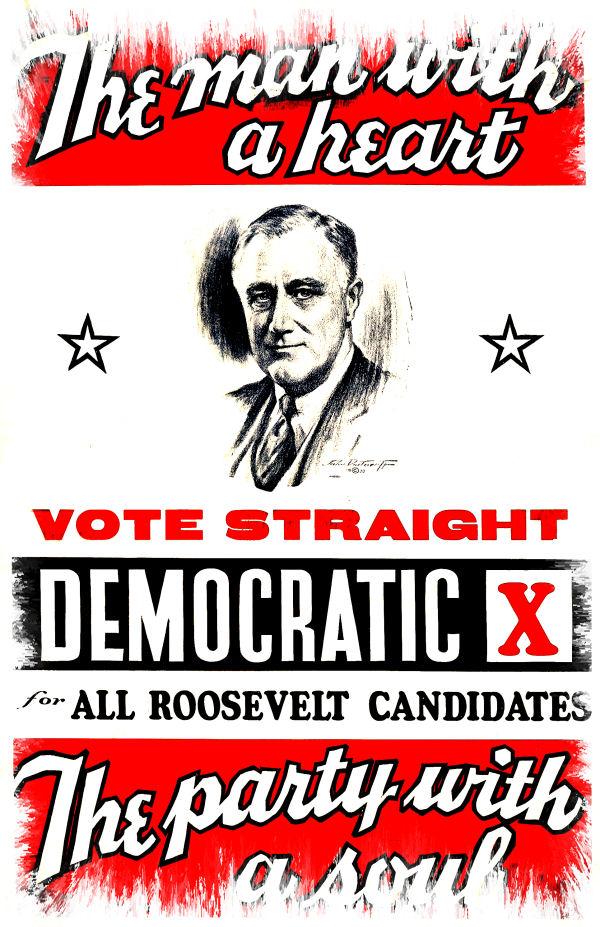
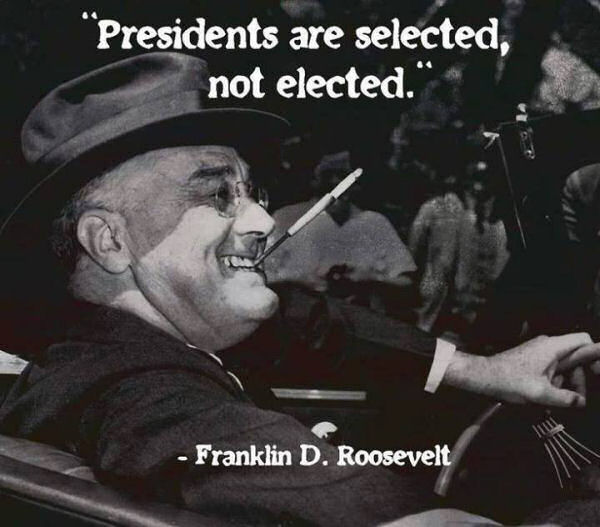
Franklin Delano
Roosevelt, president of the
United States of
America Franklin Delano Roosevelt
married Anna Eleanor Roosevelt, his 6th cousin.
the great depression and
socialism
"Irving Fisher, advocated the stamp-scrip
(demurrage) system as the way out of the Great Depression: "The correct
application of stamp scrip would solve the depression crisis in the US in three
weeks!" Other economists agreed, but pointed out to Treasury Undersecretary
Dean Acheson possible decentralizing political effects. President
Roosevelt responded by banning all emergency currencies, choosing instead the
centralized solution of the New Deal." -
Charles
EisensteinFranklin Delano Roosevelt was governor of New York from 1928
to 1932. Many of the worst banking scandals occurred under Franklin Roosevelt's
governorship.
"The smart thing to do would be to go off the gold
standard a little farther than England has done." - Henry Agard Wallace,
January 31, 1933
{Henry Agard Wallace became Secretary
of Agriculture in Roosevelt's cabinet. Henry Agard Wallace order the
slaughtering of pigs and plowing up cotton fields in rural America to drive up
the price of these commodities. Henry Agard Wallace was vice president during
Roosevelt's second term. In 1941 Roosevelt named Henry Agard Wallace chairman
of the Board of Economic Warfare (BEW) and of the Supply Priorities and
Allocations Board (SPAB). In 1944 Henry Agard Wallace was wined and dined in
Siberia by Sergei Goglidze and Dalstroi director Ivan Nikishov, both NKVD
generals. Henry Agard Wallace became a staunch supporter of the Soviet Union.
Wallace was endorsed by the Communist Party (USA), and his subsequent refusal
to publicly disavow any Communist support cost him the backing of many
anti-Communist liberals and socialists in the 1948 presidential
election.
"I reached a conclusion, that under no circumstances, ever
have any business dealings with him." - Henry Agard Wallace after getting to
know FDR
"The outright ownership of farms ought to be greatly
restricted. Under intelligent state control it should be possible to introduce
a planned flexibility into the congestion and rigidity of our outmoded system."
- Rexford Tugwell Undersecretary of Agriculture}
"I regard the
condition of the country the most serious in its history. The mere talk of
inflation retards business. If you start talking about that you would not have
a nickel's worth of gold in the Reserve System the day after tomorrow." -
Bernard Baruch, February 11, 1933
"One of the key Roosevelt advisors is
Bernard M. Baruch, a power in the Wilson Administration." - Jewish Examiner of
Brooklyn, October 20, 1933
Stephen Samuel Wise, a Austro-Hungarian-born
American Reform rabbi, Zionist leader and an intimate friend of Roosevelt, had
permanent access to FDR. Sam Roseman and Nahum Goldman contacted Roosevelt
directly.
"The Roosevelt Administration has selected more Jews to fill
influential positions than any previous administration." - Brooklyn Jewish
Examiner, October 20, 1933
"By February 19, gold withdrawals from banks
increased from five to fifteen million dollars a day. In two weeks $114,000,000
of gold was taken from banks for export and another $150,000,000 was withdrawn
to go into hiding. The infection of fear was everywhere. Factories were
closing. Unemployment was rising rapidly. Bank closings multiplied daily." -
John T. Flynn
The United States defaulted on its debt in 1933 when
Roosevelt took office and pulled the country off the gold standard, thus,
shrugging off the claims of foreign investors who were assured the US would
honor its obligations in gold.
Then to insure that America could never
be on the gold standard again Roosevelt confiscated all the gold in the
country. Americans with gold were paid $20.67 per ounce and those that refused
to surrender their gold were given a ten year prison sentence. To store the
confiscated gold Fort Knox was built. International bankers waited until the
price of gold went up to $35 per ounce and then they redeemed their gold
certificates making a substantial profit on Americans loss.
"These
original studies of the public interest disclose that during the 4 years
1933-36 a change took place which was so drastic as to constitute a revolution.
They also indicated conclusively that the responsibility for the economic
welfare of the American people had been "transferred heavily to the executive
branch of the Federal Government, that a corresponding change in education had
taken place from an impetus outside of the local community, and that this
revolution had occurred without violence and with full consent of an
overwhelming majority of the electorate: In seeking to explain this
unprecedented phenomenon, subsequent studies pursued by the staff clearly
showed it could not have occurred peacefully or with the consent of the
majority unless education in the United States had prepared in advance to
endorse it.
These findings appeared to justify two postulates, the
first of which was that the policies and practices of institutions purporting
or obliged by statute to serve the public interest would reflect this
phenomenon, and second, that foundations whose trustees were empowered to make
grants for educational purposes would be no exception. On the basis of these,
after consultation with counsel, I directed the staff to explore foundation
practices, educational procedures, and the operation of the executive branch of
the Federal Government since 1903 for reasonable evidence of a purposeful
relationship between them.
Our ensuing studies disclosed such a
relationship and that it had existed continuously since the beginning of this
50-year period .
In addition, these studies seemed to give evidence of
a response to our involvement in international affairs . Likewise, they seemed
to reveal that grants had been made by foundations, chiefly by Carnegie and
Rockefeller, which had been used to further this purpose;
by directing
education in the United States toward an international frame of reference and
discrediting the traditions to which the United States had been dedicated,
by training individuals and servicing agencies to render advice to the
executive branch of the Federal Government,
by decreasing the
dependency of education upon the resources of the local community, and freeing
it from many of the natural safeguards inherent in this American tradition,
by changing both school and college curricula to the point where they
sometimes denied the principles underlying the American way of life,
by
financing experiments designed to determine the most effective means by which
education could be pressed into service of a political nature."
- from
HEARINGS BEFORE THE SPECIAL COMMITTEE TO INVESTIGATE TAX-EXEMPT FOUNDATIONS AND
COMPARABLE ORGANIZATIONS HOUSE OF REPRESENTATIVES EIGHTY-THIRD CONGRESS SECOND
SESSION ON HOUSE RESOLUTION 217
Basically the tax exempt foundations set
up by the syndicate of the soulless pushed the ideology of socialism. Thus the
experiment known as the New Deal - a program of central control, collectivism,
similar in so many ways to fascism, communism and corporatism - was accepted by
the American people as a viable alternative to the rugged individualism of
early Americans. The syndicate of the soulless has continued this program to
morph the rugged individualism of early Americans into the self-centered
self-aggrandizing narcissism of American aristocracy.
"The traditional
story is that President Franklin D. Roosevelt rescued corporatism by resorting
to extensive government intervention; the truth is that Roosevelt changed
course from year to year, trying a mix of policies.
If I were preparing
a "New Deal crib sheet," I would start with the following lessons:
As
Milton Friedman and Anna Jacobson Schwartz argued in a classic book, "A
Monetary History of the United States," the single biggest cause of the
Great Depression was that the Federal Reserve let the money supply fall by
one-third, causing deflation. Furthermore, banks were allowed to fail, causing
a credit crisis.
A study of the 1930s by Christina D. Romer, a professor
at the University of California, Berkeley ("What Ended the Great Depression?,"
Journal of Economic History, 1992), confirmed that expansionary monetary policy
was the key to the partial recovery of the 1930s.
The worst years of
the New Deal were 1937 and 1938, right after the Fed increased reserve
requirements for banks, thereby curbing lending and moving the economy back to
dangerous deflationary pressures.
Roosevelt instituted a disastrous
legacy of agricultural subsidies and sought to cartelize industry. Neither
policy helped the economy recover.
"It was a crime against our
civilization to pay farmers in two years $700,000,000 to destroy crops and
limit production. It was a shocking thing to see the government pay one big
sugar corporation over $1,000,000 not to produce sugar." - John T. Flynn
"Roosevelt knows nothing about finance, but he doesn't know he doesn't
know." - Franklin Lane Secretary of the Interior
Roosevelt also took
steps to strengthen unions and to keep real wages high. This helped workers who
had jobs, but made it much harder for the unemployed to get back to work. One
result was unemployment rates that remained high throughout the New Deal
period.
The New Deal's legacy of public works programs has given many
people the false impression that it was a time of expansionary fiscal policy.
Government spending went up considerably, but taxes rose, too. Under President
Herbert Hoover and continuing with Roosevelt, the federal government increased
income taxes, excise taxes, inheritance taxes, corporate income taxes, holding
company taxes and "excess profits" taxes.
When all of these tax
increases are taken into account, New Deal fiscal policy didn't do much to
promote recovery.
World War II did help the American economy, but the
gains came in the early stages, when America was still just selling war-related
goods to Europe and was not yet a combatant. The economic historian Robert
Higgs, a senior fellow at the Independent Institute, has shown in his 2006
book, "Depression, War, and Cold War," how the war brought shortages and
rationing of consumer goods. While overall economic output was rising, and the
military draft lowered unemployment, the war years were generally not
prosperous ones.
"Expansionary monetary policy and wartime orders from
Europe, not the well-known policies of the New Deal, did the most to make the
American economy climb out of the Depression." - Tyler Cowen
"As the
depression deepened, Frankfurter made a more conscious effort to place his
students where their weight would be felt. A Washington bureau may employ a
thousand men, but only a handful are important - the administrator, the
counsel, the economist, the statistician, the publicity man. These are the men
who influence policy and it was policy, not jobs, that interested
Frankfurter.
Frankfurter's most important move upon this board was
sending Thomas G. Corcoran, one of his ablest pupils, to a place in the
Reconstruction Finance Corporation while Hoover was President. Tommy had a
flair for public affairs and a passion for political maneuvering.
As
the New Deal began to create bureau after bureau and the number of jobs
desirable to both Frankfurter and Corcoran multiplied, Corcoran proceeded to
fill them with what Hugh Johnson called the "happy hot dogs." Tommy found the
places; Frankfurter produced the recommendations and the Frankfurter boys were
in. They were everywhere. Most of them, of course, were lawyers, but many had
become economists overnight." - John Flynn
{Felix
Frankfurter came from a long line of rabbis. Felix Frankfurter and Walter
Lippmann attended Harvard Law School together. Felix Frankfurter and Louis
Dembitz Brandeis lobbied Woodrow Wilson to support the Balfour Declaration.
Felix Frankfurter participated in the founding conference of the American
Jewish Congress. Felix Frankfurter became a presidential adviser when Franklin
Delano Roosevelt was first elected. Felix Frankfurter successfully recommended
many bright young lawyers toward public service with the New Deal
administration, so many indeed that they became known as "Felix's Happy Hot
Dogs." Later Franklin Delano Roosevelt seated Felix Frankfurter as a Supreme
Court Justice.}
The National Recovery Administration allowed
industries to create "codes of fair competition," which were intended to reduce
"destructive competition", set minimum wages and maximum weekly hours while
also allowing industry heads to collectively set minimum prices.
"The
National Recovery Administration worked by fostering giant cartels, which made
products artificially expensive and punished small business trying to compete
against small business. The general
lesson is that government sponsored cartels don't help the economy as a
whole. " - Robert P. Murphy
In 1935, the United States Supreme
Court unanimously declared the National Recovery Administration as
unconstitutional. The National Recovery Administration was headed by Hugh
Johnson a business associate of Bernard Baruch.
"An aged physician in
Long Beach, California, was looking out his window one day when he saw three
old women rooting in a garbage can for food. The vision set Dr. Francis E.
Townsend's soul on fire. Thus inspired, he sat down to invent a plan and came
up with the Townsend Old Age Revolving Pension Plan. The plan was simplicity
itself. Every person reaching the age of 60 would receive $200 a month. There
were four conditions: (1) that he or she retire; (2) have no criminal record;
(3) have no income over the $2400 a year; and (4) spend the entire $200 each
month. A man and wife over 60 would get $400 a month. There were 10,384,000
persons over 60. But the doctor estimated that only about 8,000,000 would
qualify. This would cost the country $1,600,000,000 a month or about
$19,000,000,000 a year. The money would be provided by a transactions tax of 2
per cent on every commercial transaction. This alluring
promise lighted up the imaginations
and appetites of the aged. It spread like a prairie fire among the oldsters
until millions were marching behind the good doctor as in a holy crusade." -
John T. Flynn
The main argument against the Townsend Old Age Revolving
Pension Plan was that the taxes would not be enough to pay for the high
pensions, which would account for almost half the national income.
Wall Street creates the Nazi
war machineOwen D. Young, advised Woodrow Wilson during the Second
Industrial Conference following World War I. Owen D. Young coauthored the World
War I war reparations Dawes Plan in 1924 and the Young Plan in 1928 which
rewrote German debt service and facilitated the Wall Street loans which made
possible the cartelization of the German electrical, steel and chemical
industries. {Owen D. Young was chairman of the Executive
Committee of Radio Corporation of America; a director German General Electric
(AEG); a director of Osram in Germany; a director of General Motors, NBC, and
RKO; a councilor of the National Industrial Conference Board; a director of the
International Chamber of Commerce; a trustee of the Rockefeller Foundation; a
deputy chairman of the board of the Federal Reserve Bank of New York and
finally became chairman of General Electric after the Young Plan's acceptance.
Gerard Swope, Owen D. Young's right hand, was president and director of
General Electric Company as well as French and German associated companies,
including AEG. and Osram in Germany. Gerard Swope was also a director of RCA,
NBC, and the National City Bank of New York.}
General Motors, General Electric, DuPont - controlled by
the international bankers J. P. Morgan, Rockefeller, Chase, and Warburg - were
intimately related to the growth of the Nazi war armaments industry. Chase and
Morgan banking interests maintained open offices in occupied France during
World War II. A US Treasury investigation of Chase Bank and JP Morgan revealed
collaboration between both banks and the Nazis.
The chemical cartel
Internationale Gesellschaft Farbenindustrie A.G or I.G. Farben was formed in
1925 with funding from Wall Street by Hermann Schmitz. Wax Warburg was on the
board of directors of the German branch of I.G. Farben while Paul Warburg was
on the board of directors of the American branch of I.G. Farben. Hermann
Schmitz, a prominent Nazi and supporter of Adolf Hitler, while president of
I.G. Farben was also a director of the Bank of International Settlements.
The three German directors of American I.G. were
found guilty of Nazi collusion during the Nuremberg trials while the American
directors - Walter Teagle, CE Mitchell and Paul Warburg, directors of Federal
Reserve Bank of New York - were never tried. Max Ilgner, a German director,
directed the Nazi pre-war intelligence office in Berlin. Walter Teagle was also
the chairman of Standard Oil of New Jersey and a trustee of Franklin Delano
Roosevelt's Warm Springs Institute for Rehabilitation.
Standard Oil of
New Jersey had the patent on synthetic rubber but would not license its
production in America while licensing the process for production in Germany.
The Ethyl Gasoline Corporation shared its
anti-knock technology, dependent on tetraethyl lead patented in America, with
Nazi Germany for use in aviation fuel against the request of the War Department
and the Army Air Corps to retain the manufacturing knowledge.
The
process' developmental work on oil from coal was undertaken by Standard Oil
Development Company within the United States, in Standard Oil facilities. The
results of this research were made available to I.G. Farben and became the
basis for the development of Adolf Hitler's oil from coal program.
When
World War II began General Electric had a monopoly on the manufacture of
tungsten carbide and raised the price from $50 a pound to $453 a pound.
(Tungsten carbide is used to mill steel.)
Transfer of patented products
belonging to Standard Oil and the Ethyl Gasoline Corporation gave Nazi Germany
the ability to create synthetic rubber, oil from coal, and high-grade aviation
fuel which in turn made World War II possible.
In 1931, Standard Oil Company of New York (Socony) and
Vacuum Oil merged morphing eventually into the Socony Mobil Oil Company and
later ExxonMobile. During World War II the Tschechowitz I & II subcamps
of Auschwitz in
Czechowice-Dziedzice provided forced labor for Vacuum Oil Company facilities in
Nazi Germany.
{Max Warburg, a long time advisor of
Hjalmar Schacht, was selected by Prescott Bush to be the American Ship &
Commerce Line official representative on the board of the Hamburg-Amerika Line.
Christian Beck, a Harriman executive managed "freight & operations" in
North America. Emil Helfferich was appointed chairman of Hapag-Lloyd (North
German Lloyd Co. merged with Hamburg-Amerika Line) and later became chairman of
the Standard Oil Company subsidiary in Germany. Karl Lindemann, director of
Hamburg-Amerika, also became a top Standard Oil executive in Germany. Emil
Helfferich and Karl Lindemann were authorized to write checks to Heinrich
Himmler, chief of the Nazi SS, on a special Standard Oil account managed by the
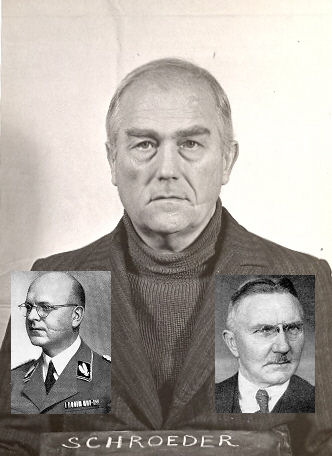
German-British-American banker, Kurt von Schroeder. Emil Helfferich wrote
checks to the SS for supervising mass murder at Standard-I.G. Farben's
Auschwitz and other death camps. According to US intelligence documents Emil
Helfferich stated SS payments were made from corporate Standard Oil
funds.
Montagu Collet Norman was the Governor of the Bank of England
from 1920 to 1944. Montagu Collet Norman was a close friend of the German
Central Bank president Hjalmar Schacht and the godfather to one of Schacht's
grandchildren. Both were members of the Anglo-German Fellowship and the Bank
for International Settlements. William S. Farish was appointed chairman of
Standard Oil by John D. Rockefeller. William S. Farish was close friends with
Hermann Schmitz, chairman of I.G. Farben. William S Farish hired Ivy Lee to
write pro-I.G. Farben and pro-Nazi propaganda and get it into the American
press. William S. Farish was the principal manager of a cartel agreement
between Standard Oil and I.G. Farben to build an industrial plant to produce
artificial rubber and gasoline from coal at Auschwitz, taking advantage of the
concentration camp's supply of slave labor.
The US Senate Nye Committee
hearings reveal Samuel Pryor, chairman of Remington Arms and founding director
of both the Union Banking Corporation and the American Ship & Commerce
Corp. joined in a cartel agreement with I.G. Farben. The committee also
uncovers that the Nazis are armed with mostly American
arms.}
Walter Rathenau* of German General Electric and
Gerard Swope* of General
Electric in America had similar ideas of putting the State to work for their
corporate ends. Gerard Swope and Walter Rathanau both promoted radical ideas
for control of the State by business interests. Walter Rathenau authored the"
Rathenau Plan," which bears a remarkable resemblance to the "Swope Plan" -
FDR's New Deal - authored by Gerard Swope. The authors were also prime backers
of Roosevelt in America and Hitler in Germany.
General Electric,
prominent in financing Adolf Hitler, profited handsomely from war production.
General Electric factories in Europe were not bombed in World War II even
though they provided critical electrical parts for the war effort.
International Telephone and Telegraph (ITT) was founded by Sosthenes
Behn. Sosthenes Behn made investments through Baron Kurt von Schroder in the
German armaments industry and bought substantial interest in German armaments
firms, including Focke-Wolfe aircraft. Armaments operations profits were
reinvested in German rearmament. Max Warburg was on the board of directors of
ITT. ITT made cash payments to SS leader Heinrich Himmler during World War II.
ITT factories in Germany were specifically spared from bombing.
Baron
Kurt von Schroder organized the banking firm of J. Henry Schroder in London and
J. Henry Schroder Banking Corporation in New York. In 1933 Baron Kurt von
Schroder became the German agent to the Bank of International Settlements.
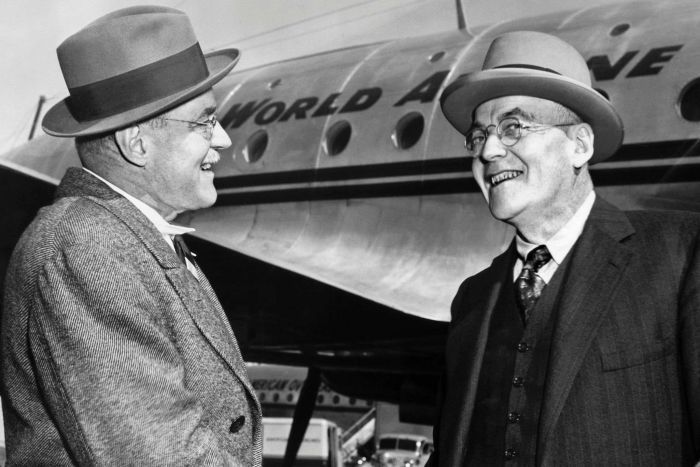
John Foster
Dulles and Allen Dulles "designed" the CIA. Both were active in intelligence
operations during WW II. Allen Dulles was the U.S. Ambassador to Switzerland
where he met frequently with Nazi leaders and looked after U.S. investments in
Germany. John Foster Dulles went on to become Secretary of State under Dwight
Eisenhower. Allen Dulles went on to serve as CIA Director under Eisenhower and
was later fired by John Kennedy. Allen Dulles covered up the Kennedy hit from
his Warren Commission perch.
John Foster Dulles presided over the phony
Goldman Sachs trusts before the 1929 stock market crash.
Allen Dulles
served on the board of the J. Henry Schroder Banking Corporation while John
Foster Dulles served as the legal counsel. John Foster Dulles lawfirm of
Sullivan and Cromwell handled the legal end of Schroder loans. In 1936 the
underwriting and general securities business handled by the J. Henry Schroder
Banking Corporation was merged into a new investment banking firm - Schroder,
Rockefeller & Company.
The Dulles and Rockefeller families are
cousins.
John Foster Dulles and Hjalmar Schacht - Nazi's economic
minister, Reichsbank director and member of the Bank for International
Settlements - agree to a cartel contract between 150 business' in Germany and
the United States which Oliver Harriman managed. John Foster Dulles publicly
supported the Nazi philosophy writing a long article for the Atlantic Monthly
entitled, The Road to Peace. John Foster Dulles becomes a director of
Consolidated Silesian Steel, whose sole asset was one-third interest in Upper
Silesian Coal and Steel. The remainder of the shares were controlled by
Friedrich Flick and Hjalmar Schacht.
"Hitler's backing in the late 20s
and early 30s came from chemical, steel and electrical industry cartels.
European plants owned by Wall Street interests were not bombed by the US Air
Force in World War II. German industrialists financing Hitler were
predominantly directors of cartels with American associations, ownership,
participation or some form of subsidiary connection. Wall Street claims it was
innocent of wrongdoing in German rearmament - and indeed did not even know of
Hitler's intentions - are fraudulent." - Anthony Sutton
Fritz Thyssen
was a German steel magnate who aligned himself with the Nazis in the early
1920s. Fritz Thyssen controlled through Vereinigte Stahlwerke AG (United
Steelworks - includes Consolidated Silesian Steel and Upper Silesian Coal and
Steel) more than 75 percent of Germany's ore reserves becoming the world's
largest mining and steel manufacturing cartel.Fritz Thyssen also controlled the
Bank voor Handel en Sheepvart NV in Holland which in turn controlled the Union
Banking Corporation of New York City.
Averell Harriman had an interest
in the Union Banking Corporation and his brother E. Roland Harriman was on the
board of directors. Harriman Investment had an ownership interest in
Consolidated Silesian Steel. Prescott Bush became the managing director of
Union Banking Corporation taking over the day-to-day operations of the Young
Plan. Prescott Bush remaind managing partner of Brown Brothers Harriman and CEO
of Union Banking Corporation, where he managerially controled the Consolidated
Silesian Steel ownership interest. Prescott Bush and Averell Harriman mismanage
and the Poles require the owners of the company (which accounted for over 45%
of Poland's steel production) to pay at least their full share of back taxes.
Prescott Bush and Averell Harriman hire attorney John Foster Dulles to cover
up.On October 20, 1942 under the Trading with the Enemy Act, the US
Government's Alien Property Custodian seized the stock shares of the Union
Banking Corporation owned by Prescott S. Bush; E. Roland Harriman; Averell
Harriman; Cornelis Lievense, (Nazi banker); Harold D. Pennington and Ray Morris
of Brown Brothers Harriman; Johann G. Groeninger (Nazi
industrialist).
"The Harrimans were intimately connected with prominent
Nazis Kouwenhoven and Groeninger and a Nazi front bank, the Bank voor Handel en
Scheepvaart. There is every reason to believe that the Harrimans knew of
Thyssen's support for the Nazis. In the case of the Harrimans, it is important
to bear in mind their long-lasting and intimate relationship with the Soviet
Union and the Harriman's position at the center of Roosevelt's New Deal and the
Democratic Party. The evidence suggests that some members of the Wall Street
elite are connected with, and certainly have influence with, all significant
political groupings in the contemporary world socialist spectrum - Soviet
socialism, Hitler's national socialism, and Roosevelt's New Deal socialism." -
Anthony Sutton
The New Deal or the "new economic order" was not a
creature of classical liberalism. It was a creature of corporate socialism. Big
business as reflected in Wall Street strived for a state order in which they
could control industry and eliminate competition, and this was the heart of
FDR's New Deal.
German General Electric (AEG) was a prominent financier
of Hitler and the Nazi Party both directly and indirectly through Osram.
International General Electric in New York was a major participant in the
ownership and direction of both AEG and Osram. Gerard Swope, Owen Young, and A.
Baldwin of General Electric in the United States were directors of AEG. General
Electric also played a role in the Bolshevik Revolution. The executive offices
of General Electric were at 120 Broadway, New York. When Franklin Delano
Roosevelt was working in Wall Street, his address was at 120 Broadway. The
Roosevelt Warm Springs Institute for Rehabilitation and the Franklin D.
Roosevelt Foundation was located at 120 Broadway. The prominent financial
backer of an early Roosevelt Wall Street venture from 120 Broadway was Gerard
Swope of General Electric.
" Swope's Plan" became Roosevelt's New Deal.
In brief, both Hitler's New Order and Roosevelt's New Deal were backed
by the same industrialists and in content were quite similar - they were both
plans for a corporate state.
William McKinley's Spanish-American War expanded Manifest
Destiny deep into the Pacific annexing the colonial empire of Spain: Cuba,
Puerto Rico, Guam, and the Philippines. A genocidal war was waged against the
Filipino people. The Kingdom of Hawaii was conquered and the Native Hawaiian
people (the Kanaka Maoli) were subjected to near genocidal conditions.
"McKinley's military and colonial expansion into the Pacific was
designed to secure America's economic exploitation of China pursuant to the
euphemistic rubric of the "open door" policy. Over the next four decades
America's aggressive presence, policies, and practices in the Pacific paved the
way for Japan's attack at Pearl Harbor on Dec. 7, 194l, and thus America's
precipitation into the ongoing WWII." - Francis Boyle
"In 1940,
Franklin D. Roosevelt (although eager to get the United States into the Second
World War and already making preparations for that tragedy) had to campaign for
re-election with the same promise
that Wilson had made in 1916 to keep us out of the European war.
Even as late as the day before the Japanese
attack on Pearl Harbor in December,
1941, the American people were still overwhelmingly "isolationist" a
word which internationalists use as a term of contempt but which means merely
that the American people were still devoted to their nation's traditional
foreign policy.
It was necessary for Roosevelt to take steps which the
public would not notice or understand but which would inescapably involve the
nation in the foreign war. When enough such sly involvement had been
manipulated, there would come, eventually, some incident to push us over the
brink into open participation. Then, any American who continued to advocate our
traditional foreign policy of benign neutrality would be an object of public
hatred, would be investigated and condemned by officialdom as a "pro-nazi," and
possibly prosecuted for sedition.
The Council on Foreign Relations has
heavy responsibility for the maneuvering which thus dragged America into World
War II.
One major step which Roosevelt took toward war (at precisely the
time when he was campaigning for his third-term re-election on a platform of
peace and neutrality to keep America out of war) was his radical alteration of
traditional concepts of United States policy in order to declare Greenland
under the protection of our Monroe Doctrine.
The Council on Foreign
Relations officially boasts full responsibility for this fateful step toward
war. On pages 13 and 14 of a book entitled The Council on Foreign Relations: A
Record of Twenty-Five Years, 1921-1946 (written by officials of the Council and
published by the Council on January 1, 1947) are these passages:
"On
March 17, 1940, a Council group completed a confidential report which pointed
out the strategic importance of Greenland for transatlantic aviation and for
meteorological observations. The report stated:
"'The possibility must
be considered that Denmark might be overrun by Germany. In such case, Greenland
might be transferred by treaty to German sovereignty.'
"The report
pointed out the possible danger to the United States in such an eventuality,
and mentioned that Greenland lies within the geographical sphere 'within which
the Monroe Doctrine is presumed to apply.'
"Shortly after this, one of
the members of the group which had prepared the report was summoned to the
White House. President Roosevelt had a copy of the memorandum in his hand and
said that he had turned to his visitor for advice because of his part in
raising the question of Greenland's strategic importance.
"Germany
invaded Denmark on April 9, 1940. At his press conference three days later, the
President stated that he was satisfied that Greenland was a part of the
American continent. After a visit to the White House on the same day, the
Danish Minister said that he agreed with the President.
"On April 9,
1941, an agreement was signed between the United States and Denmark which
provided for assistance by the United States to Greenland in the maintenance of
its status, and granted to the United States the right to locate and construct
such airplane landing-fields, seaplane facilities, and radio and meteorological
installations as might be necessary for the defense of Greenland, and for the
defense of the American continent. This was eight months before Germany
declared war on the United States.
"The Council's report on Greenland
was only one item in an extensive research project which offered an unusual
instance of wartime collaboration between Government agencies and a private
institution...."
The Monroe Doctrine, closing the Western Hemisphere to
further European colonization, was proclaimed in 1823.
Denmark, a
European nation, colonized Greenland, proclaiming sole sovereignty in 1921,
without any hint of protest from the United States that this European
colonization infringed upon the Monroe Doctrine." - Dan Smoot
"Regardless of his oft-repeated statement, I hate war,' he (Franklin
Delano Roosevelt) was eager to get into the fighting since that would ensure a
third term." - Jesse H. Jones, a member of Roosevelt's cabinet for five years
and author of Fifty Billion Dollars: My Thirteen Years with the
RFC
"President Roosevelt found it necessary to get the country into
World War II to save his social policies." - Dr. Milton Eisenhower, Dwight D.
Eisenhower's brother
Clare Booth-Luce shocked many people by saying at
the Republican Party Convention in 1944 that Franklin D. Roosevelt "has lied us
[the U.S.A.] into the war."
"America was never truly neutral. There is
no doubt where her sympathies were, and it is a travesty on history ever to say
that the United States was forced into the war. America provoked the Japanese
to such an extent that they were forced to attack." - Oliver Lyttelton

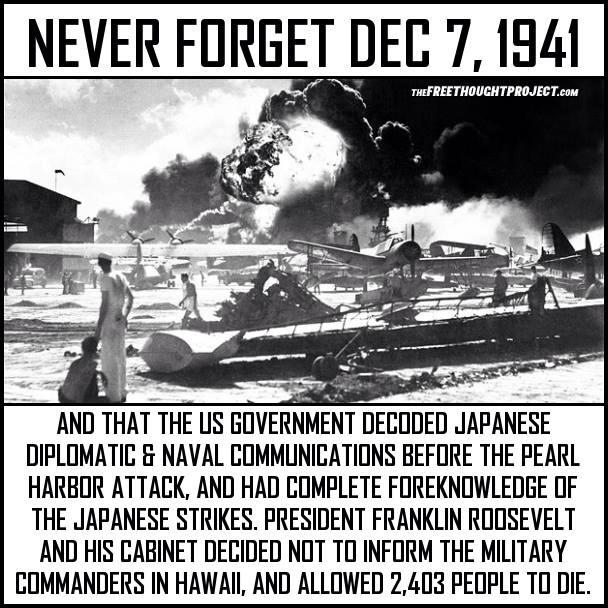
According to A Brief
History of Communications Intelleigence in the United States by Laurence F.
Safford Captain, USN (stamped top secret and only fully released in 2009):
"Installations were made at selected coastal D/F stations in the continental
US, and overseas "strategic" D/F stations were established at Manila, Guam,
Midway, Oahu, Dutch Harbor, Samoa, Canal Zone, San Juan and Greenland. By 1939,
the "strategic" D/F organization was successfully tracking Japanese warships
and merchant vessels in the Western Pacific."
"I
had no knowledge of the delivery of the ultimatum to Japan on 26 November,
1941. I am further certain that several days prior to 7 December, 1941 there
was information in the War Department and the Navy Department that Japan would
attack the United States ... that there was information in the War and Navy
Departments on 6 December, 1941, that the hour of attack was momentarily
imminent, and early on 7 December, 1941, the precise time of the attack was
known. It was known at least three or probably four hours before the attack.
All this information was denied to General Short and to me." - Admiral Husband
Edward Kimmel, commander of the Pacific Fleet at the time of the Japanese
attack on Pearl Harbor
Captain
LF Safford was in charge of the Communications Security Section of Naval
Communications in 1941. Captain LF Safford discovered, after the Japanese
attack on Pearl Harbor, that his
superiors had not provided Admiral Kimmel with the information that his Section
had decoded in the months before the attack. The MAGIC intercepts were never
made available to the Roberts Commission which found the commanders of
Pearl Harbor, Admiral Husband Kimmel
and General Walter Short, guilty of 'dereliction of duty'.
Colonel
Rufus S. Bratton was the Army officer charged with the distribution of the
Japanese intercepts to the Secretary of State, the Secretary of War, and Chief
of Staff, the Chief of War Plans Division and the Chief of Army Intelligence
(G-2), his chief assistant was Colonel Carlisle C. Dusenbury. General Miles,
Chief of Army Intelligence, claimed the intercepts were delivered to General
Marshall, the Chief of Staff.
General Marshall claimed he had never
seen them.
James Vincent Forrestal, the first United States Secretary
of Defense, attempted to have the TOP SECRET intercepts withheld from the
Congressional investigation but later relented.
Using the claim that
revealing the intercepts would harm the interest of national security and the
successful prosecution of the war the evidence in the intercepts was extracted
from the Congressional investigation records.
On May 25, 1999, the
United States Senate passed a resolution exonerating Kimmel and Short from the
condemnations of the commission.
"They were denied vital intelligence
that was available in Washington," said Senator William V. Roth Jr. (R-DE),
noting that they had been made scapegoats by the
Pentagon.
Senator Strom Thurmond (R-SC) called Kimmel and Short "the two final
victims of
Pearl Harbor."
Winston
Churchill celebrated when Pearl Harbor was hit.
"Roosevelt sought
war with Japan in order to be able to fight Germany, and he provoked Japan into
attacking United States colonial possessions in the Far East. Once the United
States got into war through the back door, Roosevelt focused the American
military effort on Germany." - Stephen J. Sniegoski
"President Roosevelt had 72 advisors. 52 were Ashkenazi,
most foreign born." - William Dudley Pelley
"If the experiment for
which Roosevelt is responsible should in any serious degree break down, as a
result of the association with it of a number of eminent Ashkenazi there would
be an outbreak of anti-Semitism in the United States more profound than
anything Anglo-Saxon Civilization has so far known." - Professor Harold J.
Laski
"In the closing days of World War II, the American Ninth Army was
rolling toward Berlin, meeting little resistance, slowed down only by German
civilians clogging the highways, fleeing from the Russians. German soundtrucks
were circulating in the Berlin area, counseling stray troops to stop resistance
and surrender to the Americans. Some twenty or thirty miles east of Berlin, the
German nation had concentrated its dying strength and was fighting savagely
against the Russians.
Our Ninth Army could have been in Berlin within a
few hours, probably without shedding another drop of blood; but General
Eisenhower suddenly halted our Army. He kept it sitting idly outside Berlin for
days, while the Russians slugged their way in, killing, raping, ravaging. We
gave the Russians control of the eastern portion of Berlin and of all
the territory surrounding the city. To the south, General Patton's forces were
plowing into Czechoslovakia. When Patton was thirty miles from Prague, the
capital, General Eisenhower ordered him to stop ordered him not to
accept surrender of German soldiers, but to hold them at bay until the Russians
could move up and accept surrender. As soon as the Russians were thus
established as the conquerors of Czechoslovakia, Eisenhower ordered Patton to
evacuate.
Units of Czechoslovakian patriots had been fighting with
Western armies since 1943. We had promised them that they could
participate in the liberation of their own homeland; but we did not let them
move into Czechoslovakia until after the Russians had taken over.
Czechoslovakian and American troops had to ask the Soviets for permission to
come into Prague for a victory celebration after the Russians had been
permitted to conquer the country.
Western Armies, under Eisenhower's
command, rounded up an estimated five million anti-communist refugees and
delivered them to the Soviets who tortured them, sent them to slave camps, or
murdered them.
Triumph in the West, by Arthur Bryant, published
in 1959 by Doubleday & Company, as a "History of the War Years Based on the
Diaries of Field-Marshal Lord Alanbrooke, Chief of the Imperial General Staff,"
reveals that, in the closing days of the war, General Eisenhower was often in
direct communication with Stalin, reporting his decisions and actions to the
Soviet dictator before Eisenhower's own military superiors knew what was going
on.
According to Arthur Krock, of the New York Times, George F.
Kennan, (a member of the Council on Foreign Relations) persuaded Roosevelt to
accept the Berlin zoning arrangement.
Why would any American want (or,
under any conditions, agree to) the crazy Berlin agreement?
There are
only three possible answers:
(1) the Americans who set up the Berlin
arrangement which means, specifically, George F. Kennan and Philip E.
Mosely, representing the Council on Foreign Relations were ignorant
fools; or
(2) they wanted to make Berlin a powder keg which the Soviets
could use, at will, to intimidate the West; or
(3) they wanted a
permanent, ready source of war which the United States government could use, at
any time, to salvage its own internationalist policies from criticism at home,
by scaring the American people into "buckling down" and "tightening up" for
"unity" behind our "courageous President" who is "calling the Kremlin bluff" by
spending to prepare this nation for all-out war, if necessary, to "defend the
interests of the free-world" in Berlin.
George F. Kennan and Philip E.
Mosely and the other men associated with them in the Council on Foreign
Relations are not ignorant fools. I do not believe they are traitors who wanted
to serve the interests of the Kremlin. So, in trying to assess their motives, I
am left with one choice: they wanted to set Berlin up as a perpetual excuse for
any kind of program which the Council on Foreign Relations might want the
American government to adopt." - Dan Smoot, The Invisible Government
"Fifty years ago, Harry Truman replaced the old republic with a
national-security state whose sole purpose is to wage perpetual wars, hot,
cold, and tepid. Exact date of replacement? February 27. 1947. Place: White
House Cabinet Room. Cast: Truman, Undersecretary of State Dean Acheson, a
handful of congressional leaders. Republican senator Arthur Vandenberg told
Truman that he could have his militarized economy only if he first "scared the
hell out of the American people" that the Russians were coming. Truman obliged.
The perpetual war began. Representative government of, by, and for the people
is now a faded memory. Only corporate America enjoys representation by the
Congresses and presidents that it pays for in an arrangement where no one is
entirely accountable because those who have bought the government also own the
media." - Gore Vidal
World War II was very profitable for Onassis,
Rockefellers, Kennedys, Roosevelts, I.G. Farben, etc. Onassis ran his shipping
firm without losing a single ship or man.
identified communist spies that
had FDR's ear* Harry Dexter White, Office of
Monetary Research, Assistant Secretary of the Treasury; Head of the
International Monetary Fund, primary participant in the Bretton Woods
conference and the formation of the International Monetary Fund and the World
Bank, * Alger Hiss, protégé of Felix
Frankfurter, Agricultural Adjustment Administration (AAA), special assistant to
the Director of the Office of Far Eastern Affairs, Director of the Office of
Special Political Affairs United States Department of State, executive
secretary at the Dumbarton Oaks Conference, secretary-general of the United
Nations Conference on International Organization, president of the Carnegie
Endowment for International Peace *Donald Hiss,
United States Department of State; United States Department of Labor; United
States Department of the Interior * Allen Rosenberg*, Board of Economic Warfare;
Chief of the Economic Institution Staff, Foreign Economic Administration;
Senate Subcommittee on Civil Liberties; Senate Committee on Education and
Labor; Railroad Retirement Board; Counsel to the Secretary of the National
Labor Relations Board Schlomer (Solomon) Adler*, New Deal Works Progress
Administration's National Research Project, United States Department of the
Treasury *Virginius Frank Coe, Assistant Director,
Division of Monetary Research, Treasury Department; Special Assistant to the
United States Ambassador in London; Assistant to the Executive Director, Board
of Economic Warfare; Assistant Administrator, Foreign Economic Administration
* Irving Goldman*, Office of the Coordinator of
Inter-American Affairs * Victor Perlo*, was the Chief of the Aviation
Section of the War Production Board during World War II; head of branch in
Research Section, Office of Price Administration Department of Commerce;
Division of Monetary Research Department of the Treasury; and later the
Brookings Institution * Harold Glasser*, Director, Division of Monetary
Research, United States Department of the Treasury; United Nations Relief and
Rehabilitation Administration; War Production Board; Advisor on North African
Affairs Committee; United States Treasury Representative to the Allied High
Commission in Italy * Charles Kramer (Krevisky)*, Senate Subcommittee on War
Mobilization; Office of Price Administration; National Labor Relations Board;
Senate Subcommittee on Wartime Health and Education; Agricultural Adjustment
Administration; Senate Subcommittee on Civil Liberties; Senate Labor and Public
Welfare Committee; Democratic National Committee * George
Perazich*, Foreign
Economic Administration; United Nations Relief and Rehabilitation
Administration * Donald Niven Wheeler, United States
Department of Agriculture, Department of Treasury, Office of Strategic Services
(OSS) Research and Analysis division *Nathan Gregory
Silvermaster*, Chief
Planning Technician, Procurement Division, United States Department of the
Treasury; Chief Economist, War Assets Administration; Director of the Labor
Division, Farm Security Administration; Board of Economic Warfare;
Reconstruction Finance Corporation Department of Commerce *Norman Chandler Bursler, United States Department of Justice
Anti-Trust Division *Lauchlin Currie, Administrative
Assistant to President Roosevelt; Deputy Administrator of Foreign Economic
Administration; Special Representative to China *Bela
Gold*, Assistant Head
of Program Surveys, Bureau of Agricultural Economics, Agriculture Department;
Senate Subcommittee on War Mobilization; Office of Economic Programs in Foreign
Economic Administration *Sonia Steinman Gold*, Division of Monetary Research
U.S. Treasury Department; U.S. House of Representatives Select Committee on
Interstate Migration; U.S. Bureau of Employment Security *Irving Kaplan*, Foreign Funds Control and
Division of Monetary Research, United States Department of the Treasury Foreign
Economic Administration; chief advisor to the Military Government of Germany
*George Silverman*, civilian Chief Production
Specialist, Material Division, United States Army Air Forces Air Staff, War
Department, Pentagon * William Henry Taylor,
Assistant Director of the Middle East Division of Monetary Research, United
States Department of Treasury * William Ullman*, delegate to United Nations
Charter meeting and Bretton Woods conference; Division of Monetary Research,
Department of Treasury; Material and Services Division, Air Corps Headquarters,
Pentagon * Edward Fitzgerald, War Production Board
* Charles S. Flato, Board of Economic Warfare; Civil
Liberties Subcommittee, Senate Committee on Education and Labor *Michael Greenberg*, Board of Economic Warfare;
Administrative Division, Enemy Branch, Foreign Economic Administration; United
States Department of State *Henry Samuel Magdoff*, Chief of the Control Records
Section of War Production Board and Office of Emergency Management; Bureau of
Research and Statistics, WTB; Tools Division, War Production Board; Bureau of
Foreign and Domestic Commerce, United States Department of Commerce; Statistics
Division Works Progress Administration *Jenny Levy
Miller*, Chinese
Government Purchasing Commission *Robert Miller,
Office of the Coordinator of Inter-American Affairs; Near Eastern Division
United States Department of State * Ezra Moscrip*, Nuclear Physicist who worked
on the Manhattan Project. *Willard Park, Assistant
Chief of the Economic Analysis Section, Office of the Coordinator of
Inter-American Affairs; United Nations Relief and Rehabilitation
Administration * Gerald Graze, United States Civil
Service Commission; Department of Defense, U.S. Navy official *
Stanley Graze, United States Department of State
intelligence
*Julius Joseph*, Far Eastern section (Japanese
Intelligence) Office of Strategic Services * Duncan
Lee, counsel to General William Donovan, head of Office of Strategic
Services * Bernice Levin*, Office of Emergency
Management; Office of Production Management * Bernard
Redmont, head of the Foreign News Bureau Office of the Coordinator of
Inter-American Affairs * William Remington, War
Production Board; Office of Emergency Management * Emanuel
Larsen, State Department *Andrew Roth*, Office of Naval
Intelligence *John Stewart Service, Foreign Service
(China) * Maurice Halperin, Chief of Latin American
Division, Research and Analysis section, Office of Strategic Services; United
States Department of State *William Taylor, Assistant
Director of Monetary Research, United States Department of Treasury *Helen Tenney, Office of Strategic Services *
Lee Tenney, Balkan Division Office of Strategic
Services * Arthur Gerald Steinberg*, United States Office of
Scientific Research and Development *Michael Whitney
Straight, speechwriter for President Franklin Roosevelt *John Abt, Agricultural Adjustment Administration (AAA) and
other New Deal programs *Whittaker Chambers,
Department of State, testified against Alger Hiss *Henry
Collins, National Recovery Administration; Department of
Agriculture *Nathaniel Weyl*, Agricultural Adjustment
Administration (AAA) *William Ward Pigman*, National Bureau of
Standards; Labor and Public Welfare Committee# *Lee
Pressman, Department of Agriculture; Works Progress Administration;
General Counsel Congress of Industrial Organizations (CIO) *Vincent Reno, mathematician at United States Army Aberdeen
Proving Ground *Julian Wadleigh, United States
Department of State *Flora Wovschin, Office of War
Information, United States Department of State *Julia
Older, Office of Strategic Services; Office of War Information *Jack Fahy, Office of the Coordinator of Inter-American
Affairs; Board of Economic Warfare; United States Department of the
Interior *Bill Weisband*, United States Army Signals
Security Agency *Viktor Vasilevish Sveshchnikov,
United States War Department *Thomas Arthur Bisson,
World War II Board of Economic Warfare (BEW), Institute of Pacific Relations
(IPR), founding editorial board member of Amerasia. *Owen
Lattimore, director of Pacific Operations for the United States Office
of War Information, U.S. political advisor to Chiang Kai-shek
*Frederick Vanderbilt Field, Institute of Pacific Relations,
American Peace Mobilization (APM) (Communist front group) *Mary Price, stenographer for Walter Lippmann* of the New York
Herald *Paul Massing, scientist at Columbia
Universitys Institute of Social Research. * Samuel
Dickstein*, Congressman
from New York, Vice Chairman of HUAC during hearings into the Business Plot
against President Franklin D. Roosevelt *Bernard
Redmont, head of the Foreign News Bureau Office of the Coordinator of
Inter-American Affairs Many of the Soviet spies arrested by
the American government during the Cold War were Askenazi. None were more
damaging than the group of spies who passed the secret of the Atom Bomb to the
Soviet Union. This group of Communist spies was all Jewish, from the
ringleaders, Julius and Ethel Rosenberg, to the actual scientists working at
the top secret Los Alamos laboratory, namely David Greenglass and Theodore
Hallsberg. The latter actually passed the atomic secrets to the Rosenbergs, who
then passed it onto their Soviet handlers, via their Jewish courier, Harry
Gold.
Solomon (Schlomer) Adler and John Stewart Service sent
back reports opposing Franklin D. Roosevelt's gold loan program of $200 million
to help the Nationalist Chinese Government finance its defense against the
Japanese invasion in 1943.
Assistant Secretary of the Treasury
Harry Dexter White and Director of the Treasury's Division of Monetary
Research Virginius Frank Coe supported Solomon Adler's and John Stewart
Service's opinions. Hyperinflation in China amounted to more than 1,000% per
year between 1943 and 1945, weakening the standing of the Nationalist
government and helping the Communists eventually to come to power in China.
Solomon Adler worked for twenty years for the Chinese Communist
Party's Central External Liaison Department, an agency involved in foreign
espionage. A photograph shows him with Henshen Chen, a senior government
official who had been an intelligence operative in the United States from the
late 1930s until 1949. Chen wrote in his memoirs that he used the cover as an
editor for the journal Pacific Affairs and worked as a researcher at the
Institute of Pacific Relations, and had covert liaisons with the
Communist Party of the United States.
The
Institute of Pacific Relations (IPR) was an international organization
established in 1925 by grants from John D. Rockefeller, Jr. and the Rockefeller
Foundation, the Carnegie Corporation, and other major corporations according to
self-proclaimed Communist Party member Frederick Vanderbilt Field. Other IPR
staffers identified later as Communists or collaborators with Soviet
intelligence agents were Kathleen Barnes, Hilda Austern, Elsie
Fairfax-Cholmely, Chi Chao-ting, Guenter Stein, Harriet Levine, Talitha
Gerlach, Chen Han-seng, Michael Greenberg, and T.A. Bisson, as well as Kate
Mitchell and Andrew Roth, both of whom were arrested in the 1945
Amerasia scandal.
The Institute of Pacific Relation was closely
allied with Amerasia. The two organizations shared the same building,
and many members of the Editorial Board of Amerasia were officers or
employees of IPR. An FBI review of Amerasia and The Institute of Pacific
Relation publications found that approximately 115 people contributed
articles to both.
" The IPR was like a specialized political flypaper
in its attractive power for Communists ... British Communists like Michael
Greenberg, Elsie Fairfax-Cholmeley, and Anthony Jenkinson; Chinese Communists
like Chi Chao-ting, Chen Han-Seng, Chu Tong, or Y.Y. Hsu; German Communists
like Hans Moeller (Asiaticus) or Guenter Stein; Japanese Communists (and
espionage agents) like Saionji and Ozaki; United States Communists like James
S. Allen, Frederick Field, William Mandel, Lawrence Rosinger, and Alger Hiss.
The IPR has been considered by the American Communist Party and by Soviet
officials as an instrument of Communist policy, propaganda and military
intelligence. The IPR disseminated and sought to popularize false information
including information originating from Soviet and Communist sources.The IPR was
a vehicle used by the Communists to orient American far eastern policies toward
Communist objectives. "- Senate Internal Security Subcommittee (SISS), chairman
Senator Pat McCarran 1952
On October 1st, 1949 Mao Zedong
declared the founding of the People's Republic of China in Tiananmen Square,
Beijing. Mao Zedong was funded by connections with the syndicate of the
soulless through Solomon Adler, a former United States Treasury official;
Israel Epstein, the son of a Jewish Bolshevik; and Virginius Frank Coe.
After World War II, Virginius Frank Coe was a leading official of the
International Monetary Fund (IMF) from 1946 to 1952, when he resigned after
public calls were made by Congress for his ouster. In 1958, Virginius Frank Coe
moved to the Communist People's Republic of China to work for the Chinese
Communist government of Mao Zedong.
Coe participated in Mao's Great
Leap Forward, a plan for the rapid industrialization and modernization of
China. The plan is generally agreed to have failed in its intentions, leading
to millions of Chinese deaths in addition to widespread economic dislocation,
and is widely regarded both inside and outside the People's Republic of China
as a policy and human rights catastrophe.
In the autumn of 1938, Israel
Epstein joined the China Defense League, which had been established by Soong
Ching-ling, Sun Yat-sen's widow, for the purpose of publicizing and enlisting
international support for the Chinese cause. In 1951, Soong Ching-ling invited
him to return to China to edit the magazine China Reconstructs, which was later
renamed China Today. In 1955, 1965 and 1976 Israel Epstein visited Tibet, and
based on these 3 visits, he published in 1983 the book "Tibet Transformed".
Israel Epstein was elected as a member of the Standing Committee of the
National Committee of the Chinese People 's Political Consultative
Conference, an advisory body, in
1983.
Patriots -- George Washington, Thomas
Jefferson,James Madison, James Monroe, Abraham
Lincoln, Theodore Roosevelt,
Woodrow Wilson, Calvin
Coolidge, Harry S. Truman,
Dwight D. Eisenhower, John
F. Kennedy, Ronald Reagan --
Presidents
See
Social Control
See
American aristocracy
See
The Corruption of the American Dream
See
The Subversion of American
Democracy
|
|
back to stacks
contents
 |
This web site is not a commercial web site and
is presented for educational purposes only.

This website defines a new religious
ideology to which its author adheres. The author feels that the falsification
of reality outside personal experience has created a populace unable to discern
propaganda from reality and that this has been done purposefully by an
international corporate cartel through their agents who wish to foist a corrupt
version of reality on the human race. Religious intolerance occurs when any
group refuses to tolerate religious practices, religious beliefs or persons due
to their religious ideology. This web site marks the founding of the religion
aptly named The Truth of the Way of Life - a rational religion based on reason
which requires no leap of faith, accepts no tithes, has no supreme leader, no
church buildings and in which each and every individual is encouraged to
develop a personal relation with God through the pursuit of the knowledge of
reality in the hope of curing the spiritual corruption that has enveloped the
human spirit. The tenets of The Truth of the Way of Life are spelled out in
detail on this web site by the author. Violent acts against individuals due to
their religious beliefs in America is considered a hate
crime.
This web site in no way condones violence. To the contrary
the intent here is to reduce the violence that is already occurring due to the
international corporate cartels desire to control the human race. The
international corporate cartel already controls the world central banking
system, mass media worldwide, the industrial military entertainment complex of
America and is responsible for the collapse of morals, the elevation of
self-centered behavior and the destruction of global ecosystems. Civilization
is based on cooperation. Cooperation does not occur at the point of a
gun.
American social mores and values have declined precipitously over
the last century as the corrupt international cartel has garnered more and more
power. This power rests in the ability to deceive the populace in general
through mass media by pressing emotional buttons which have been preprogrammed
into the population through prior mass media psychological operations. The
results have been the destruction of the family and the destruction of social
structures that do not adhere to the corrupt international elites vision of a
perfect world. Through distraction and coercion the direction of thought of the
bulk of the population has been directed toward solutions proposed by the
corrupt international elite that further consolidates their power and which
further their purposes.
All views and opinions presented on this web
site are the views and opinions of individual human men and women that, through
their writings, showed the capacity for intelligent, reasonable, rational,
insightful and unpopular thought. All factual information presented on this web
site is believed to be true and accurate and is presented as originally
presented in print media which may or may not have originally presented the
facts truthfully. Opinion and thoughts have been adapted, edited, corrected,
redacted, combined, added to, re-edited and re-corrected as nearly all opinion
and thought has been throughout time but has been done so in the spirit of the
original writer with the intent of making his or her thoughts and opinions
clearer and relevant to the reader in the present time.
Fair Use Notice
This site may contain copyrighted material the use of which has
not always been specifically authorized by the copyright owner. We are making
such material available in our efforts to advance understanding of criminal
justice, human rights, political, economic, democratic, scientific, and social
justice issues, etc. We believe this constitutes a 'fair use' of any such
copyrighted material as provided for in section 107 of the United States
Copyright Law. In accordance with Title 17 U.S.C. Section 107, the material on
this site is distributed without profit to those who have expressed a prior
interest in receiving the included information for research and educational
purposes. For more information see: www.law.cornell.edu/uscode/17/107.shtml. If
you wish to use copyrighted material from this site for purposes of your own
that go beyond 'fair use', you must obtain permission from the copyright owner.
|
Copyright
© Lawrence Turner All Rights Reserved |